









Tully Potter reviews the autobiography of Julian Lloyd Webber, from the British cellist’s early years growing up in South Kensington to his time as principal of the Royal Birmingham Conservatoire – and beyond
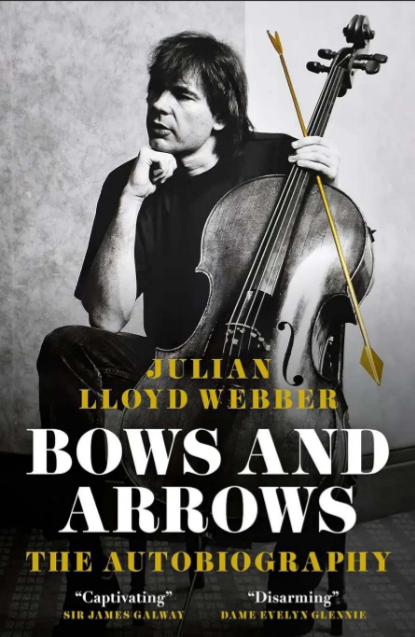
Bows and Arrows: The Autobiography
Julian Lloyd Webber
352PP ISBN 9781837360581
Biteback Publishing £22
At 75 Julian Lloyd Webber can look back on a life that has brought many successes as well as a few catastrophes – the most obvious being the twelve-year interruption of his career as a cellist, for physical reasons. Since this book was finished, he has had to cope with a diagnosis of prostate cancer.
He has good tales to tell. Many people will have heard of the slightly chaotic menage in which he grew up, including father William, a musician, teacher and composer; mother Jean, a violinist and pianist; elder brother Andrew, an up-and-coming composer; and grandmother Molly, whose life had not been easy.
The family’s South Kensington flat was home at various times to an assortment of animals and humans, the latter species including pianist John Lill and lyricist Tim Rice. A measure of sibling resentment emerges: Julian clearly felt that Gran, who bore the burden of their upbringing, let Andrew have his own way too much.
It is good to be reminded that, far from trading on Andrew’s success as a composer, Julian was well on his way to being a significant cellist before Andrew had his first triumphs. This fact did not prevent a great deal of backbiting – a review in Tatler, quoted in the book, was so bitchy that it made me pop my monocle.
From the beginning JLW sought out new or neglected repertoire for his concerts or recordings. He started his career by premiering Arthur Bliss’s Concerto, unearthed Holst’s magnificent Invocation and Sullivan’s enjoyable Concerto, commissioned Rodrigo’s Concierto como un Divertimento, Gavin Bryars’s Farewell to Philosophy, Philip Glass’s Concerto and sundry shorter pieces, and made the first recordings of such pieces as Britten’s Third Suite and Prokofiev’s Ballade. He had a hit with Andrew’s semi-pop Variations (on Paganini’s Caprice no.24); and the only real stinker I can recall was a dreadful concerto by Michael Nyman.
Concert review: Julian Lloyd Webber 75th Birthday Gala
Read: ‘I felt the power suddenly go from my bowing arm’ – Julian Lloyd Webber on facing the unthinkable
His Elgar Concerto recording with Menuhin – one of the best, I think – led to more performances and tours with the great man. He was a successful president of the Elgar Society (2009–18); and he did a lot of good as principal of the Royal Birmingham Conservatoire, until he felt he had to resign over budget cuts.
His proudest achievement came as one of the chief movers of the Music Education Consortium and the In Harmony programme, which is still going strong. JLW is one of those who feel, as I do, that we desperately need more music in schools. It has been proved to help children in so many other aspects of their education: JLW names ‘levels of concentration, discipline, motivation and attendance’.
His private life has at times been tumultuous but he seems to be happy with his fourth wife, the Chinese cellist Jiaxin Cheng. They have a daughter, Jasmine Orienta (the latter a pun on his favourite football team and his wife’s origins), and with Jiaxin’s help he has started playing again.
The text has a breezy impetus that carries one along, although one is regularly brought up short by JLW’s habit of starting a sentence with a clause that does not agree with the rest. One of the briefer examples reads: ‘Arriving with my cello at the appointed 6 pm, the receptionist called his room.’ A good editor would have corrected ‘careened’ for careered and such solecisms as ‘a rare bacteria’.
The book is nicely produced and printed in Adobe Caslon Pro, easy to read. Eight pages of photos are reproduced on art paper. A selected discography is included. The index is rather skimpy, making it difficult to find composers’ individual works.
TULLY POTTER







No comments yet