







Philip Brown reads the exhaustive study, published by Jost Thöne Verlag, bringing together the scholarship of violin experts with high-resolution photos, CT scans and analysis under different kinds of light
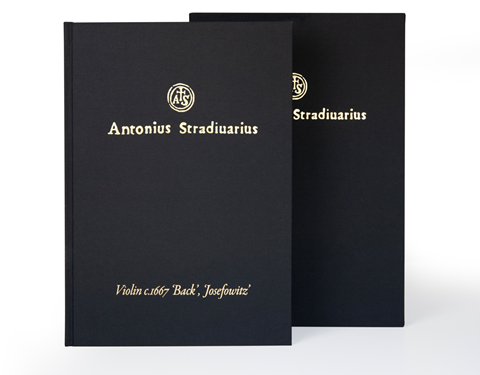
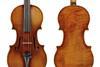
Monograph of the Antonio Stradivari Violin c.1667 ‘Back’, ‘Josefowitz’
Ed. Jonas Thöne
352PP ISBN 9783000787348
Jost Thöne Verlag €800
Jost Thöne’s monograph on Antonio Stradivari’s c.1667 ‘Back’, ‘Josefowitz’ violin is a fabulous addition to any violin enthusiast’s library.
The violin studied is one of the earliest known by Stradivari. It is subjected to a breathtaking level of forensic study, after which the story of reconverting it to a quasi-original state unfolds. The study was an enormously ambitious project, calling on the services of 27 people including many violin experts with highly nuanced specialities. This book is the latest example of a new level of scientific study made possible by the Bambarone Foundation. The result is a fabulous document.
It is a beautiful and large volume. The photographs, mostly taken by Leonhard Rank, are truly exceptional with stunning definition, depth of field and excellent colours, all printed on highest-quality paper. The result is, unsurprisingly, a feast for the eyes.
Carlo Chiesa’s essay gives a fascinating insight into Stradivari’s early life and influences (such that we can know it), exploring his links to wood carving rather than violin making, as well as the violin’s associations with the Amati design concepts, adding to the mystery of Stradivari’s Amati connections.
Chapters on identification and stylistic evolution lead us to a fascinating study by violin maker Philip Ihle, looking for the probable mould used for the ‘Back’, ‘Josefowitz’. Ihle, having previously made a comprehensive study of the moulds, walks us through his painstaking, technically impressive process to line up rib garlands to the moulds in Cremona’s Museo del Violino. His many observations rightly conclude that the violin had been reduced, possibly in a repair, and he is able, after considered adjustment to assign it to Stradivari’s so-called ‘S’ mould.
A comparative study of two other contemporary violins by Stradivari is made by Francesco Toto and Igor Moroder, who analyse archings, varnish, corners and other features. They find subtle experimentation and perhaps the early signs of Stradivari’s ambitious development towards an instrument fit for solo concertos.
Read: Forms follow function: early Stradivari violin patterns
Book review: Monograph of the Antonio Stradivari Cello c.1690 ‘Barjansky’
The Strad Shop: Jost Thöne Verlag
More than 40 pages are reserved for photographic studies of the violin. Leonhard Rank highlights areas of special interest he has observed while studying the violin in standard lights, and then in various ultraviolet wavelengths. This study makes up a more than comprehensive condition report on the violin. Such investigation inevitably raises interesting questions, and Rank takes us on a fascinating journey using some clever tech, exploring work done to the front and back. This chapter includes a lot of fascinating imagery, with the most arresting being the cross-sectional 3D image visualisation using CT scans.
A study by Andreas Jacobi of tension analysis, whereby laser scans show how the whole body distorts under differing states of set-up, is intriguing. The scans were taken before and after the conversion to Baroque set-up. This is a fascinating branch of investigation that will no doubt prove increasingly useful in the future.
The process of making the right strings for the converted Baroque violin is studiously investigated, and brilliantly documented by string maker David Longhi. In a way he had the hardest of all tasks in this project; estimating what would have been an authentic set of violin strings in 1667 is fraught with problems.
Using archival documents and some unavoidable suppositions he explains in illuminating detail the complexity of his subject. This journey is a fascinating one, using actual tantalising remnants of string sets woven into letters – you’d have to read it to believe it. The resulting set of gut strings was happily received by the performers.
This is only a snippet of a tremendous, luscious deep dive, one that the reader can easily get lost in. Surprisingly I did have some unanswered questions – but my reservations are somewhat dwarfed in the face of the sheer mass of expertise that has been brought to bear on the project. One cannot be anything other than filled with awe. Does that passion spill over into overindulgence? Perhaps – but then, who doesn’t like to overindulge at times?
PHILIP BROWN








No comments yet