







Celia Cobb reviews a new series of warm-up patterns designed to help students at intermediate string-orchestra level to prepare themselves for rehearsal
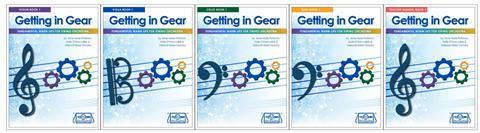
Getting in Gear: Fundamental warm-ups for string orchestra
Anne Marie Patterson, Katie O’Hara LaBrie, Deborah Baker Monday
Violin: 56PP ISBN 9798992393606 $12
Viola: 56PP ISBN 9798992393613 $12
Cello: 56PP ISBN 9798992393620 $12
Bass: 56PP ISBN 9798992393637 $12
Teacher’s manual: 190PP
ISBN 9798992393644 $40
Randall Standridge Music
Getting in Gear is a comprehensive collection of structured warm-ups aimed at intermediate-level school string orchestras. The book is divided into three clear sections – finger patterns, bowing and rhythm – and the authors describe it as a ‘drop-in resource’ for ensemble rehearsals. Play-along tracks are available on the accompanying website, and those who use the music education platform MakeMusic Cloud will also find them there, with all the extra benefits associated with that tool.
The finger patterns in section one of the book are labelled as individual ‘Gears’. Gear 1 is the basic beginner pattern, Gear 2 introduces low 2s/finger 2s, Gear 3 adds high 3s/extensions, and so on. Each new ‘Gear’ is introduced in a simple and easily memorisable five-note exercise before further exercises are added, both to reinforce the new pattern and to combine it with previous ones. This allows students to develop familiarity with each finger pattern and hone their intonation before applying their knowledge to the slightly longer pieces that follow.
Throughout the book, each exercise is labelled with Gear icons indicating the finger pattern(s) used, which is helpful for minimising teacher input and chat. How much quicker and easier it is for a group of students to practise, for example, a short ‘Gear 3’ exercise, then move confidently to the next one bearing the same icon, than for the teacher to give out a long list of instructions about high 3s, forward extensions and shifts for basses! For those familiar with Barbara Barber’s Fingerboard Geography, the ‘Gears’ concept works in a similar way, with an emphasis on finger patterns rather than scales, albeit that the ‘Gears’ don’t correspond exactly to Barber’s first basic patterns group.
The second part of the book focuses on bowing technique. There are Ševčík-style bowing variations for bow distribution and different articulations, and exercises to explore different points of contact, as well as introductions to ‘special effects’ such as sul ponticello, col legno and tremolo. Students who like a good acronym may find the ‘LAWS’ (Lane, Amount, Weight, Speed) section helpful.
Read: Group instrumental lessons can provide opportunities not offered by one-to-one teaching
Read: Analysis January 2024: A case for small-group teaching
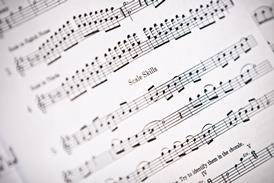
The section on rhythm is the shortest part of the book. It provides a whistle-stop tour of subdivision and rests (my students particularly loved the off-beat exercises and challenges) and also touches on compound time. In addition, the teacher manual contains a selection of photocopiable resources, including some fillable worksheets and fingerboard maps, and a section on scales, which are not specifically covered in the main body of the books.
Overall, the books are very well presented, with the occasional splash of colour to liven things up. The pages of the student books sometimes feel a little busy, but this is perhaps a price worth paying for the inclusion of so many tips and tricks. Throughout the teacher manual there are handy notes giving instrument-specific information, and as an upper strings specialist, I particularly appreciated the advice on extensions for cellists and finger pattern choices for basses.
Many of the longer exercises include a second, often slightly easier part, always in the same ‘Gear’ as the main part, which works well for keeping the more able children fully occupied during rehearsals, as they can switch between the parts to maintain their interest. Although the book is probably aimed at those lucky enough to be working in the system of daily ‘orchestra’ rehearsals, it could easily be adapted by ensemble teachers in the UK and elsewhere, as it offers a technically sound and productive way to start rehearsals. The series is not currently readily available outside the US, but perhaps a digital download will soon be forthcoming.
CELIA COBB












No comments yet