








String players loomed large at this year’s Edinburgh International Festival and Fringe (7–31 August), as David Kettle discovered
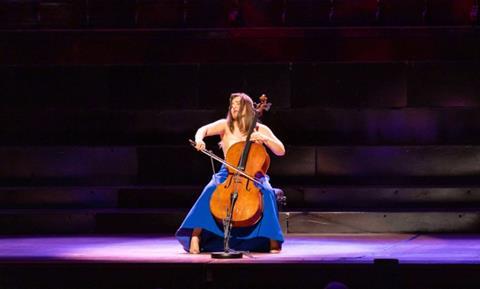
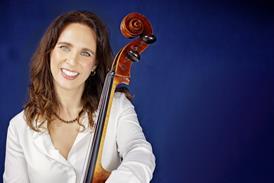
It probably wouldn’t be right to claim that 2026 was an outstanding year for string music at the Edinburgh International Festival – though two unexpectedly excellent string-related shows made quite an impact amid the chaotic rough and tumble of the Fringe (we’ll come to those later). It was, however, an undeniably outstanding year for cellist Alisa Weilerstein at the Edinburgh International Festival, across two very fine and enthusiastically received concerts.
First up, Weilerstein was the passionate, fiercely committed soloist in Mexican composer Gabriela Ortiz’s cello concerto Dzonot with the Montreal Symphony Orchestra and conductor Rafael Payare (who also happens to be Weilerstein’s husband) on 20 August. The piece was inspired by an intricate network of underground rivers and caves in northern Mexico, once thought to be the entrance to the underworld (though the International Festival’s misplaced decision to axe programme notes left audience members none the wiser about that).
There was little dark about Ortiz’s writing, however. Instead, the concerto glittered with strange and fleeting colours across its four movements, with Weilerstein launching into the solo part with real insight and conviction, rising to the composer’s unusual sounds and instrumental combinations with evident enthusiasm. She injected a wonderfully folk-like rawness into some of the slow movement without losing a sense of poise and elegance, and her finale was fiery and muscular, as Weilerstein negotiated Ortiz’s dense, athletic writing with apparently tireless energy. It was a work that would have been familiar to only a few in the audience, but Weilerstein made a compelling and committed case for it.
Just a couple of days later, Weilerstein returned to the Usher Hall, this time to an entirely empty stage save for a single stool. The event was a complete cycle of Bach’s Cello Suites – the afternoon offering in an all-Bach day from the International Festival – and while there may be questions about whether these kind of completist concerts serve anyone well (performers, organisers or listeners), any reservations were silenced by Weilerstein’s own insights, playing and sheer stamina across almost three hours of music, which was quite extraordinary.
Dance movements pranced nimbly, while more thoughtful ones took their time to unfold, and Weilerstein had a firm grasp not only on the flow of movements in each suite, but also the progression and evolution of the six suites as a whole. It felt like a rare moment to commune with a single composer and a single performer – the result bordered on the spiritual.
Read: Switched on: the 2026 Edinburgh International Festival
Read: ‘You want to give your best for every note’: cellist Alisa Weilerstein on Bach and Ortiz
Read: Festival round-up: Edinburgh International Festival 2025
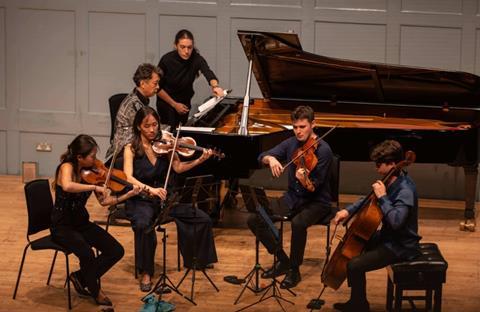
There was less of the spiritual, but more of the energetic in the morning recital given by the young, UK-based Kleio Quartet in the Queen’s Hall, which was joined by cellist Sheku Kanneh-Mason and pianist Makoto Ozone (19 August).
The performers had set themselves two mighty mountains to climb, first in a high-contrast account of Schubert’s String Quintet, which went to sometimes excessive extremes in its collision of vibrato and non-vibrato, serene and stormy, velocity and stillness. While it’s undoubtedly a work that looks towards both joy and despair, the Kleio players and Kanneh-Mason perhaps over-emphasised its contradictions, though there was no shortage of passion on display.
The concert’s real revelation, however, was Bartók’s early Piano Quintet, which beautifully showed off the Kleio’s stylistic adaptability in its wavering between Brahmsian Romanticism and more modernistic harshness. Though Ozone’s sometimes thunderous pianism occasionally threatened to drown them out, the Kleio players delivered a Magyar dance of a finale that surged with joy and abandon that nearly brought the house down.
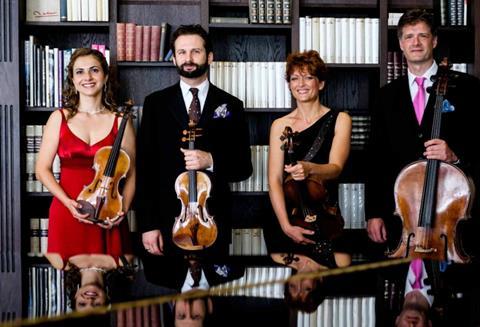
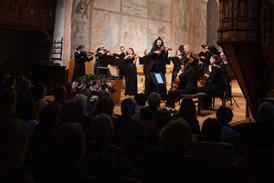
There was, admittedly, less to bring the house down in the high-concept recital from the Gringolts Quartet (24 August), though there was plenty to stimulate the mind and the imagination. On paper it was an old-meets-new collision of Schubert’s monumental G major Quartet D887 with more aphoristic utterances by György Kurtág (who turned 100 this year).
In reality, though, it was a revelation, as the tiny movements of Kurtág’s Officium breve, Hommage à Jacob Obrecht and Microludes seemed to zoom in on microscopic details in the Schubert, dissecting them in extraordinary detail. The Gringolts’ readings bristled with conviction and barely restrained power, though it could be heartbreakingly lyrical, too, in Schubert’s more tender moments. It was a breathtaking performance, one that was as rewarding intellectually as it was involving emotionally.
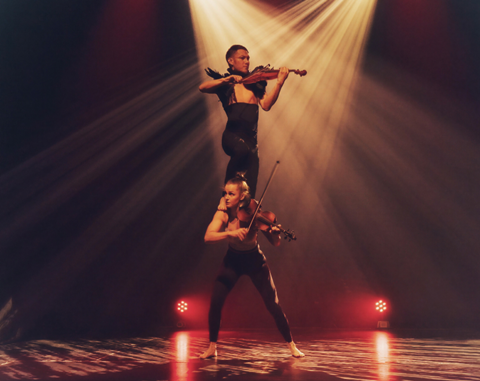
Alongside the calmer artistry on show at the International Festival, however, its more unruly, more unpredictable sibling the Fringe threw up two surprisingly outstanding string-related shows. At that hitherto unexplored intersection between string playing, acrobatics and fire-eating stood Tale of the Firebird at Assembly Roxy from the Vienna-based Freestyle Orchestra, whose twelve players combine some very fine playing across violins, violas, cellos and bass with some equally impressive circus skills of intricate aerial work, acrobalance and fire manipulation.
The fairytale storyline might have been a bit hackneyed and tough to follow, but it was enough to sit back and marvel at the orchestra’s exceptional abilities: lead violinist Sonja Schebeck, in particular, stood out in the title-role, and composer Chloé Charody’s slow-build score was powerful and effective.

If string playing plus acrobatics plus fire didn’t raise an eyebrow, then maybe the equally niche collision of violin and soccer might have done. These were the two elements in the uncategorisable Up: Violin vs Football as part of the French Institute of Scotland’s Fringe programme, which brought together the breathtaking ball skills of freestyle footballer Paul Molina with the equally consummate electric violin playing of Gabriel Majou.
Using just his five-string fiddle and a loop station, Majou conjured endlessly inventive musical tapestries that partnered Molina’s bristling ball virtuosity beautifully. Importantly, however, the two performers told a quietly touching story, albeit an abstract one, of friendship, competition and collaboration. It was testament to Majou and Molina’s skills and insights that such an unlikely combination of tools should, by the end of their 40 minutes of gleeful teamwork, seem entirely natural, even inevitable. Up cast the violin in an entirely new light, and it also seemed to encapsulate everything that’s playful, generous and welcoming about the chaos of the Fringe.









No comments yet