


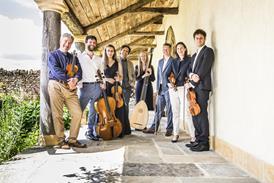
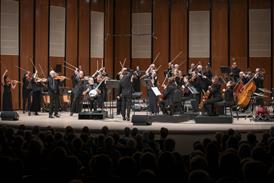
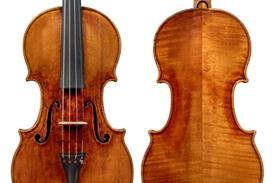



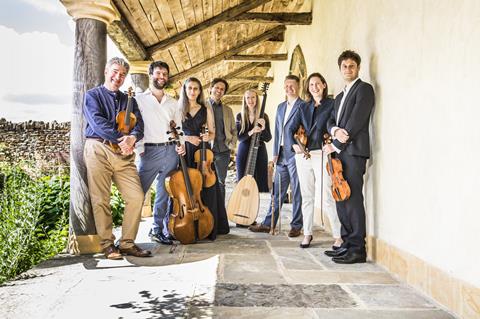
La Serenissima’s violinist and director Adrian Chandler speaks to The Strad about the inspiration behind the ensemble’s new album Hell’s Angels, named after a legendary musical encounter that provided the catalyst for baroque technique development in Europe
Discover more Featured Stories like this in The Strad Playing Hub
On 9 October 2026, La Serenissima releases is latest album, Hell’s Angels. The album takes its title from a legendary 1728 encounter between Jean-Marie Leclair and Pietro Locatelli, whose contrasting styles were described as angelic and diabolical.
The album features works that trace the cross-pollination of French and Italian baroque technique through sonatas by Vivaldi, Leclair, Guillemain, Marcello and Mascitti. At the heart of the programme is Vivaldi’s rarely heard early Sonata RV 820, its final movement completed by La Serenissima’s violinist and director Adrian Chandler, following the loss of the original manuscript.
The Strad spoke with Chandler about the historic encounter that provided inspiration for the album, the diversity of baroque techniques showcased in the programme, as well as how he approached reconstructing the incomplete Vivaldi sonata.
The title of the album ‘Hell’s Angels’ takes its name from ‘a legendary encounter’ between two violinists of contrasting styles. Could you tell us more about what happened?
The title Hell’s Angels takes its inspiration from the legendary meeting between the virtuoso violinists Pietro Locatelli and Jean-Marie Leclair on 22 December 1728 at the court of Kassel, Germany. The meeting was witnessed by Jakob Wilhelm Lustig, who afterwards wrote that Leclair played like an angel on account of his beautiful tone and extreme rhythmic freedom, while Locatelli played like a devil, with a deliberately scratchy tone and left-hand pyrotechnics.
This description has often since been used to illustrate the key differences in the national playing styles of France and Italy. Far from introducing a feeling of rivalry between the two men, if history is to be believed, the two violinists developed a deep respect for each other’s playing and went on to engage in a mutual exchange of ideas.
It is thought that Leclair then returned with Locatelli to Amsterdam. The technical demands of Leclair’s Opus 5 violin sonatas are surely as the result of his time spent with Locatelli.
How would you describe the outcomes of ‘cross-pollination’ of French and Italian baroque technique? How did this inform your repertoire choices for the album?
In Vivaldi’s day, the French style seldom crossed into Italy. Pockets of influence certainly existed: the French oboist Alexis Saint-Martin (father of the Sammartini brothers) found work in Milan, while Italian masters north of the Alps, such as Giuseppe Antonio Brescianello and Pietro Torri, freely absorbed French sensibilities.
Even within Italy, composers such as Francesco Gasparini and Nicola Porpora experimented with French overtures and Vivaldi himself occasionally flirted with French airs. Yet these instances were exceptions to the rule; by and large, the music retained its deeply rooted Italian character.
The music found on Hell’s Angels is intended, instead, to explore the dissemination of the Italian style in France, primarily through the works of Jean-Marie Leclair and Louis-Gabriel Guillemain, both pupils of Giovanni Battista Somis.
Hailing from Turin, Somis was born into a musical family; he studied the violin with Arcangelo Corelli and – possibly alongside Antonio Vivaldi between the years 1701 and 1703 – with his father Lorenzo Francesco Somis; he may also have studied with Vivaldi’s father, Giovanni Battista Vivaldi.
This close connection with the Vivaldi family may explain why Somis’ music contains many Vivaldian traits, particularly in his treatment of sequences, a feature that is also common in the music of Leclair and Guillemain.
This album was made around the time when the restrictions brought about by the pandemic were finally being relaxed. As concerts were still few and far between (in reality, things have never returned to their pre-pandemic state), we decided to meet on the run up to Christmas and record an album of chamber music.
Originally, we had intended for there to be a sonata for violin and another for two cellos by Somis himself, but owing to the impossibly long repertoire list – mea culpa – the works by Somis were reluctantly shelved (and the disc is still over 80 minutes long); the sonata for two cellos by Marcello, however, did make the cut!
I have wanted to explore the influence of Vivaldi on the likes of Leclair and Guillemain for many years now, and so selected two sonatas for two unaccompanied violins by Vivaldi (originally written for himself and his father) and by Leclair, as well as a sonata for harpsichord and violin by Guillemain – a real walk on the wild side for La Serenissima.
The album is bookended by two sonatas for violin and cello by Vivaldi and the Paris-based Neapolitan composer, Michele Mascitti.
Tell us about the rarely heard RV 820 Sonata, how you came across it and went about learning and recording it. How did you complete the final movement with no original manuscript?
Vivaldi enthusiasts are always attuned to the possibility of a new discovery. When the manuscript of RV 820 was officially attributed to him in 2014, it brought to light a deeply intriguing backstory.
Beyond his father’s tutelage, it is thought that Vivaldi also studied under the Bolognese master Giuseppe Torelli. This hypothesis is strongly supported by a manuscript trail: while teaching the young Saxon Johann Georg Pisendel in Ansbach (1698–99), Torelli gifted his student a remarkably early Vivaldi sonata for violin and cello (RV 820).
Given the nascent stage of Vivaldi’s career, it is highly improbable that Torelli could have acquired such a piece through any means other than direct personal contact. Decades later, in 1716–17, Pisendel would complete the artistic circle by becoming a pupil of Vivaldi himself.
However, the final page of the manuscript is missing, so it was therefore necessary for me to ‘reconstruct’ the last 20 or so bars of the sonata. In some respects, this wasn’t too difficult as most of the ideas had already by committed to paper by Vivaldi earlier in the movement, but the difficult challenge, I was soon to discover, was to make the new music flow in the same manner as Vivaldi; in many respects it was like trying to finish a conversation that had been started over three hundred years ago. My decision to include an extra simple cadence at the very end was influenced by the 1708 sonata for violin, oboe, organ and chalumeau, RV 779.
Hell’s Angels is released on Signum Classics on 9 October 2026.
Read: Sentimental Work: Adrian Chandler on Vivaldi’s Four Seasons
Read: Soojin Han: finding something new in Vivaldi’s ever-renewing Seasons
Discover more Featured Stories like this in The Strad Playing Hub











No comments yet