
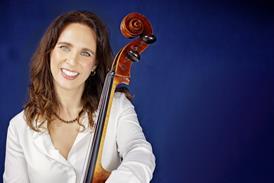







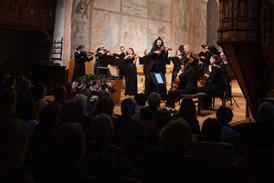






Davina Shum spoke with Alisa Weilerstein about her two contrasting performances at the 2026 Edinburgh International Festival: Ortiz’s concerto Dzonot and a marathon performance of the Bach Cello Suites
Discover more Featured Stories like this in The Strad Playing Hub
When a cellist is preparing to perform the complete Bach Cello Suites, quite possibly the last thing that cellist wants to do an hour before the performance is speak to a journalist.
So it’s no surprise that when I attended the Edinburgh International Festival (EIF) this month to see Alisa Weilerstein perform the suites, that she rejected an interview time just before her performance on Saturday 22 August, and instead opted for a time two days prior.
‘I mean, I’m free, but I am not free. I will not be free at that point,’ she tells me, laughing.
It is with the Bach Suites that we begin our chat about Weilerstein’s two projects that featured at this year’s EIF – that and a performance of Gabriela Ortiz’s Grammy Award-winning concerto Dzonot, which she performed on Thursday 20 August with the Orchestra Symphonique de Montréal (OSM) and Rafael Payare. By clearing her schedule, what is Weilerstein’s process before taking to the stage for a near three-hour Bach marathon?
‘I like to be at the hall an hour and a half before, just to know everything is in place and there’s no logistical stress or anything like that.
‘I like to start each movement by going backwards. So I would start with the Gigue of the sixth suite and then work backwards until I get to the Prelude of the first suite, so that the last thing I play in practice will be the first thing I play on stage.
‘The whole day, I’d just be running through the suites in my head.’ She tells me that the Bach Suites are always in her subconscious, having performed them since she was a child, and that they’re very much at the forefront of her brain.
‘They require a certain kind of marathon concentration, which is different from anything else that I do. There’s so much expressed in the music, which is impossible to express all at once. You want to give your best for every note, so the preparation requires stillness.’
Weilerstein recorded the suites in the summer of 2019, with release early in 2020. But a recorded rendition, representing a snapshot in time, is going to differ hugely from a live interpretation, especially given world events that have occurred since 2020. How does live performance of the suites affect her interpretation differently? Besides acknowledging that she can’t just do another take, she speaks about knowing that the moment on stage is ephemeral, and to accept spontaneous things that may take her playing in a different direction.
‘I think we make the mistake of putting the Suites on this sort of divine, ivory tower pedestal, which puts an enormous amount of pressure, not only on the performance, but also the audience. The Suites are divine, and yet completely human.
‘Knowing that the Suites are expressing human thoughts and emotions so profoundly makes it more of a pleasure to play and a deeper journey to take.’
The Bach Suites require a certain kind of marathon concentration. There’s so much expressed in the music, which is impossible to express all at once
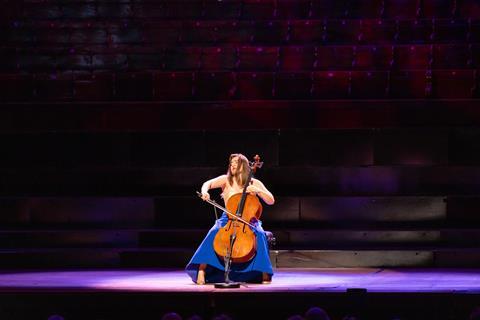
From a practical point of view during the marathon, Weilerstein performs the first three suites, with a 20-minute intermission, followed by the fourth, and then a short break before the fifth suite to administer the scordatura, with the A string tuned down to G. Luckily, she says, her 1723 Montagnana is stable enough to withstand the tuning change. Finally, she takes about a three-minute break before the sixth suite to retune the cello, as well as give a bit of respite for the audience: ‘It’s a long time to sit… everyone has to acclimatise, like they’re the instrument. You have to get into a different mindset.’
A stark contrast from the solo Bach Suites written 300 years ago, Ortiz’s Dzonot was written for Weilerstein in 2024. Since then, she has played the piece ten times across four different projects, and the work earned a Grammy Award for Best Contemporary Classical Composition in February 2026. It premiered with Gustavo Dudamel and the LA Phil, though for EIF she’s performing with the OSM and Payare – her husband. What’s the dynamic like, working with Payare?
‘It’s fabulous,’ she says. ‘Not just this piece, but all repertoire. We have very similar musical values. It’s not just because we’re married that we like playing together – we would anyway. He’s an incredible conductor and musician so it’s very easy.’
She relates a line that Payare always says to orchestras in rehearsals: ‘”I know her a little bit, and it’s going to be different in the concert. So just watch me.” It’s sort of become a running joke because he knows I’m spontaneous in performances.’
The theme of the work covers existential environmental threats to nature, ecosystems and life in Mexico, where Ortiz is from. Each of the four movements has a title and is a testament to Ortiz’s skill as ‘an incredible sound painter’, according to Weilerstein. They are ‘Vertical Light’ – showcased by harmonic effects that illustrate water glistening in brilliant light; ‘The eye of the jaguar’ – comprising a wild Colombian dance; ‘Jade’ – a rhapsodic solo movement representing a delicate ecosystem overrun by industry; finally culminating in ‘Flight of Toh’ – representing Mayan folklore of a ‘very vain bird’ that likes to show off his feathers, only to have his tail cut off by a storm.
‘It’s a wonderful piece,’ she says. ‘Very, very colourful, very brilliant and with pointed colours.’
Pointed colours – how does she mean? Weilerstein urges me to listen to the piece. ‘You’ll know what I mean when you hear it.’
Which I did on the evening of 20 August. The work was certainly colourful, with Ortiz orchestrating imaginative colours and a huge range of versatility in the solo cello part that is rarely heard in a single piece of repertoire. Weilerstein demonstrated highly virtuosic passages, as well as microtonal glissandos and plaintive melodies, supported by the OSM, as well as being engulfed by the orchestral forces when required, representative of those under threat by industry.
Colour was explored in a different way two evenings later, when Weilerstein took to the stage for her marathon Bach performance. The lighting changed with each suite – reminiscent of our conversation we had about how the keys of each suite represents a different timbre, mood and scene, such as imagining a bleak, seaside cliff for the fifth suite, making way for a post-storm lushness of nature and sunshine for the sixth. It was an intense yet enjoyable journey through the Bach Suites which left me exhausted, so I could only imagine how she felt, having had to play them all.
It was probably a good idea that she decided not to speak to any journalists that day.
Read: Switched on: the 2026 Edinburgh International Festival
Read: Alisa Weilerstein: fragments of the future
Discover more Featured Stories like this in The Strad Playing Hub















No comments yet