






Charlotte Gardner reports on two days (1–2 July) of string-related highlights at the festival, which took place at Évian-les-Bains, France, from 24 June to 5 July
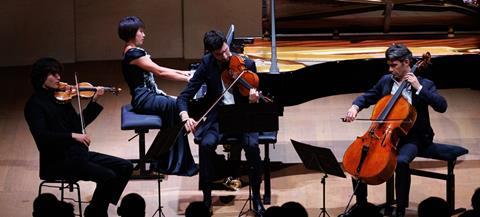
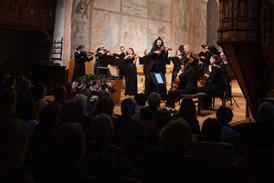
To describe 2026 as a major year for France’s two-week Rencontres Musicales d’Évian Festival is something of an understatement. Not only was it marking its 50th anniversary, but it was also inaugurating La Source Vive, a new 500-capacity chamber music hall built to complement La Grange au Lac, the 1,000-capacity wooden hall built in 1993 for former artistic director Mstislav Rostropovich. To celebrate, current festival director Renaud Capuçon presented a star-studded Brahms chamber cycle, split between the two halls, and to arrive for this cycle’s seventh and eighth instalments allowed for an illuminating side-by-side comparion.
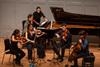
First, in La Grange au Lac, there was Brahms’s Piano Trio no.2 from Capuçon himself with his cellist brother Gautier and pianist Yuja Wang, plus the Piano Quartet no.2 from Wang and Gautier, with violinist Daniel Lozakovich and violist Paul Zientara. The Trio was superb: tonally warm, emotionally nimble, with a Classical clarity and poise which sat beautifully within the hall’s quite analytical, semi-dry acoustic. From the strings there was abundant graceful interlocking of tone and phrasing, while Wang drew deep on her gifts for poetic delicacy. The A minor Andante con moto’s cello-driven fifth variation was another highlight, Gautier Capuçon drawing a doleful line that was very touching.
Read: The musical pride of France: The Capuçon brothers’ Olympic journey (so far!)
Read: String stars perform at reopening of Notre Dame cathedral
Concert review: Gautier Capuçon (cello) Yuja Wang (piano)
In the Quartet Lozakovich’s lighter-weighted elegance brought a subtly contrasting sound world: sweetly golden-toned, with slightly more air between phrases. It was perhaps a touch careful at points, but nonetheless classy.
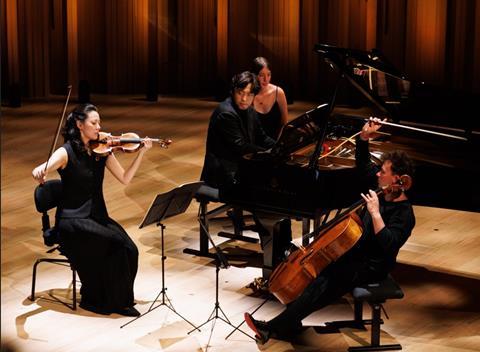
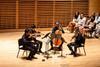
The following afternoon, La Source Vive – also wooden, with a white domed ceiling – hosted three works underpinned by pianist Sunwook Kim. A dynamically partnered Cello Sonata no.2 with Edgar Moreau revealed an intimate, high-definition acoustic of a dry-tinged warmth with subtle bloom. Here, Moreau enjoyed showcasing his instrument’s meaty resonance combined with an easy virtuosity, with his high-register lines glowing dazzingly in the space. Lozakovich’s slenderer sound often seemed more lost in the acoustic in Brahms’s Second Violin Sonata – perhaps down to some acoustical skittishness shortly to be fine-tuned out? Still, thoughts on acoustics went out of the window over the Third Piano Trio from Kim, Moreau and Clara-Jumi Kang. In every regard, this was the performance of the concert, and the audience knew it. Through Kang’s palpably deep communion with the music, here we could sense the composer’s passion and complexity over a reading by turns generous, grounded and dramatic. It was no surprise that there were four curtain calls.
La Source Vive doesn’t exactly sound better for chamber music than La Grange du Lac, but it brings something different, and goodness can it pack a glorious punch – as witnessed here. Note, too, that from now on the halls, known together as Les Mélèzes, offer year-round programming.
Read: Beautiful and noble: Edgar Moreau on Haydn Cello Concerto in C
Watch: Clara-Jumi Kang plays Paganini, Caprice no.11
Read: Violinist Daniel Lozakovich: lost to the world, led by the heart







No comments yet