









Davina Shum reports from four concerts at the 2026 Edinburgh International Festival, where a diverse range of repertoire from Bach to Ortiz satiated the musical appetites of the ever-hungry festival attendees
Discover more Featured Stories like this in The Strad Playing Hub
It’s no surprise that Edinburgh feels like the centre of the world in August, with several festivals occurring simultaneously, bringing crowds of arts lovers to the Scottish capital every summer. Amid the chaotic plethora of performers playing at the Fringe and busloads of tourists attending the Military Tattoo, you’ll find the original Edinburgh International Festival (EIF), with events covering music, theatre and opera, this year held from 7 to 30 August.
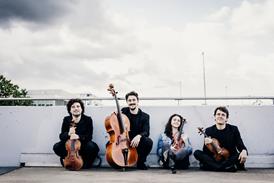
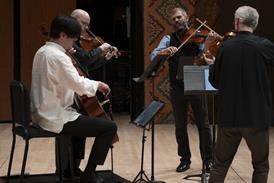
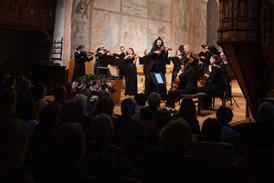
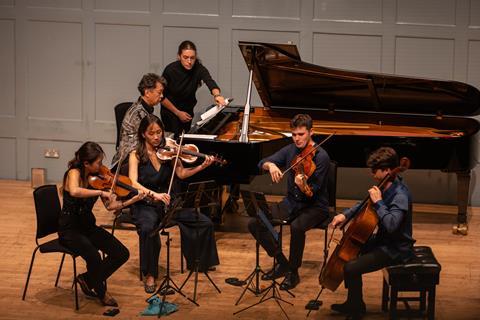
The first concert I attended was an 11am performance at The Queen’s Hall on Wednesday 19 August. On the menu was a C-major themed chamber programme of works by Schubert and Bartók, presented by the Kleio Quartet, joined by guest artists Sheku Kanneh-Mason and pianist Makoto Ozone.
The last time I attended a concert at The Queen’s Hall was two years ago at EIF, where Kanneh-Mason was centre stage with collaborative partner Harry Baker in a wide-ranging recital of arrangements. So it seemed fitting for me to see him take to the stage again, albeit this time as second cellist for Schubert’s mighty 53-minute-long string quintet.
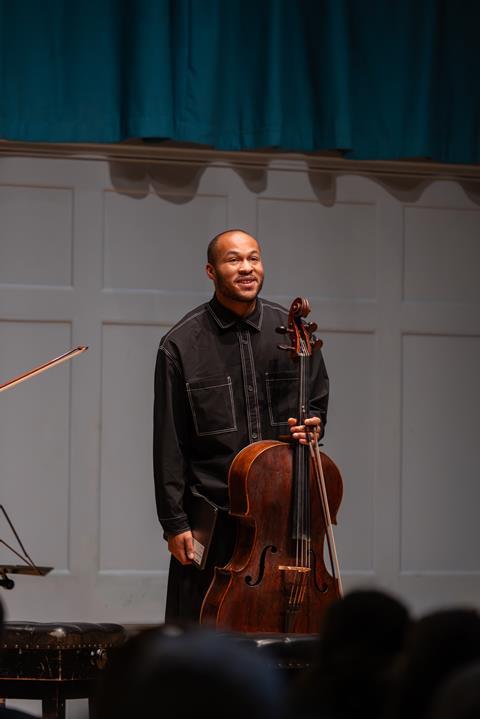
Kanneh-Mason provided a sturdy foundation for the Kleio Quartet, comprising violinists Yume Fujise and Katherine Yoon, plus newest recruits Jaren Ziegler and Gerard Flotats on viola and cello respectively. The quintet’s ethereal emergence from silence had a nebulous sense of spaciousness, juxtaposed with driven injections of pace as the first movement progressed.
The lower-string team of Kanneh-Mason and Flotats worked well together, exchanging grins during the many unison passages, while Flotats floated in dialogue with Fujise on first violin. Schubert’s first violin part is no easy task, but Fujise played with lyrical ease, soaring above the textures of the inner voices, attentively provided by Yoon and Ziegler.
The packed Queen’s Hall benefited from its intimate atmosphere. However, it was a shame that someone’s phone rang during the quietest moment in the second movement of the Schubert, despite the festival’s widely publicised ‘Switch off to switch on’ campaign, which urges audience members to turn off their devices and fully immerse themselves in the performance. Clearly, the message has yet to reach some concert-goers. And while organisers can tell people not to use their phones, they cannot stop people from dropping their phones during a performance.
The second half was prefaced by a short speech from Fujise, who shared when she had the ‘crazy idea’ to programme Schubert and Bartók Piano Quintet with festival director Nicola Benedetti, the response was simply to ‘go for it!’ The Kleio Quartet was joined by jazz pianist and composer Makoto Ozone, who was on this occasion delving into more classical repertoire, for the Bartók.
It was a piece that I was hearing for the first time, and Bartók’s use of folksong and Hungarian rhetoric was evident in the work. The Queen’s Hall audience loved it – thankfully this work was uninterrupted by cellular devices – and the ensemble received a huge ovation at the end.
On Thursday 20 August, I attended the ‘Voices of Canada’ symphonic concert at Usher Hall, where the concerto on offer was Gabriela Ortiz’s Grammy Award-winning 2024 work, Dzonot. It was performed by Alisa Weilerstein, for whom it was written, with conductor (and her husband) Rafael Payare at the helm of the Orchestra Symphonique de Montréal (OSM). I spoke with Weilerstein the previous day, when she described Ortiz as ‘an incredible sound painter’ – a quality vividly reflected throughout the concerto.
From the shimmering string accompaniment in the opening movement ‘Vertical light’, to percussive col legno battuto passages in the concerto’s second movement, ‘The eye of the jaguar’, Ortiz’s orchestration was rich in colour and imagination and showcased the full versatility of the solo cello. In the latter, orchestra violinists held and strummed their instruments like guitars, while Weilerstein navigated the fiery passagework with ease, and tresillo rhythms lent the music an unmistakable Latin American pulse. In ‘Jade’, Ortiz juxtaposed plaintive, mourning melodies with an introspective cadenza, before ‘Flight of Toh’ erupted in a whirlwind of heavy metal-esque passagework, punctuated by flashes of birdsong from the woodwinds.
Saturday 22 August presented two string-focused programmes, the first of which brought me back to The Queen’s Hall for yet more Bartók in ‘Vilde Frang and Friends’ at 11am. The Norwegian violinist headlined a programme of music primarily by Bartók and of the Balkans, and she was joined by Finnish pianist Olli Mustonen and Hungarian multi-instrumentalists and brothers, Benjamin and Salamon Eredics. Frang’s main offering was Bartók’s Violin Sonata No. 1 with Mustonen, a performance that encompassed everything from delicate, ethereal streams of consciousness to dramatic, almost violent outbursts, while fully embracing the composer’s trademark folk-song and dance influences.
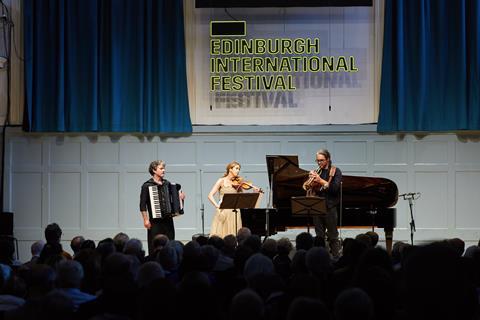
The rest of the programme featured a variety of shorter works by Bartók alongside traditional melodies. The Eredics brothers were particularly impressive in their multi-instrumental versatility: Benjamin alternated between trumpet and guitar, while Salamon moved between piano, accordion and an assortment of recorders, at one point even playing recorder and accordion simultaneously.
With so much folk song and dance on offer, I would have liked to have seen the social aspect and intention of this music evident in the hall. This music was written to be shared in social settings, yet it felt as though The Queen’s Hall audience was looking at it from a distance from behind glass. Some degree of audience engagement, or a brief spoken introduction to the works, might have helped bridge that gap. In the works where Frang wasn’t performing, she would sit quietly on the side of the stage and watch the Eredics brothers; conversely, when Mustonen wasn’t playing, he’d leave the stage altogether (after playing in the third-to-last item of the programme, Bartók’s Romanian Dances, he left, not to be seen again until the bows).
Additionally, there was no indication of how any of the musicians were connected (brothers aside), for a programme entitled ‘Vilde Frang and Friends’. I wanted to know how the collective came about, their shared history (if there even was one) and why they had curated this programme. The fragmented entrances and exits somewhat undermined any sense of a collective artistic venture, so that it may as well have been called ‘Music from Hungary and the Balkans’. In fact, there wasn’t a single piece where all four performers played together.
The second concert for me on Saturday afternoon saw Weilerstein take to the Usher Hall stage once again, for a marathon performance of Bach’s Cello Suites. It was rather striking watching her all alone on stage, having seen her two nights previously backed by a full symphony orchestra.
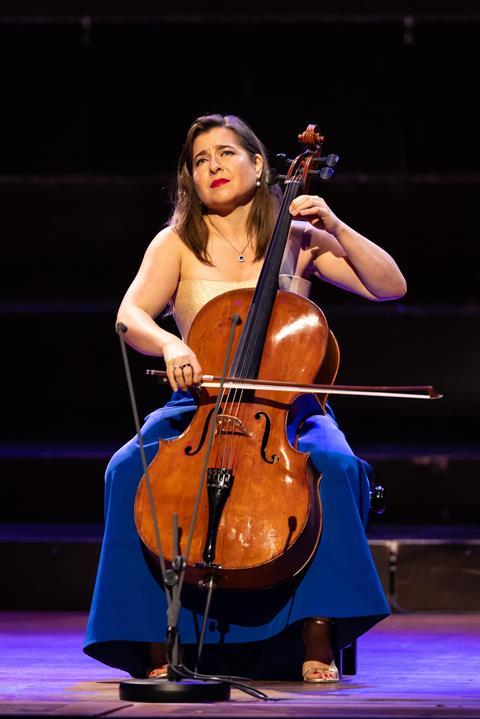
I loved the pace at which Weilerstein took many of the movements; she gave an improvisatory and contemplative character to many of the Preludes and Allemandes, but without losing momentum. A few of the Courantes went by at a lick, perhaps with some of the detail lost from where I was sitting. Weilerstein brought to life Bach’s organ-like writing beautifully, from the resonance and care given to pedal notes, to the filigree cadenza passages. She did an incredible job of drawing listeners in at the most intimate moments of the suites – particularly in the Sarabande of the fifth suite, which had me on the edge of my seat. It was therefore unfortunate that at this point in the performance, there was a man a few rows behind me, pint in hand, fast asleep and offering his own unsolicited bass line in the form of loud snoring.
A nice touch was added by the venue by changing the lighting colour with each suite, adding to the dramatic juxtaposition of characters portrayed throughout each one.
As a cellist myself, I am in awe of anyone willing to take on such a monumental challenge, fully aware of the strength, stamina and technical command required to sustain it. By the time Weilerstein reached the jubilant Gigue of the sixth suite, it felt as though she had carried the audience with her on an extraordinary journey. After nearly three hours of uninterrupted playing, she was rewarded with a deserved standing ovation.
While Edinburgh in August can feel overwhelming and overstimulating, it’s a testament to the breadth of events on offer, as well as the demand for artistic nourishment during challenging times. There is truly nowhere else in the world where you can see the diversity of the performing arts converge onto one single city to such a degree, and it is so heartening to see a huge population of arts lovers in one place.












No comments yet