





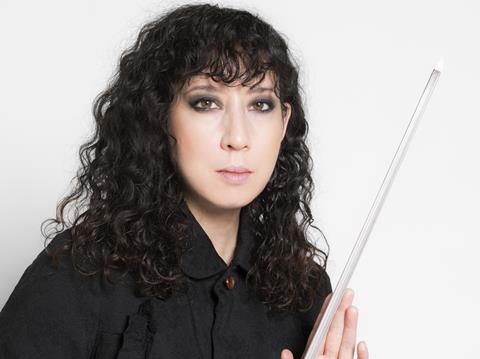
The New York-based cellist and composer chats with Lauren Wesley-Smith about her album In holiday clothing, out of the great darkness, and her experience of stadium shows with the American rock band
Discover more Featured Stories like this in The Strad Playing Hub
Cellist and composer Clarice Jensen seems to be living the New York artist’s dream. A graduate from the Juilliard School, she’s performed and recorded with artists including Max Richter, Taylor Swift, Björk and, most recently, American rock band My Chemical Romance (MCR). She’s scored for television and film, including No Man of God starring actor Elijah Wood, Caught in the Web: The Murders Behind Zona Divas for Netflix, and Sin Señas Particulares (Identifying Features) for which she received an Ariel Award nomination for Best Original Music. Plus, she’s the artistic director of the American Contemporary Music Ensemble.
Amid all of this, Jensen has already released three studio albums, with the fourth due to release at the end of the week. The Strad received an advance release of In holiday clothing, out of the great darkness and, as a cellist whose all-time favourite band happens to be My Chemical Romance, I was eager to give it a listen, and subsequently all the more excited to chat to Jensen.
In holiday clothing, out of the great darkness is the fourth album you’ve released. What was the recording process like this time?
My recording process is always a little different. I play cello through chain of effects pedals, so the writing process often involves sort of just playing around and finding new techniques for using the technology. I let that inform the composition, then go back and look at things on paper, back and forth until it turns into a piece. In this case, I wrote a lot more music acoustically and then brought in the pedals later.
Generally, I like for the entire album to make sense from start to end, so I have individual pieces going, then I look at the whole and edit to make the entire listening experience make sense as well. This time I really tried to be organised – usually it’s a lot more messy and chaotic!
I wrote everything here in New York during most of July and August last year, as I had a solo tour in September to Europe and the UK and was trying to get everything written before then. Afterwards I got in touch with Max Richter, who very generously offered his studio in Oxford for me to record in, and in talking to his team I matched with Rupert Coulson to do the engineering. It was such a dream come true! It’s a gorgeous studio, and I’ve been playing music with Max for over ten years, so it was a nice progression in our relationship as colleagues.
You’ve mentioned using Bach as a departure point – tell me about the inspiration there?
I was inspired by Bach because, at least for the solo pieces, I’ve always been amazed by them: it’s one instrument, but there are so many voices that are interacting with each other. The implication of one cello playing by itself and suggesting multiple voices was just like magic to me! I tried to imagine music that’s contrapuntal in the same way: a solo instrument, but as many voices.
That kind of embodied the whole concept of being and working alone. I’ve been living on the outside of New York City for some years now and really focused on working alone, so both from a compositional standpoint and emotionally, that was really resonating with me.
In the more literal sense, the very first work on the album sounds a lot like the first gesture of the first cello suite prelude. It’s a bit on the nose, I realised, but I’ve looped it and layered it so it’s a kind of a meditation on that one gesture that everyone so famously knows.
The movement ‘2, 1’ is to me like a very slow sarabande, as I conceived of it in three with an emphasis on the second beat.
The album has quite an improvisational feel, yet you describe quite a detailed compositional process. How much freedom was there in that?
It’s sort of a spectrum between what I call like controlled improvisation and music that’s written from the beginning to the end. For example, the movement ‘From A to B’ was through-composed; other movements, like the first, were structured improvisation. The bits that are looped and layered are always the same, but within that, I leave myself room to improvise and to stretch those sections as long as feels right.
I like to create scenarios in which I have freedom to depart from the script. In live performance, depending on how it’s going or how the room feels, sometimes I’ll cut a piece short and transition to something else, or go into an improvisation period and then return to the piece.
I leave myself room to improvise and to stretch those sections as long as feels right
What’s your takeaway from recording this album?
The nicest lesson that I learnt was that it really was helpful to write everything first and then take it on the road. It affords you the opportunity to make edits based on the real-life experience of performing these pieces, feeling out what’s good and what’s not working, that kind of thing.
I had been feeling a bit frustrated with my solo set before, and my first instinct was to turn it against myself and say, ‘Well, this isn’t just a problem with your setup – this is a problem with your concept’. But then I reframed that discomfort by just creating solutions, writing down the things that I felt were missing, and listening to the inner critic in a way that was constructive as opposed to destructive.
It’s something that I think was missing not only from my set, but also just from me as a performer and writer, and it feels like I’ve turned the negative self-talk around with this.
Tell me about playing with My Chemical Romance – how did that come about?
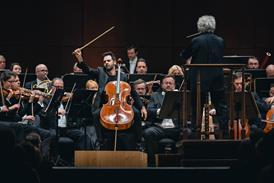
I was performing at the Disney Concert Hall with Max Richter in May, and my friend Jeremy Lambert – who has written some graphic novels with [MCR lead singer] Gerard Way – came to watch, bringing Gerard with him! So that’s when I met him, although I didn’t start touring with them until July. It was really quite unexpected for me to spend my summer doing this, but I was really excited to play!
I play a few songs in the middle of their Black Parade set, alongside violinist Kaylee Goldsworthy. Then, at a certain point, Gerard asked if I could play during the interlude when the band is moving from the A stage to the B stage. So, during that I’m playing ‘From A to B’ from my latest album, and a bit of a piece from my very first album!
MCR has such an amazing fan base – listeners that are incredibly loyal to them, but also very open-minded and curious to listen to new things. It’s been very serendipitous timing for getting involved with their tour and the release of my record, so I’m super lucky!
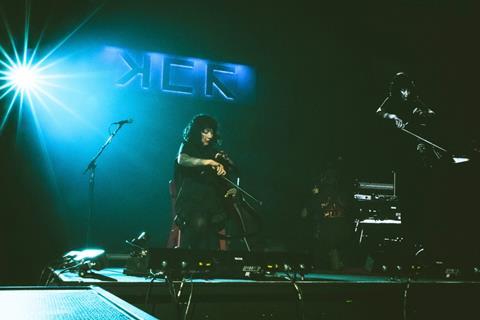
What has the MCR touring experience been like?
Musically it’s intense – and I’m speaking more about when I’m playing by myself in the stadium – because there are tens of thousands of people in the audience! It’s a concert experience and you go into a place of performing, but at the same time there’s part of me that’s sort of disassociating, because it’s such a bizarre experience to be in the middle of a of a stadium in front of that many people and with the Jumbotron and crazy lighting and all of that! It’s pretty unique, to say the least.
Everybody is so nice and supportive though, and so on that front it’s been a breeze. Sometimes you go out on the road with people that you don’t know, and you don’t know what you’re getting yourself into, but fortunately for this group, they’re all incredible people and super professional.
It’s obviously a very large-scale production – there’s a set that’s constructed in every stadium, pyrotechnics, and actors – and I’m still amazed that this crew set this up every weekend. We played at the Soldier Field stadium in Chicago the night after Oasis, so they essentially cleared everything out and brought in our entire show overnight! The fact that these things can happen is really incredible to me.
I’m looking forward to seeing you at one of MCR’s London shows next year! Are there any other performances you have lined up?
Later this year I’m opening for the wonderful electronic composer Suzanne Ciani here in North America as part of the Reflections Series. They put on concerts in giant churches with incredible visuals and projection mapping schemes, as well as an amazing quadraphonic sound setup. It’s very beautiful, both visually and as a listening experience. I’ve loved Ciani and her music for so long, so I’m really excited to have the opportunity to open for her!
Is there a message or a feeling you hope to convey to your listeners?
My music is all pretty meditative in nature: it’s repetitive, and meant to be enjoyed in a variety of contexts. For this album, I would hope that people could spend some time with it, sit down, and listen to it from beginning to end.
My second album came out in April of 2020, just as everybody was getting stuck at home and not running around living super busy lives. A lot of people, friends and strangers, were telling me that they were listening to my album, and I felt very honoured I could provide a listening experience in that scenario.
The world is different now: it’s a lot more chaotic, and there’s a lot of unrest. I’m just hoping that this can be a bit of an antidote to that, a reminder of the times when we’re able to just sit at home, put our feet up, and listen to music.
Clarice Jensen’s album In holiday clothing, out of the great darkness releases on 17 October via FatCat Records
INTERVIEW BY LAUREN WESLEY-SMITH
Read: Raphael Weinroth-Browne: a metalhead turned full-time cellist
Watch: A cello distortion rock-up: Zoë Martlew performs ‘G-lude’
Discover more Featured Stories like this in The Strad Playing Hub










No comments yet