



How does the cello become a vehicle for metal and Middle Eastern influences? Raphael Weinroth-Browne speaks to The Strad about his autobiographical album of original works, Lifeblood
Discover more Featured Stories like this in The Strad Playing Hub
’The cello has become not just my instrument but an extension of my compositional identity’.
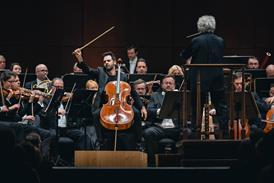
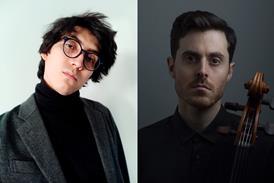
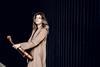
Raphael Weinroth-Browne has been described as a ’modern cello alchemist’, ’genre wrecker’ and a ’progressive metal soul trapped in a classical body.’
Perhaps this is evident in the Canadian cellist and composer’s new album Lifeblood, which counts Arabic maqams, modern classical architecture and progressive metal’s pulse among its myriad influences.
’This album is my most autobiographical work to date,’ he says. ’As a metalhead turned full-time cellist making original music outside the classical realm, I’ve taken the road less travelled.’
Weinroth-Browne has been a member of the Norwegian progressive metal band Leprous since 2016 and has performed worldwide with artists such as Apocalyptica, Hania Rani, Evanescence and Devin Townsend. He composed the full-length score for James Wilton Dance’s BACH Reimagined, which toured major theatres across the UK and Germany in 2025.
Weinroth-Browne spoke to The Strad about his initial musical journey and his approach to his creative processes, ahead of the release of Lifeblood on 3 October.
Most cellists come from a classical background and training - as you mention you did - when did you start to explore other genres such as Middle Eastern music and metal and take influence from this?
I discovered metal and Middle Eastern music at a very young age from listening to my parents’ wide-ranging and eclectic record collection, as well as university radio stations in my hometown of Ottawa, Canada. In addition, I attended many concerts as a teenager, notably the Palestinian group Le Trio Joubran and the Iranian Dastan Ensemble, both of which had a profound effect on me.
I have composed and improvised for as long as I can remember. The angular riffs and crushing rhythms of metal and the modality of Middle Eastern music made their way naturally into my creative process on cello, as well as other instruments, such as piano and electric guitar, the latter of which I played in metal bands in high school.
As a result, my compositional preferences were already very developed by my teenage years; as my cello technique improved I found ways of articulating my creative ideas more clearly and effectively.
In my early twenties I wrote virtuosic pieces that emulated my influences in metal and Middle Eastern music while still drawing heavily on the classical cello vocabulary that I had amassed at the University of Ottawa for my Bachelor of Music degree and Toronto’s Glenn Gould School during my graduate studies.
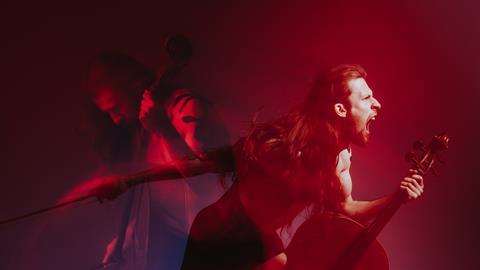
Can you describe your compositional process? Your works comprise many layers - how does it all come about? Is it notated or largely improvised?
My solo cello pieces on my albums Lifeblood and Worlds Within were born from improvisation and exploration and gradually solidified into a very structured and detailed form. The finished pieces are fully composed but not notated. I memorise them as the creative process unfolds.
Most of my solo compositions use alternate tunings (also known as scordatura), which inform much of the writing as they allow for new and interesting intervallic combinations, extended range and increased resonance, and exciting possibilities with natural harmonics. I use the sound world and the idiomatic chord shapes and voicings of open tunings to guide the creative process.
I typically improvise using my loop station and try to quickly establish an interesting and complete-sounding musical arrangement. When I happen upon something appealing, I usually improvise a solo over the loops and make a rough phone recording of both the spontaneous solo as well as the sequence of loops that leads up to it.
Inspiration always strikes very rapidly for me, typically as a rush of multiple ideas and permutations all at once and I have to move quickly to capture them in the moment. For this reason, I always try to take voice memos of my improvisations that I can catalogue and refer back to later.
I make rough recordings not only because they are faster than notation but because they capture the spontaneous feel of the moment. It is of utmost importance to me to preserve this energy in the studio and live versions of my compositions.
Looping has become an integral component of my solo cello work. When I create loop-based pieces, I always try to give the impression of an ensemble or an ever-shifting musical arrangement that builds up and deconstructs itself in an organic ebb and flow, rather than a predictable and repetitive scheme.
I would say that my approach to compositional structure lies somewhere between through-composed progressive metal songwriting and classical form, rather than amorphous soundscapes, although I enjoy creating those too!
I like to use very neutral-sounding ostinati (short repeated motifs) to tie the work together as they can be superimposed against a range of different harmonic progressions and rhythmic designs and can carry through the piece as a subtle but constant thread.
On my new album, both Lifeblood and Ophidian use this technique to provide continuity while the rest of the musical landscape changes more dramatically. By the same token, my pieces always feature a melodic solo voice that ’narrates’ the storyline throughout.
These solo lines originate as improvisations that I refine and shape into a fixed form, often after having workshopped the pieces live to the point where I find something beautiful and emotionally compelling. In a sense, I feel that this lead voice is like the concerto soloist and the loops are the orchestra.
Describe your gear - what instrument and bow do you use, as well as any other equipment?
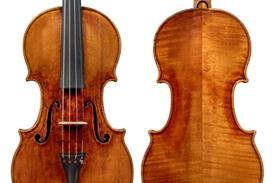
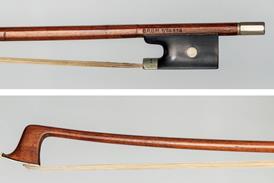
I play a 2012 cello by the celebrated Canadian luthier Raymond Schryer. The Strad actually published an article about this instrument for the November 2013 edition of the magazine which featured interviews with both Raymond and myself. My main bow was made by the award-winning Canadian bow maker Emmanuel Bégin.
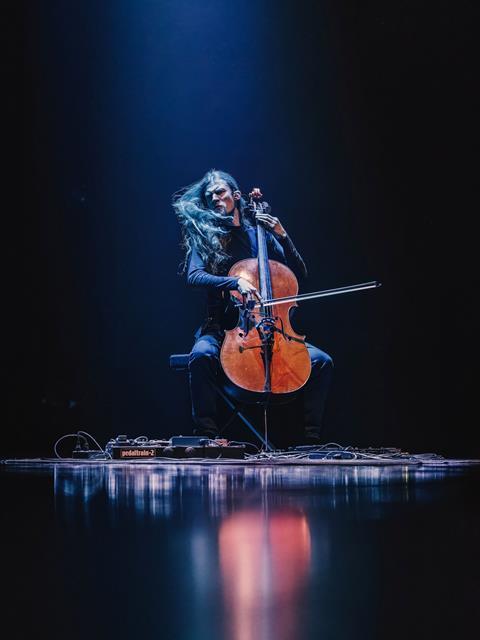
Electronics have become an integral part of my solo shows. In addition to using a DPA 4099 microphone to capture the acoustic sound of my cello, I use a pickup made by the Canadian company Schatten to run the signal into an effects chain and a loop station.
My effects rig consists of a variety of guitar pedals, including a Neunaber Immerse reverb, Boss Space Echo delay, Electro Harmonix Freeze, an Eventide Pitch Factor (for octaves and harmonization), a Diamond tremolo, Empress Heavy Menace distortion, and Digitech Whammy. I use a Boss RC-300 loop station to build multilayered and immersive compositions.
Sonically, I aim to find a meeting place between the acoustic ’woody’ sound of the cello and the electric, amplified sound achieved through the use of effects pedals. I love the feeling of proximity to the instrument - the textural sound of the bow on the strings and sympathetic resonance (especially when chords ring in tune).
However, I also want the cello to feel massive and powerful - larger than life, in a way that allows it to compete on a shared bill or playlist alongside contemporary popular music and rock, and I am able to achieve that through amplification and various types of processing that lead to greater harmonic saturation.
Lifeblood is released on 3 October 2025.
Read: Asja Valčić: improvising is like composing in the moment
Read: Nick Revel on weaving video games and music together via ‘The Hero Levels’
Discover more Featured Stories like this in The Strad Playing Hub








No comments yet