





From borrowed violins to a composite Strad with a storied past, the Australian violinist recounts the decades-long journey to find an instrument with a soul – and the lessons learnt along the way
Read more Featured Stories like this in The Strad Playing Hub
The biggest quest in the life of a young string player is surely to acquire the perfect instrument, the life companion that can express one’s deepest feelings, complement whatever career one is pursuing, and act as a valuable contribution to one’s superannuation by holding or increasing its value. It’s a big ask and a process fraught with pitfalls and dangers, my experience of which I hope may give courage and understanding to the younger people embarking on the quest.
In my twenties, I was intent on my solo career but being poor I was utterly dependent on the loan of a suitable instrument. Someone lent me a fine French violin for my Wigmore Hall debut in 1967 for which I was enormously grateful. However, suddenly the instrument became ‘for sale’ and I had to return it ignominiously as I couldn’t afford to buy it. That is the obvious pitfall of borrowing instruments. As Polonious said to Laertes in Hamlet: ’loan oft loses both itself and friend’.
Facing an important concert tour and with a new base in the US, I set about looking for an instrument I could actually perhaps buy! I had for years frequented the wonderful shop of Jacques Francais in 57th Street in New York City. In partnership with expert luthier René Morel it was the shop. Jacques himself was tall and elegant and had grown up seeing the world’s finest instruments at his father Emile’s shop, in Paris. He had a great eye for quality and as I took the violin I was playing at the time out of the case, he said from across the room ‘Tedesco’. He was, of course correct. It was a ’German trade’ violin.
To be fair to the population of Mittenwald, they did indeed make instruments available to the general public at an affordable price. Some of them were even quite decent sounding. They had Strad, Guarneri or Stainer labels not to deceive the public, but to denote the basic shape and form of the instrument. Stainer, for example, had a nice, rounded belly producing a ’sweet’ sound, satisfying for home amateur chamber music players.
So having accurately condemned the violin I had been playing, Jacques brought out a few great ones for me to try. I had just started my first job and could borrow a bit, had saved a bit and maybe could scrape together a deposit on – well, something! I had some important musician friends who came to my aid and persuaded Jacques to be generous.
He was indeed, lending me a Guadagnini for my upcoming concert tour. This was wonderful, but of course, I had to return it or buy it when I finished the tour. He had asked for a $1000 retainer for me to borrow the instrument. According to the arrangement he would have kept that money when I returned the instrument, but one of my famous friends persuaded him to use it as a deposit on an instrument of my choice.
Now came a very difficult time of trying to find a violin that had a distinctive voice that I responded to and could serve as a solo instrument. I couldn’t afford the Guad. It was $15,000!
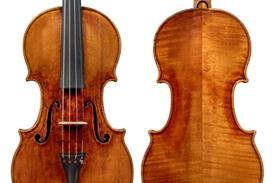
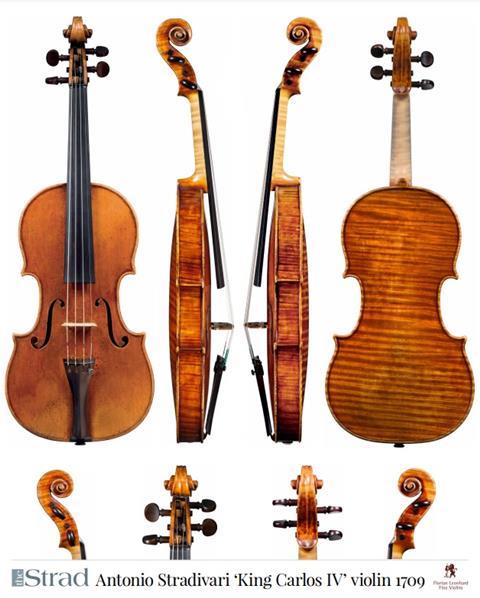
So with the help of my partner and former teacher, Richard Goldner, we zeroed in on a beautiful old violin which had a bit of an interesting history. Ruggiero Ricci had seen it in pieces in a shop in Argentina on a tour, had thought it intriguing and bought it. He took it back to New York and had Morel set it up. It had an Antonio Stradivari label 1666 with the final six crossed out in ink and replaced by seven.
About this time the great luthier-restorer, Sacconi, turned 80 and a big celebration brought together all the violin dealers of the world. Young Charles Beare was there representing his family firm J & A Beare of London. Jacques produced this violin for them to examine and pontificate upon. The consensus was that the violin was a composite instrument with the back and sides early Strad and the front Tononi. I bought it as such.
Richard Goldner had escaped to Australia from Nazi Vienna in 1939. He was a violist, teacher and inventor and in 1945 founded Musica Viva, the chamber music organisation in Australia. He moved to the US in 1968 and became a professor at Duquesne University in Pittsburgh. I joined him there and together we built up a significant string department. At the earliest opportunity we went to Vienna.
A wonderful old friend of Richard’s was the luthier Viktor Tröstler, who looked after all the valuable instruments in Vienna. He was renowned for having helped Jewish musicians during the dark days of the war. By the time of our visit, he was quite an old man and as we descended the couple of stairs to his shop around the corner from the Opera, he was counting the hairs for a bow rehair. We made sure not to disturb him, but when he saw Richard he broke into an emotional hug and they launched into rapid-fire Viennese of which I caught only a small fraction.
Finally, he welcomed me with exquisite Viennese manners and eventually the conversation turned to the violin I had just purchased. He took one look at it and said ’I know this violin – it was part of the Hämmerle collection. I looked after it. The daughter Hämmerle took it to South America. Look, here are my marks for the sound post.’
He pointed out some tiny pinpricks in the wood. The Hämmerle Collection was a famous collection of Strads before the war. My violin was the earliest example, made while Strad was working with Amati, only the second year he put his label in a violin. I felt shock, joy, elation and a powerful wave of empathy for this little fiddle that had already been through so much! If only it could speak and tell us its story.
I felt shock, joy, elation and a powerful wave of empathy for this little fiddle that had already been through so much! If only it could speak and tell us its story
Some months later after a lengthy stay in Europe and a trip home to Australia, I returned to the Francais-Morel shop eager to tell them our findings. To my surprise they were not the slightest bit interested. It was as though owners always came up with far-fetched stories about their instruments. It was a composite Strad-Tononi and that was that!
I think I grew up very rapidly with this experience. My admiration and trust in dealers and experts was never quite the same. But I loved the violin and played on it for a wonderfully fulfilling career. When I first acquired the violin, it was uncomfortable to play as it was set up with very high strings and a lot of tension giving it maximum power. I did not have the experience to realise that reducing that discomfort would reduce the power and make it less suitable for solo work. I returned to Morel regularly to adjust it. But it never quite had the volume of sound I needed. I should have bought the Guad!
Fast forward to 1994 and I had dug myself out of poverty. We had moved back to Sydney from the US to bring together families as Richard and my mother faced their eighties in marginal health. He died in 1991 and my mother in 1993. I had a chamber music gig in New York City in 1994. By that time Morel and Français had acrimoniously split up. Both had shops in New York. I decided to visit Jacques.
Still elegant and impressive with his ’charming’ French accent he was showing his age and close to retirement. I had two former students with me and they witnessed an impressive event. I asked to see what violins he had and he brought out a Goffriller. I fell in love! It had everything I had always been looking for in an instrument. I had just sold my house and could buy it straight away. That, of course, rendered the Strad redundant. Now came the next chapter in the saga of my Strad. Selling it!
It took twelve years to sell. First, I left it with Francais but after a couple of years, he was retiring and I came from Australia to retrieve it. I then took it to Morel, who reluctantly took the instrument for sale. I believe he made no attempt to sell it but put it to sleep in the ’too hard’ basket. After a few years I lost patience and retrieved it.
Several years later I had formed a good relationship with another dealer in the US. Finally, he took it on and passed it into the underworld of violins where you consign the instrument and know nothing more about what happens to it. The dealer offers you a payment for it eventually and I don’t know where it has gone or what it has become. I suspect it is a Strad again. I hope so.









No comments yet