
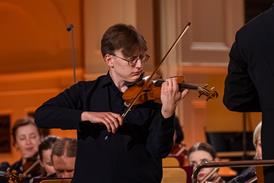



The violinist spoke to The Strad about recording the two works on her debut concerto album, both of which have accompanied her during defining moments of her life
Read more Featured Stories like this in The Strad Playing Hub
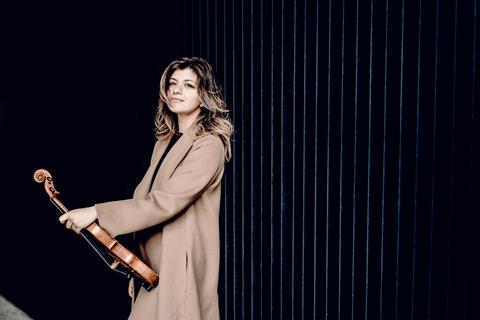
Moldovan violinist Alexandra Tirsu recently released her debut concerto album, comprising works by Dmitri Shostakovich and Paul Hindemith.
Tirsu chose concertos by the two composers as two works that have accompanied her during defining moments in recent years. Shostakovich’s Violin Concerto no.1, written during a time of political unrest and pressure, has been a part of Tirsu’s life since childhood, where she was surrounded by stories and films about war.
Her grandfather served as a soldier in the Soviet army. His memories of that time passed down through the generations, shaping the way she heard the music of Shostakovich.
Tirsu’s connection with the Hindemith Violin Concerto goes back to her participation in the 2021 ARD Competition in Munich, where it was the set piece in the finals. ’I quickly came to appreciate its structural clarity and the way it speaks without pretense,’ she says.
’While Hindemith’s music is often described as cerebral, I found it full of energy and subtle emotion, demanding a kind of directness that I’ve come to value in performance.’
Tirsu spoke with The Strad about pairing these two works on her new album:
How do you convey the emotional arc of Shostakovich’s Violin Concerto no. 1, from its shadowy opening to the ironic finale, while keeping clarity?
For me, the first movement carries a very introverted kind of pain, a pain that never becomes outwardly dramatic. It feels like entering a room where people learnt not to speak too loudly. Shostakovich himself was a timid, cautious person in public, but his inner world was enormous, and it feels as if he poured everything he couldn’t express openly into this movement.
That’s why I begin with a transparent, almost whispered sound. The music has a delicate structure, like light filtering through heavy curtains – restrained but full of pressure underneath. The emotional arc of the concerto is not linear, for me , it moves like a mind trying to remain intact. The scherzo has that sharp, sarcastic smile, the passacaglia carries a slow, inevitable weight and the finale has this unsettling, nearly hysterical irony.
To keep clarity through all of this, I tried to rely on precise articulation and bow control. Even in the most charged moments, the line has to stay pure. For me, the essence of this concerto is exactly that balance: intense inner emotion held together by discipline and restraint.
How have the war stories you grew up with shaped your interpretation of Shostakovich’s concerto, especially in the passacaglia and cadenza?
Even though I was born after the fall of the Soviet Union, the atmosphere of that time was still very present around me – in school, in the books we read, and especially in the films about the war and Soviet life.
As a child, I didn’t feel the weight of it directly, because my parents protected me from the instability of those years. But later, when I started reading more on my own and understanding what people actually lived through, the heaviness of that era became much more real to me. My grandfather’s stories also had this mixture of heroism, hardship and resilience that stayed with me.
When I play Shostakovich, especially the passacaglia, a lot of those images come back. There’s a seriousness and gravity in that movement that immediately connects to the things I learnt growing up. I relate to the natural weight that the music carries instinctively.
The cadenza feels even more personal. It’s like a single voice standing alone with everything it carries inside. I try to let that feeling come through in a straightforward, honest way – without over-shaping it, but also without shying away from its intensity. It’s a moment where memory, reflection and emotion all meet, and I let the music speak from that place.
What drew you to Hindemith’s Violin Concerto during the 2021 ARD Competition, and how do you reveal its subtle emotions for today’s listeners?
I discovered the Hindemith Concerto through the ARD Competition – I had never studied it before – and my connection to it grew gradually. The more time I spent with the score, the more I understood why so many critics describe this concerto as one of Hindemith’s most sincere and personal works.
It has a very introverted emotional language, but it’s full of depth once you enter it. At times, it feels like a solitary walk, almost private, and then suddenly it opens into these grand, brilliant tuttis that completely change the space around you. Performing it with the Royal Philharmonic Orchestra really reminded me how incredible those contrasts are – those tutti moments feel physically unforgettable when you’re inside the sound.
One thing I’ve come to love is how Hindemith balances structure with real warmth. Critics often call this concerto ’neoclassical’, which is true in its discipline and clarity, but inside that framework there is so much humanity.
The second movement, for me, is one of the most beautiful slow movements I’ve ever played – lyrical, dignified, and deeply emotional without being overt. And then the third movement brings this unexpected playfulness and rhythmic vitality, which adds a completely different color and shows a more humorous side of him. There are also pastoral moments, where the music opens up and suddenly feels spacious and honest.
Because of all these qualities, I’ve developed a very personal relationship with the piece. It asks for time, but once you understand its language, it becomes incredibly rewarding. When I perform it now, I try to highlight those contrasts – the introspection, the openness, the playfulness – so listeners can feel the many layers that made me fall in love with it.
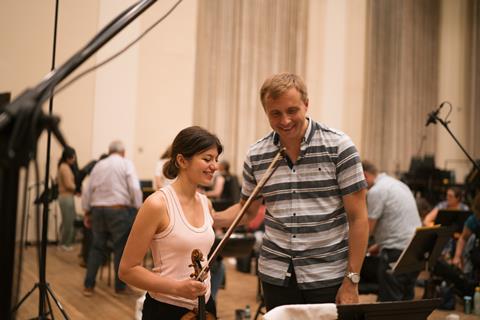
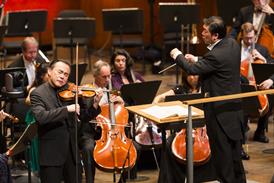
What was the recording process like with the Royal Philharmonic Orchestra and Vasily Petrenko, given the extremely limited rehearsal time?
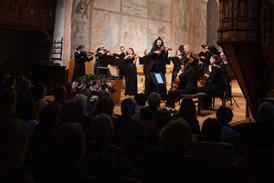
Because of several scheduling circumstances, we all had to work under very limited time. We had only six hours per concerto – including meeting the orchestra, rehearsing and recording everything. It was an extremely condensed process, but the level of focus and professionalism from everyone involved made it possible.
I felt truly honoured to work with the Royal Philharmonic Orchestra (RPO), Vasily Petrenko and our producer Andrew Walton. The RPO’s adaptability and concentration were extraordinary, and they created an atmosphere in which things could come together very quickly.
Vasily’s clarity, experience and musical insight guided the entire process, and his ability to lighten the atmosphere by cracking genuinely funny jokes was honestly one of my favourite parts of that session. Under such pressure, those moments made a huge difference and helped all of us stay relaxed and focused. I learnt a great deal from him – and from everyone involved – even within such a short time.
Alexandra Tirsu’s album of Shostakovich Violin Concerto no.1 and Hindemith Violin Concerto, with the Royal Philharmonic Orchestra and Vasily Petrenko, is out now on Fuga Libera.







No comments yet