




![Ayanna Witter-Johnson [Jordan Woods] 7](https://dnan0fzjxntrj.cloudfront.net/Pictures/274x183/4/9/4/44494_ayannawitterjohnsonjordanwoods7_224583.jpg)






Read more Featured Stories like this in The Strad Playing Hub
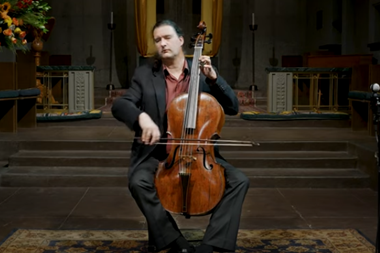
Cellist and composer Zoë Martlew performs her work G-lude, a piece described as ’a cello distortion rock-up’ and ’a Hendrix-esque workout.’
Listening to the audio, you may think initially you’re listening to an electric guitar solo, with no shortage of distortion pedal. Martlew mimics this sound using the cello, giving the impression of the electronic soundscape.
G-lude came about from a Spitalfields Festival commission to write and perform a solo cello piece for its ’Bach Rework’d’ festival in 2021. The commission followed a time where Martlew says ’the cello and I had moved firmly into separate bedrooms during the pandemic. Not really on speaking terms.’
She describes G-lude as ’a raucous response to Bach’s iconic G major Prelude,’ calling it ’a wild visceral catharsis of shrieks, gasps, scrapes and howls that ghosts the harmonic architecture of the original.
’The delicate string resonance central to all the cello suites is here blown up in distorted overtone clouds, finally exhausting itself and coming to rest within the stillness of the Prelude’s opening chord sequence, here outlined in harmonic pizzicatos.
Clearly, numerous specific techniques are required to create the sounds in the work. How does Martlew replicate the sound of an electric guitar on distortion? Martlew says that the piece was born from more than three decades immersed in contemporary music, much of it involving extreme, experimental techniques.
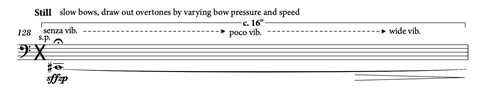
’One favourite technique that I’ve played with in this piece is drawing out overtones to give the impression of an electronic soundscape,’ says Martlew.
’The execution is about finely tuned variation of bow pressure, bow speed, and point of contact on the string, moving from extreme sul pont (on the bridge), to slightly higher up the string and back, and “feathering” all of the above until you find the sweet spot and hear the string lock into an overtone pitch. At which point the overtone is sustained for as long as feels musically interesting (note duration allowing), before moving on and drawing out the next overtone.’
She continues: ’If this technique is combined with a left-hand half finger pressure on the given pitch, this emphasises the effect, adding something that sounds very close to a feedback distortion cloud. And then if you add to that an exaggeratedly wide vibrato or rapid half-pressure trill, plus a very slow, almost imperceptible glissando - combining all with the “feathering” bow technique, you get some fabulously spooky electronic colours.’
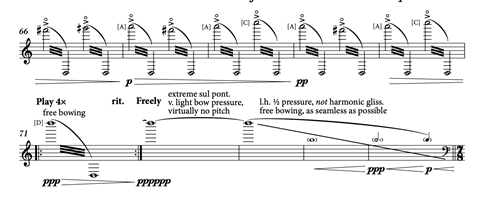
Martlew also makes use of rapid oscillation of harmonic pitches at the very top of the string, where the left hand is well into the zone of rosin, ‘trilling’ between harmonic and open string. ’The effect is a magical silvery shimmer of high pitches while simultaneously hearing the ghostly open string. When played at extremely quiet dynamics, especially in a live performance, this can be spellbinding.’
Martlew stipulates that the cello should be amplified in this piece, ’not just because it’s a wild rock up, and needs the extra zazz, but also it allows the performer to play extremely quietly and the gentlest bow whisper be audible.’
On the opposite end of the spectrum from overtones and ‘feathering’ are some wild scrape sounds - to which Martlew warns responsible cello teachers to ‘please avert your eyes NOW.’
’For maximum C string crazy guitar diva crunch, I literally hold the bow in my fist (teachers, I did warn you..), turn the cello sideways to get maximum leverage on the string, and then scrape vertically up the string, from bridge towards fingerboard, with as much pressure as poss. It makes an awesome noise, especially with the amp volume up, and even better when interspersed with crazy breath sounds - as in this piece.’
With such complex and seemingly unconventional techniques to convey, Martlew says that the challenge for the composer is to notate the techniques in such a way that other cellists can understand in her absence.
’Having experienced countless badly notated scores over the years, I’ve become incredibly nerdy about what’s on the page, not wanting to inflict any vaguery on my fellow cellists,’ adding that she is ‘a bit of a control freak’ about her notation.
’Even though this particular piece might sound improvisatory in places, in fact all of my music is very precisely written out, with clear rhythmic, pitch, dynamic, character and technical indications, and almost nothing is left to “interpretation”. As this piece follows the harmonic architecture of the Bach G major prelude, there are also other structural things going on beneath all the string colours, so needs to be compositionally watertight.
’However, in the process leading up to the finished piece I’ll always play around with the kind of sounds I want on the cello, exploring the techniques as far as they can go. Improvisation is a fantastically useful starting point - whether on the cello itself, or singing my way into a new piece. Then after that comes the really tough job of pinning down the dots.’
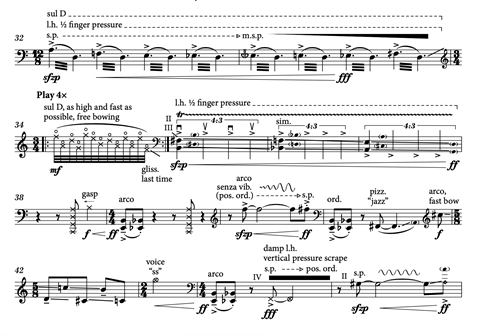
G-lude was released as an single on NMC Recordings on 3 October 2025. It will be followed by another advance album single In the Kyoto Gardens, which along with G-lude, will feature on Martlew’s debut disc as a composer, Album Z, to be released on 28 November 2025 on streaming platforms and CD.
Watch: Perfectly poised pizzicato: Louise McMonagle performs ‘Salat Babilya’ for solo cello
Read: Yo-Yo Ma: celebrating 70 years of the eminent cellist
Read more Featured Stories like this in The Strad Playing Hub












No comments yet