







Violist Carol Hubel-Allen explores the emotive effects that key signatures can play in music, and offers practical methods for musicians to deepen their understanding of tonality
Read more Featured Stories like this in The Strad Playing Hub
Have you ever experienced a fleeting sense of wonder while playing or listening to music?
A change of harmony takes you by surprise and all of a sudden you feel elated, or there is a sense of peace, that you are being ‘taken care of’, or perhaps you experience an acute pain of sadness. The list is endless.
Being drawn into and encompassed by such an emotion, to the exclusion of all else, is surely proof of the power of music, a power which can be more direct or forceful than words.
How does a composer create these emotions?
Could it be that, among the many tools in the world of music composers have at their disposal, the key signatures play a bigger role than we imagine?
To grasp the meaning ‘behind the notes’ is the ultimate goal for which the musician is forever searching. We search for clues to be able, through our instrument or voice, to re-produce the composer’s intentions. Maybe it is ‘behind the notes’ that the biggest clue is to be found: the keys!
Let’s start with a fun exercise:
Play the first bars of Bach’s E major Partita for solo violin. Now transpose it one whole tone lower into D major and play the same pattern again. Then go further, into as many keys as you wish. Note down the different ‘timbre’ of each key together with your immediate emotional reaction when you begin to play in one of the ‘wrong’ keys.
It’s not the easiest thing to do but one thing is clear – Bach chose E major because of its celebratory character. His E major Violin Concerto BWV1042 is the same: both shine with a brilliance and grandeur that no other key can match.
Another experiment would be to transpose the opening bars of Shostakovich’s last major work – his testament, so to speak – the Viola Sonata op.147, written on his deathbed. He chose the viola, not only because of its ability to create the sombre hues of life’s crises but because its lower C string can conjure up a C minor atmosphere – just about as sad as you can get.
The tentative pizzicato of the open strings of the viola paint a picture of underlying trepidation, setting the stage for this true story Shostakovich tells us of his persecution, of the dread, suffering and often extinction endured by his fellow countrymen under Stalin’s repressive regime.
Into this C minor atmosphere enter other keys, one by one: F minor, B flat minor, E, G and A minor, all fleeting and scarcely long enough to be defined, enabling the listener to experience these emotions physically. Transposing this music into a different key environment sounds grotesque! (A whole tone higher and you have the beginnings of a tango!)
A case of the opposite, where transposition of a melody from D flat major into G major made it a top hit, is Shostakovich’s Romance from The Gadfly. Shostakovich originally wrote the music for the Russian film Ovod, in which the Romance depicts an underground spy sitting in a cold cell awaiting to be shot at dawn, writing a letter of contrition. Arranged in G major for violin and piano, this endearing melody has become one of the most passionate love themes in the repertoire.
Keys then mean something, or, to be precise, each key can mean something different. We announce a piece of music thus: Beethoven’s String Quartet op.132 in A minor, or Haydn’s ’London’ Symphony in D major, but this is usually as far as we think about keys. An exotic sounding key such as C sharp minor conjures up something special, maybe even otherworldliness. But what is ‘special’, ‘otherworldliness’?
For this we rely on our emotional reactions while playing or practising, on ‘getting the feel of the music’, as we say. Thankfully this gut feeling of how a passage of music should sound is, more often than not, spot on.
To pinpoint from where this particular feeling emanates, however, would be a step further into this endlessly fascinating world of keys.
String players will find practising scales more challenging if we lend an ear to how different each key actually sounds. As an example, the arpeggio sequences in Ivan Galamian’s Contempory Violin Technique Vol.1 come to life when you concentrate not only on finger patterns and intonation but on the succession of the characters of the various keys.
It is interesting to observe the phenomena that when players today tune their instruments down from, for example A440, to the Baroque pitch of A415, the relationships between the keys between themselves remain constant, each key retaining its unique characteristics.
Why did the composer choose a particular key in the first place? Pure chance? More likely, as we have seen from Bach and Shostakovich in the examples above, the composer chooses that key or key environment which enables them to express a particular emotion, enabling us as a consequence to know what lies behind the notes. So far so good – but the question arises, are we implying that keys are individuals, each one possessing characteristics of its very own?
For a reliable answer, we can turn to Bach’s 48 Preludes and Fugues, The Well-Tempered Clavier. In 1722 Bach bequeathed us, free of charge, a book of reference, most likely the most valuable book the music world possesses. Beginning with C major and ending with B minor, he writes twice-over a Prelude and Fugue for each of the twelve major and twelve minor keys we use in the Western world; each Prelude and Fugue with its own visiting card and each one setting forth its own unmistakeable blueprint.
Bach wasn’t the first composer to write music in every key for a keyboard instrument, which, until equal temperament was introduced, was every instrument-maker’s headache. He was however the first to realise and hand down to us the amazing fact that each key has a unique life of its own, able to convey an encompassing array of moods and emotions, truer, deeper than words can ever express. Many musicians will admit that music began with Johann Sebastian Bach.
Music has been described as a universal language, meaning no doubt that music possesses its own language, not limited by words. If we do attempt to compile a glossary of the meanings of the keys, an exact description is well-nigh impossible, the same dilemma as when trying to sum up a person in a few words!
In spite of this handicap, let us choose a key, say B minor, and define its characteristics as best we can with the aid of well-known musical examples:
- The monumental, forceful opening of Bach’s B minor Mass creates an atmosphere of unfathomable sadness, grief and guilt, portraying our human weakness and our yearning for the eternal.
- Schubert chose B minor for his ‘Unfinished’ Symphony. The haunting darkness of the opening theme gives way to clouded mystery. Perhaps for Schubert there was no ‘ending’: he always seemed to have one foot on earth, the other in heaven.
- Brahms begins his B minor Clarinet Quintet op.115 with an inner cry of yearning, a plea, and despite sharing with us the happier memories of his life in the middle movements, ends the work in B minor with deep sadness and resignation.
- Tchaikovsky’s despair reaches its darkest depths in the B minor sections of his Sixth Symphony, the ’Pathetique’.
- Dvořák’s haunting Cello Concerto has to be in the key of B minor! Those present when Rostropovich played this work in London on the eve that Russian tanks rolled through the streets of Prague on 21 August 1968 could physically feel the tragedy. Yes, B minor’s capacity for pain and sadness is boundless.
A complete contrast would be the key of D major, the relative major key of B minor. Think of the joyous outburst of Handel’s Hallelujah Chorus in D major, or the first movement of Mozart’s ’Prague’ Symphony K504, when, after dark D minor echoes of Don Giovanni, the D major Allegro bursts forth, dispelling all the shadows.
An intimate knowledge of the keys is the sign of a truly great composer. For the musician, it’s a valuable gift and a trusted guide.
In Shakespeare’s As You Like It, Jaques casually maintains with irresistible arrogance:
All the world’s a stage
And all the men and women merely players.
They have their exits and their entrances
And one man in his time plays many parts.
Tongue-in-cheek, we could apply this to the world of music:
The world of music is like a stage
And all the keys are the players.
They have their exits and their entrances
And one key in its time plays many parts.
Taking the time to get to know the keys, and to ferret them out and analyse them while studying a piece of music, can be more than gratifying. The more keys we discover, the more meaning we discover in the music – and when we get stuck, there’s Bach’s book of reference waiting to be consulted, to provide the answers!
The prime intention of sharing these thoughts is to encourage a lively discussion – every musician and music lover will have interesting experiences to share.
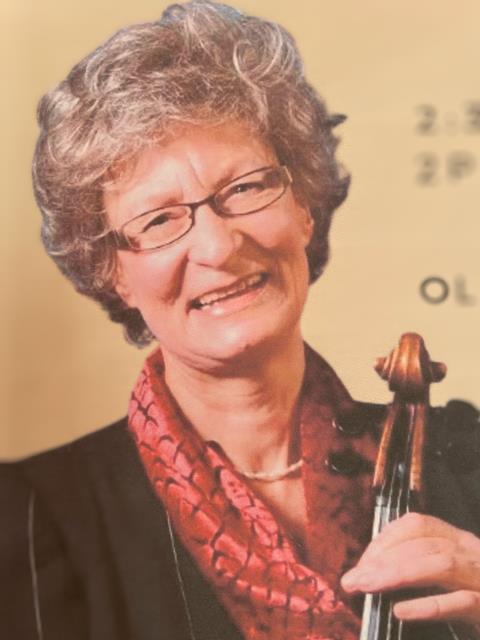
Carol Hubel-Allen, LRAM, teacher and recital diplomas, London, was a member of the BBC Scottish Symphony Orchestra and the Princeton Chamber Orchestra NJ, US. She then toured for over 20 years in two international string quartets on both sides of the Atlantic, culminating in performances of the complete cycle of Beethoven’s String Quartets in Barcelona, Stuttgart and Vienna. Back in the UK she became a founding member of the Bochmann String Trio and Duo Karadys, Viola and Piano.
Read: In pursuit of meaning: why music matters
Read: Mindset beyond technique: why mental training matters for musicians
Read more Featured Stories like this in The Strad Playing Hub











No comments yet