
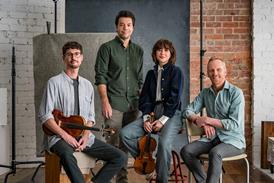

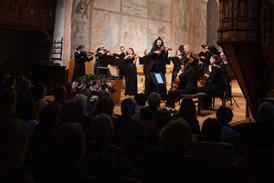


Ahead of the world premiere of Daniel Bernard Roumain’s new work, founder of the Apollo Chamber Players, Matthew J. Detrick, explains how the group explores the issues of our time through their commissions and the rich possibilities of the quartet form
Read more Featured Stories like this in The Strad Playing Hub
’You know, one of my great-great grandfathers was said to be present at Lincoln’s 1865 inauguration… maybe he and Frederick Douglass sat next to each other.’
Chills went down my spine as Haitian–American composer Daniel Bernard Roumain (DBR) recounted his family legend via Zoom to Kenneth Morris, Jr., the living descendent of both Frederick Douglass and Booker T. Washington. At that moment, I knew we were delving into something special. That Douglass, as the nation’s Ambassador to Haiti, could have had ties to DBR’s ancestors only reinforced the notion that he was the right choice of composer for this commission.
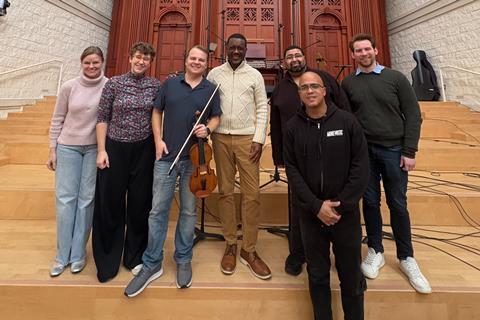
DBR’s new work for string quartet, vocal quartet and narrator, And Still We Cross, was written in collaboration with Morris. It feels like a particularly timely collaboration. Premiering this February – Black History Month’s 100th anniversary in America’s 250th anniversary year – it channels our shared reflections on migration, resilience, and unfinished struggles and honours the legacies of Douglass and Washington by tracing their imprint on history, education and racial justice.
It is a project that deeply reflects our enduring identity as a string quartet at our core. This quartet foundation has allowed our commissioning work to expand outward with creative intention and imagination, reflecting the complexity of our 21st-century world.
Since the time of Papa Haydn, the quartet has functioned as a complete musical organism – four instruments spanning the full SATB range, capable of melodic and harmonic roles and an almost inexhaustible palette of tone colours. This completeness makes the ensemble both structurally stable and uniquely adaptable, able to absorb new voices in collaborative harmony.
Works conceived with strings at their core are not locked to a single configuration. They can be reimagined years later, scaled up to include additional instruments or voices, or adapted to new spaces and artists while retaining their identity. For composers, this gives them the opportunity to write music beyond one performance; for performers, it keeps us creatively and technically nimble.
This adaptability has enabled us to combine strings not only with traditional classical instruments but also with culturally specific instruments whose timbres might initially seem distant from the Western string tradition: Vietnamese đàn bầu, Carnatic Indian chitravina, bandoneón, Persian percussion, and electronics, to name a few. Rather than equalising these sounds, we let strings function as mediator and collaborator.
Ideas around extended techniques (pizzicato, sul ponticello, and other Tango efectos, for example) are guided by the composer and implemented by the quartet. The goal is not fusion for its own sake, but communication: allowing distinct musical languages to coexist authentically. Our many collaborations have unleashed the dynamic inventiveness that emerges when our philosophy as globally curious performers meets the unique talents and cultural influences of each composer.
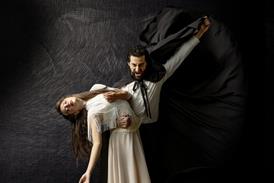
The addition of spoken word, as in DBR’s work, is also a particularly impactful influence. Strings shape time without overpowering language – supporting, punctuating, or retreating as text unfolds. Our commissions which have incorporated spoken word have ranged from otherworldly ventures with American Indian astronaut John Herrington to a powerful collaboration with actor George Takei, who narrated his childhood experiences in a Japanese-American internment camp and lifelong advocacy. In every commission of this kind, timing is everything. The quartet – with me as leader – must respond to pacing, nuance, and serendipitous moments in real time.
And Still We Cross reflects the creative synergy and societal relevancy that we’ve honed for almost two decades and over 70 commissions and counting. In this perilous moment, truer words and music could not be expressed. Just as Kenneth Morris’s famous ancestors were witnesses to tyranny, we in the 21st century find ourselves on a similar path.
Just as Americans then assisted the enslaved in their pursuit of freedom on the Underground Railroad, Americans today are courageously coming to the aid of our brothers and sisters – and strangers alike – on homeland battlefields. Immigrants and migrants displaced by war, poverty, and climate change still dare to dream of a better life on American soil.
Our national soul rings with cacophony. May this commission help it heal, bringing the story of America at 250 years into full relief, and grant us the courage to ’Stand so others can cross.’
The premiere will take place on Saturday 7 February at the Midtown Arts & Theater Center Houston. A video of the recording session of DBR’s work can be found here.








No comments yet