




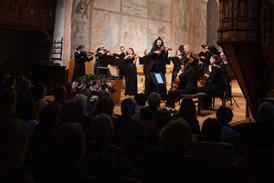




Edward Bhesania watches Fragments, an innovative staging of Bach, Joseph Hallman, Thomas Larcher, Missy Mazzoli, Jeffrey Mumford and Matthias Pintscher, at London’s Purcell Room on 17 May 2026
Collaborations between musicians and other creators are increasingly part of the concert world, but the results can amount to much less than the sum of their parts. Alisa Weilerstein’s Fragments is a multi-year touring project in six parts, each featuring one of Bach’s Cello Suites juxtaposed with a range of commissions from 27 composers across the series. The two concerts on this particular afternoon – Part Three ‘Emergence’ and Part Four ‘Labyrinth’ – presented new pieces from, among others, Joseph Hallman, Thomas Larcher, Missy Mazzoli, Jeffrey Mumford and Matthias Pintscher, alongside Bach’s Suites nos.3 and 4.
With each concert being presented in a continuous span (just over an hour each), and adding in set and costume design, lighting and make-up, it’s a bold experiment, designed to break down the established lines of association between composers. The project, says Weilerstein, is ‘not … about people who write music but rather about the music they write.’ To this end, we are only informed after the event of what we’ve heard, via a QR code linking to Weilerstein’s website.
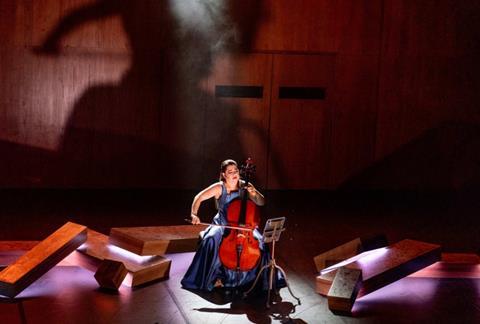
This led to a listening experience that is both disorienting (even the Bach movements are reordered) and tiring (with the new pieces being largely abstract). It’s also self-contradictory. Director Elkhanah Pulitzer claims there is no ‘hierarchy or narrative’ across the series. And yet in the fourth instalment, Weilerstein swapped her casual black top and rhinestone-embellished jeans for a statement cobalt-blue gown, while the grey blocks that in the previous instalment formed a backdrop wall were now dismantled and artfully arranged around her.
The fact I haven’t yet got to describing the music or the performance is a measure of how displaced this element seems to be in the mix, despite the intensity of Weilerstein’s commitment and concentration throughout. It sometimes felt as if every composer wanted to exploit similar playing techniques – sliding harmonics, sul ponticello, pizzicato and tapping the strings – which deadened any sense of novelty. And you couldn’t even enjoy the oases of Bach without being distracted by Weilerstein’s brutal stage make-up. Clearly a lot of effort has gone into this project, but it’s hard not to see it as a concept that has ballooned and seduced its originators into letting it drift away.
EDWARD BHESANIA
Watch: Alisa Weilerstein performs The Recovery of Paradise: Blackford Cello Concerto
The Strad Recommends: Alisa Weilerstein: Brahms
Read: Alisa Weilerstein’s top 5 tips on maintaining a natural stage presence










No comments yet