


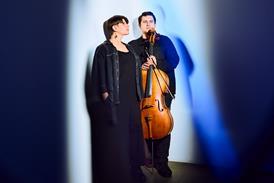



When jazz violin pioneer Stuff Smith left behind six minutes of themes for a concerto, composer Dave Soldier set out to complete what he had started. He shares how he transformed the fragment into a full-scale work while grappling with a central question: how do you finish a masterpiece without losing the voice of its creator?
Read more Featured Stories like this in The Strad Playing Hub
In the 1980s, I would occasionally encounter John Cage riding the New York City subways. Cage was arguably the most famous living American composer, yet no one approached him or even seemed to notice him. He was friendly, funny, and gave the impression of someone open to conversation.
One day on the subway I said to him, ’John, I think it’s time for you to write a new string quartet. My group, the Soldier String Quartet, will rehearse and work with you until you have what you want.’ He replied, ’I don’t write for strings now – all of the violinists sound the same.’
I pushed back: ’But that’s not true. Mischa Elman doesn’t sound like Fritz Kreisler, who doesn’t sound like Jascha Heifetz.’ He paused and said, ’Yes…but that was back then.’
I realised that Cage’s point was valid, something had happened in the world of the classical virtuoso. And yet, there remain creators whose sound and personality feel irreducibly their own – what I would call genius. Among jazz string players, the clearest examples to me are the twin poles of improvisation: Stéphane Grappelli and Stuff Smith.
Grappelli is the one who immediately strikes most classical players dumbstruck: my young friend En-Chi Cheng, a violist who plays with the Metropolitan Opera and New York Philharmonic, nearly had to pull his car off the side of the road when we heard Grappelli on the radio. Particularly as Grappelli became older, every note and idea seems to sing with an impossible sheen. Grappelli has many followers, and with his partner Django Reinhardt, invented what is often called ’Gypsy jazz’.
Stuff Smith came of age in the Midwest when Louis Armstrong and Jelly Roll Morton were transforming American music and influencing a generation of future jazz greats. Stuff found the means, I think still the best path a century later, to extend Louis Armstrong and the Basie band on a string instrument. He invented scoops, distortions, fifths and tritones and octaves and almost octaves, drops, jumps to other keys that long predate and perhaps inspired Ornette Coleman. He provided a vocabulary of African and Caribbean cross-rhythms, a new virtuosity of widths and kinds of vibrato that could emulate all sorts of voices. Those voices include his own singing, also influenced by Louis Armstrong but carried by Stuff to his own first-in-ten-yard line.
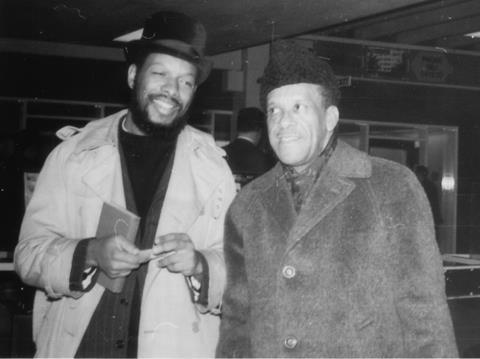
He began performing in traveling territory bands in Texas, the South and Midwest, a circuit that helped nurture the blues, country music, and countless early jazz musicians. Near the start of his career he worked for a short time with Jelly Roll Morton himself – while the New Orleans pioneers often used violinists, I don’t think they previously had anyone who could make the violin solo in the style of the clarinets and trumpets.
By the time of his death in 1967, Stuff had recorded with Dizzy Gillespie, Nat King Cole, Ella Fitzgerald, Oscar Peterson, and Sun Ra. I often recommend starting with his duo recordings with Grappelli, then his work with Dizzy, and sessions like Together with Herb Ellis.
His 1930s recordings, when he was the king of 52nd Street with Cozy Cole and Jonah Jones, are essential as well, especially his house band at the Onyx Club, with drummer Cozy Cole and trumpeter Jonah Jones. His biggest hits were songs about pot - he composed ‘You’se a Viper’ because one sounds like a hissing snake when smoking reefer.
I don’t know how I heard this, but Stuff was friends with Fritz Kreisler. I know from the violinist Harry Lookofsky himself, the top session player of his time and a member of Toscanini’s NBC orchestra, that Stuff and he would go on long walks at night in the city, which will become relevant shortly.
Stuff maintained a wide circle of friends in New York. His archive is curated by Anthony Barnett in Great Britain, who has released many recordings beyond what is available on streaming platforms. Through Anthony, I learnt that around 1963 or 1964, Stuff Smith had an idea to write a concerto and recorded six minutes of melodies in Los Angeles on a home tape recorder.
For safe-keeping, he sent the poorly recorded tape to his friends Mary Lee and Don Hester of Arlington, Virginia, who sent it to Anthony in the 1990s. Then perhaps 20 years later, Anthony sent me the recording. You might imagine how stunned I was that Stuff Smith, whom I loved since age 15 when my mother gave me his second record with Grappelli for my birthday, recorded these themes.
About ten years ago, I transcribed what he played, which took some weeks, due to the poor sound. Still, after a lifetime of listening to Smith, I had an ear for what he was doing and mostly figured it out - even then Miranda Cuckson showed me that I misheard a phrase at the very end. I later made a digitally ’cleaned up’ version you can hear on my website.
Of course, Smith would need the themes expanded for a concerto. So in my expansion, some of Smith’s parts are played by the soloist, and some are used to create a conversation between soloist and orchestra. To create a piece of about 18 minutes from six minutes of melodies, I wrote new themes and developments. I used mostly Stuff’s technical repertoire for the soloist, but composed spiccato passages and some high note sections he would not have played himself but I think would have liked.
One important technically challenging section that Stuff wrote and I made sure to feature is the bouncing glissando at the start of the cadenza, Smith’s own variation of a phrase from Tambourin Chinois by his friend, Fritz Kreisler.
I substituted chords and introduced jumps to keys that weren’t implied in Smith’s melodies, but that I think he might have said ’whoa, that works’. While there are a bunch of contemporary features, I tried to think of what I believe he would have liked. Except for Kreisler’s Tambourin quote, the cadenza is my commentary, and I think it makes sense for the concerto.
Here is what I suspect he would have done if he had an opportunity to play a concerto with an orchestra. Harry Lookofsky recorded the definitive bebop violin album, Stringsville. Although they sound improvised. Harry wrote out his solos and handed the arrangements to Bob Brookmeyer and Hank Jones, great players who were also great arrangers. My guess is that if an orchestra were to play his concerto, Smith would have asked Brookmeyer or Jones to essentially do what I’ve done. We would have gone back and forth, the way my quartet would work with Cage and others.
Very thankfully, Smith’s surviving grandchildren, John and Cheryl Smith, still in Ohio, say they love the piece and that Smith is smiling down on us. But someone else could certainly come up with a very different concerto from the same fragments.
My first version was performed by Composer’s Concordance, who asked me to write a piece for string orchestra. I asked one of my favourite violinists, Miranda Cuckson, to play the solo. Miranda has developed her own reservoir of techniques and sounds and uses these to enormously extend the repertoire of music that can be performed on the violin. I think that she is doing more for new repertoire for the instrument than anyone else.
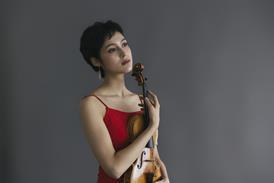
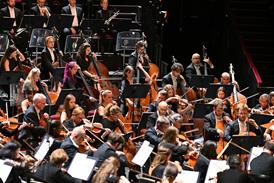
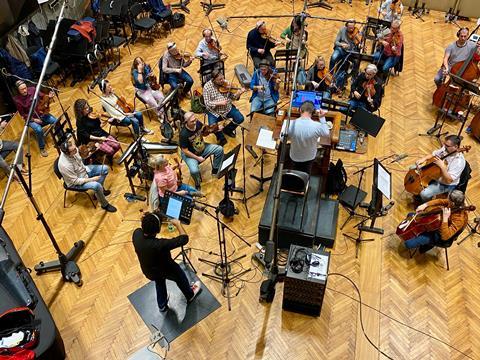
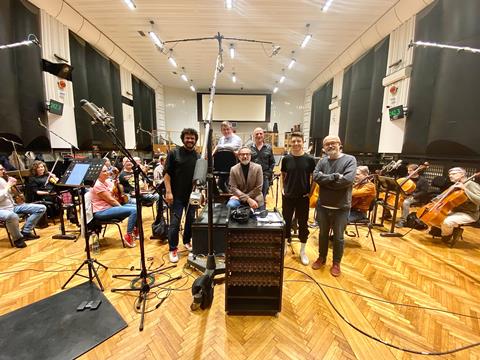
Then the opportunity came up to record the piece with the Prague FILMharmonic Orchestra, an ensemble assembled by Petr Pycha and consisting primarily of musicians from the Prague Symphony Orchestra and the Czech Philharmonic, conducted by Adam Klemens. Miranda couldn’t make the date in Prague, so I called my other favourite contemporary violinist, Curtis Stewart, whose PubliQuartet recorded several of my string quartet pieces. Curtis is a stellar classical player whose father, Bob Stewart, and mother, Elektra Kurtis, are great jazz musicians, and knew Stuff Smith’s ouvre very well.
To hear how Curtis creates his own world, listen to his new album adapting Paganini into variations on rock, hip hop, folk, R&B, et al., the 24 American Caprices. As is absolutely called for in this concerto, Curtis altered notes, moving a note an octave higher and making a new short cadenza before the ending and adding swoops and a range of vibratos Stuff would have loved.
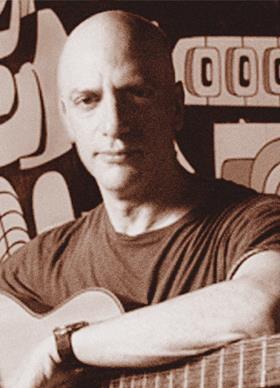
Miranda and Curtis intuited Smith’s message from decades before to us. It is to find a means to play his concerto in your own way with your own sound.
If you explore the concerto, or the violin and piano version (that I call ’Stuff Smith’s Unfinished Sonata’), first listen to his phrasing on that tape (on my website or order from Anthony), and then find a way to play it that YOU would want to listen to. Make Smith proud of those who follow, and let John Cage know that there is a lot of individuality still to come in this world.
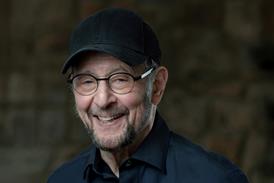
Dave Soldier is a composer and performer. As David Sulzer, he is a professor of neuroscience at Columbia University, and his book Music, Math and Mind (Columbia Press) is for musicians interested in the physical basis of their art, including the basis of sound and how the ear and brain perceive it, topics that are not taught in conservatories. His new CD, Vipers at the Onyx (2026, Bright Shiny Things) is a set of orchestra works including Curtis Stewart’s recording of Stuff Smith’s Unfinished Violin Concerto. To hear an example of Dave’s own idiosyncratic violin playing, a new record is Paiva River Songs (2026, Gold Bolus Records).
Read: Inside Philip Glass’s early violin masterpiece Strung Out
Read: Reaching for the stars: Ethan Jankowski on creating a celestial sound galaxy for strings
Read more Featured Stories like this in The Strad Playing Hub










No comments yet