





![Ayanna Witter-Johnson [Jordan Woods] 7](https://dnan0fzjxntrj.cloudfront.net/Pictures/274x183/4/9/4/44494_ayannawitterjohnsonjordanwoods7_224583.jpg)





Tully Potter gives a robust opinion of Tim Bosworth’s account of one of the earliest American-trained string quartets, featuring Jascha Brodsky and Max Aronoff
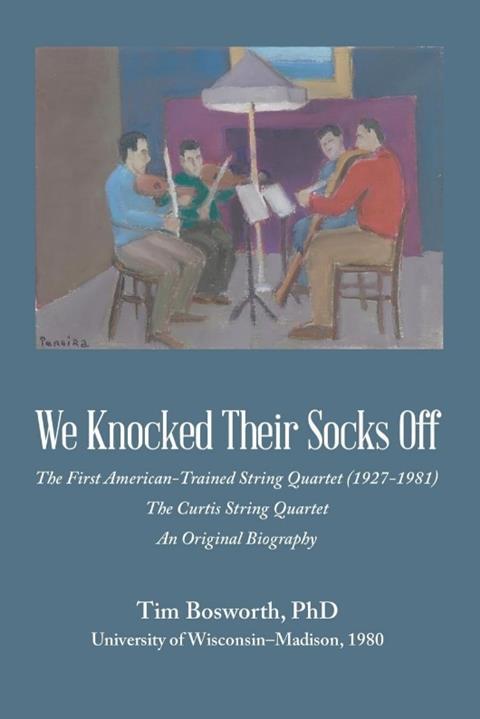
We Knocked Their Socks Off: The First American-Trained String Quartet (1927-1981) – The Curtis String Quartet
Tim Bosworth
375PP ISBN 9798369432495
Xlibris £19.95
This book irritated the hell out of me. The author’s style is an amalgam of Trump and Gump, composed of over-assertion, naivety, misplaced folksiness and sheer ignorance. But perhaps we should try to see beyond the ham-fisted method and at least honour his subject.
The Curtis Quartet grew out of the Swastika Quartet, formed in 1928 in Philadelphia. The name, its Nazi associations not yet known in America, was suggested by Mary Bok, patron of the new Curtis Institute where its members studied. Max Aronoff became the violist in 1930 and Jascha Brodsky was leader from 1932, when the title ‘Curtis Quartet’ was taken. Brodsky, Aronoff and cellist Orlando Cole remained in place to the end, while eight second violinists came and went.
How good were they? Good enough for me to have collected most of their sparse discography. Their French and Czech recordings are not competitive but two pre-war Barber performances, Dover Beach (with the composer singing) and the original version of the String Quartet, have obvious historical importance. Their postwar Dohnányi, Brahms, Mendelssohn and Schumann are very respectable, and a live 1958 Haydn on YouTube is excellent.
The trouble is, author Tim Bosworth keeps saying they were the best American quartet, which they never were. They were not ‘the first American-trained string quartet’, as his subtitle asserts, or the first US quartet to include a woman, as claimed on page 139. Nor were the Curtis players the best in their own time: the Musical Art Quartet, from the institution that became the Juilliard School and in action by 1927, was palpably better.
Bosworth offers dogged explanations of everything from Köchel and Deutsch numbers to the sobriquets given to certain works. He tells us how to pronounce ‘viola’, confuses Barber’s Serenade op.1 with his Quartet, and gives us ‘Sir Harry Wood’, ‘Antonin Debussy’, ‘Caesar Franck’, ‘Dimitri Shostakovich’. His explanation of an octet is wrong.
On page 91 we read: ‘Music played the old way, as exemplified by snippets of the Flonzaley and Busch Quartets heard over the computer, sounds way too mushy to modern ears.’ Mushy? If he is referring to portamento, the Curtis Quartet employed a lot of it (and I like it).
The illustrations are often appalling, and miscaptioned. The discography omits the Barber Quartet, available on CD since 2011. The index omits all the quartet members, so if you want a fact about any of them you must do a trawl. A listing of 359 Curtis Quartet concert programmes is useful and welcome.
TULLY POTTER
Read: Obituary: Michael Grebanier, San Francisco Symphony principal cellist
Read: Dover Quartet joins Curtis Institute of Music Faculty as Ensemble in Residence








No comments yet