







Richard Linnett interviews composer Gernot Wolfgang on his latest string quartet Make it Real! and gains insights on his compositional processes and inspirations
Read more Featured Stories like this in The Strad Playing Hub
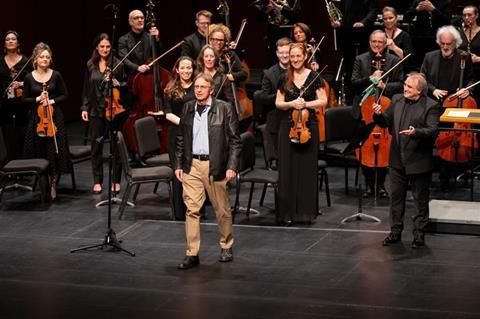
The composer of String Theory and countless chamber music pieces, Gernot Wolfgang discusses his latest string quartet Make It Real! and the power of folding ’grooves’ into chamber and orchestral music.
’I’d rather like to think of it as Lutosławski having a chat with the members of Weather Report,’ says Wolfgang. His concert works have been programmed by the Los Angeles Philharmonic, Berlin Philharmonic, Los Angeles Chamber Orchestra, Seattle Symphony, Kansas City Symphony, Santa Barbara Chamber Orchestra, Las Vegas Philharmonic, Kyushu Symphony (Japan), Sydney Symphony (Australia), Münchner Rundfunkorchester (Germany) and the Symponieorchester Vorarlberg (Austria), receiving over 1,000 performances worldwide so far.
He speaks to Richard Linnett about his two string quartet works, as well as his compositional process.
Tell us about your new string quartet work, which you have just finished composing
I had just come off a movie orchestration job, and after this kind of intense work I experience I high level of momentum. It’s like training at altitude for an athlete. You must be fast, accurate, and the result has to sound very good. So, I used that moment to write a string quartet, since I hadn’t written a chamber piece for strings in a while.
What’s the inspiration behind the piece?
I mapped out the piece during a hike, the general idea was to give lyrical, yet expressive and slightly abstract solo passages to each of the players. These sections would then be separated by groove-oriented ensemble passages.
As I was writing, the lyrical passages turned out to be somewhat dreamy and aspirational, which led to me to the idea that they represented day dreaming, visualisation of goals, making plans. The subsequent, energetic groove passages then portray the realisations of these goals. Thereby the title of the piece - Make It Real!
What was your process composing the piece?
I usually work out ideas in my head to a certain degree and then start writing directly into the computer. Logic Pro is my DAW (Digital Audio Workstation) of choice, and it affords me good playback possibilities using sampled instruments. The playback is most helpful in determining the form of a piece, but I had to learn to listen past the inferior sound of the samples (as compared to the wonderful sound of the real instruments) to stay connected to the music.
Once I am happy with the results of my composing, I transfer the midi information stored in the Logic file into Sibelius and create professional looking score and parts. The important thing when working this way is always to keep in mind the strengths and limitations of the real instruments, since the combination of computer and samples can almost do anything, technically.
How does this new piece compare to String Theory?
String Theory was written in 2013, and in the meantime, I have evolved as a composer. While I still stand 100 per cent behind what I wrote then, the new piece reflects my present state of mind. The harmonies I used in both pieces are related, but - besides String Theory being in four movements, while Make It Real! is one continuous piece - the main difference between the two might be that I am now more resolute about my musical decisions. The lyrical passages feel more lyrical now, and the groove sections have a higher degree of rigour.
String Theory is beautiful and dynamic, with echoes of Bartók and John Adams. Tell us about the inspiration behind that
Bartók and John Adams are some of my favorite concert composers, and elements of their work have certainly slipped into this piece. In fact, the first movement is dedicated to Béla Bartók.
Why have you written only two string quartets?
Often opportunities, like commissions or the potential for a recording, have dictated the instrumentation that I was writing for. I have had more opportunities that involved woodwind instruments. However, I have a number of compositions combining strings with piano and/or winds.
Who are your favourite composers for strings?
There are so many. If I had to name three, it would be Bartók, Shostakovich and Lachenmann. I also love the violin concertos by Esa-Pekka Salonen and Gabriela Ortiz.
Who are your favourite string performers?
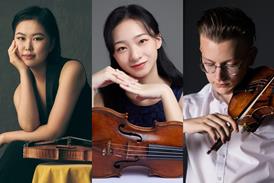
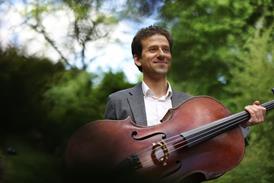
Again, so many. A highly incomplete list would include violinists Leila Josefowicz, Maria Dueñas and Tereza Stanislav, violists Paul Neubauer and Yura Lee, cellists Yo Yo Ma, Paul Watkins, Ben Hong and Andrew Shulman, and jazz bassists like Christian McBride and Ron Carter. Apologies to the wonderful musicians that I’ve collaborated with who I didn’t mention here, due to space constraints.
What do you hope to do with the new quartet?
I will offer it first to string players/quartets I know personally and eventually plan a recording project.
What are the challenges of writing for strings, say in comparison to writing for wind instruments?
Both instrument groups have their own composing challenges. What is easy to play for one, can be tricky for the other. Just as examples, octave down slurs are easy for violin or viola, but can be hard for some wind instruments. On the other hand, intricate, fast-moving chromaticism is harder for string instruments than for winds, especially in higher registers.
Tell us about your ‘groove’ philosophy? Have you applied it to your string compositions?
The primary reason for me to get into contemporary classical composing was the prospect of integrating grooves from jazz, rock world music etc into a chamber music or orchestral idiom, while making sure that the result would still be within - or close to - the comfort zone of a classically trained musician.
Grooves are present in all my compositions for strings. Since you mentioned String Theory, the fourth movement of this piece, Nashville, would be a good example.
In your opinion, what is the future of chamber music today, particularly strings, does it need more ‘groove’ to survive and thrive?
I wouldn’t answer the groove aspect of your question with a blanket ‘yes’. Yes only if they are utilised by composers who feel a deep connection to them and see them as indispensable devices for expressing themselves (which is the case for me).
But I think the larger way forward is for every composer to stay true to their own convictions and preferences about music. Following that path will produce honest music, and in the end truth wins.
You compose quite a bit of jazz; how do you alternate between chamber music and jazz?
I used to write lots of jazz tunes and arrangements, but these days jazz resides within my concert music. Whether it’s in subtle form, or obviously recognisable, it’s always there.
You also orchestrate a lot for film and TV. Is this work as inspired and fulfilling for you as your chamber work?
Yes, in a different way. The goal is to make the material that I receive from composers sound as good, and as close to their vision, as possible. That is a fun task.
I am typically part of a team of four to six orchestrators, since the work load on most projects would be too much for one person to handle. My orchestrator colleagues are all fantastic at what they do, and I enjoy being in their company. The whole process is very collaborative.
Do you plan to compose more string compositions? A symphony perhaps?
Yes. A symphony would be a good challenge, but number one on the list would be a violin (or viola, or cello) concerto.
Any parting shots, advice or comments for Strad readers?
I think we might live in the best of all times for contemporary classical music. Dogmatic schools of composing have largely come and gone, so we presently live in a musical age of individualism. This creates a variety of styles within the genre, and audiences have the opportunity to take advantage of the smorgasbord of vastly different sounding music offered by living composers. Go, and listen to what’s out there!
Read: Violinist Daniel Lozakovich: lost to the world, led by the heart
Read: ‘Chamber music at its finest is an act of generosity’: Daniel Hope on shaping Wolf Trap
Read more Featured Stories like this in The Strad Playing Hub












No comments yet