














Celia Cobb reads Annelle K. Gregory’s book of advice to string players on how they can use their practice time most effectively and combat stage fright, among other things
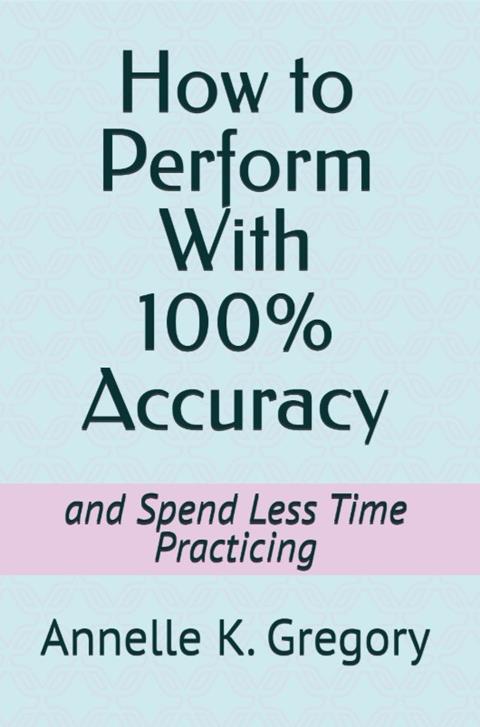
How to Perform with 100% Accuracy and Spend Less Time Practicing
Annelle K. Gregory
276PP ISBN 9798265070555
INDEPENDENT $14.99
This book is a practical guide for players who want to learn how to improve their performances by streamlining their practising and preparation techniques. It covers everything from strategies for making practice sessions more efficient and practical hints about specific aspects of technique, to dealing with concert-day situations (including thinking about shoes, hair and make-up, and how to accept flowers on stage). Most of the advice offered in the first half of the book is string-specific, although the remainder contains plenty that will be of interest to musicians in general, including sections on musical matters such as interpretation and intonation.
A key part of the section about making practice time more efficient and effective focuses on what the author calls the 51 per cent ratio. Using a rather charming marbles-in-a-jar metaphor, the author explains the idea that in order to eliminate mistakes from specific sections in performances, students must have played the passage many more times correctly than incorrectly: ‘The goal is to ensure that at least 51 per cent are green “correct” marbles in order that we have a greater than 50/50 chance of playing without mistakes on stage.’
Memorisation is also an important part of the advice given about effective performance preparation, with the author recommending a process of ‘spaced repetition’ in order to combat the human tendency to forget new information over time. She suggests using a strategically planned schedule of review in carefully spaced intervals when learning new repertoire, and notes that the method can also be applied to memorisation as well as learning.
‘Using this method, it takes no longer to learn two pieces than only one… and you may find that you no longer have to consciously work on memorising a new piece because reviewing the material in intervals has done that automatically for you!’
Read: 7 techniques to combat stage fright
Read: Performance anxiety: Fighting stage demons
Read: Release the Fear Monster: how to conquer performance anxiety and perform at your best
The book also deals with the psychological side of performance, discussing pre-performance nerves and stage fright, and how to avoid negative self-criticism by using mistakes to build confidence. As well as the mental aspect of performance, the importance of the ‘visual art of performance’ is highlighted; performers are offered guidelines about how to present themselves for success, including tips on appearance, taking a bow, and managing the walk to the platform.
The text itself is very easy to read, not least because of the satisfying layout, which presents bite-sized paragraphs interspersed with plenty of musical extracts and the occasional graph. The writing style is open and friendly, in the manner of a kindly mentor imparting wisdom to a younger student: ‘Here is everything I know about music. Let us begin our journey.’
The chapters in the first half of the book are organised alphabetically within sections, which may suit those who wish to dip in and out, but occasionally makes for a slightly clunky experience for those who prefer to read sequentially.
Available in hardback, paperback or as an e-book, this book is a valuable collection of ideas and advice that all performers, particularly string players, are likely to benefit from reading.
CELIA COBB












No comments yet