






Robin Stowell reads composer Robin Holloway’s colossal survey of the whole Western classical music tradition, replete with the author’s own reflections and opinions
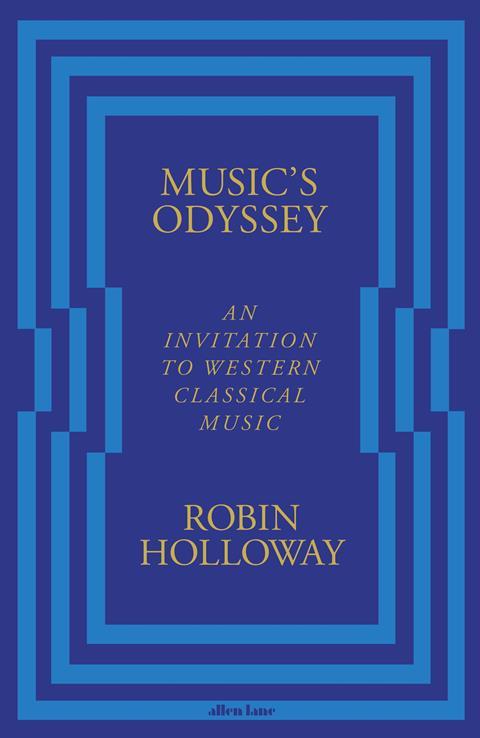
Music’s Odyssey: An Invitation to Western Classical Music
Robin Holloway
1232PP ISBN 9780241183014
ALLEN LANE £35
Robin Holloway records his odyssey in 20 chapters, some chronologically ordered and others aligned to composer nationality. His logbook is intended as an appreciation, rather than a history, of the diverse works experienced during his lifetime of musical engagement. Beginning with an autobiographical section, his volume also has autobiographical leanings, its need for selectivity encouraging him to forge a personal path through the dense musical jungle.
‘Drunk on Debussy, Mahler and modernism’ as a teenager, he describes himself largely as a musical Hun: ‘“Bach to Brahms” with a 20th-century extension for Strauss, Mahler, Schoenberg and his great pupils and a special cathedral dedicated to Bruckner.’
Holloway’s text alights briefly on focal works for the principal composers discussed. Some of his choices are predictable mainstays, while others are slightly off-piste; his opinions veer from discerning to contentious. He occasionally breaks his journey for brief composer comparisons and ‘nexuses’ revealing connections between composer pairs.
Overall, though, he seems to have bitten off more than he can comfortably chew. He repeatedly apologises for employing ‘drastic selectivity’ and ‘compression’ and often resorts to notes, especially for his ‘telegrammatic’ biographies. Moreover, he clearly feels restricted when assessing 20th- and 21st-century repertoire, the very period about which his views would be most valued; he admits to ‘skimping’ Messiaen’s oeuvre, for example, and he regrets that his overview of the postwar avant-garde is limited to ‘six staccato vignettes’.
Coverage of Baroque, Classical and early 19th-century concertos is virtually non-existent; after Brahms’s Violin Concerto, though, Elgar’s ‘rather overblown’ work and the ‘indifferent, even mediocre’ material of Sibelius’s are outshone by Walton’s ‘Cadillac with silver fittings, custom-built for Jascha Heifetz’.
Schoenberg’s is ‘strong and assertive, admitting no amelioration’, Stravinsky’s ‘perhaps the finest fruit’ of interwar neoclassicism and Berg’s ‘a key icon of musical modernism’s problems and their solutions’; but Prokofiev’s ‘magical’ First Concerto surpasses its successor’s ‘detached drollery’ and Delius’s three concertos (violin, cello, and violin and cello) ‘fall flat on their faces for argument’.
Walton’s ’masterpiece of passionate, elegiac, melancholy introspection’ heads the viola concerto parade and Elgar’s tops that for the cello for its ‘wide range of mood, tone, expression, on fresh living material’. In sharp contrast are Schoenberg’s Baroque reworkings, Lutosławski’s Concerto and Dutilleux’s Tout un monde lointain.
The Strad Recommends: Alda Dizdari: Robin Holloway
Read: East vs West: differences in string teaching approaches
Read: How the violin trade has changed since the Queen’s accession
Holloway rates Bartók’s Solo Violin Sonata as the ‘finest fruit of his veneration for Bach, in spirit not letter’; but Elgar’s violin/piano sonata is ‘overwrought and turgid’, Delius’s three ‘give hostage to the blasphemer’, Ravel’s is ‘very variable’ and Elliott Carter’s Duo ‘rebarbative and unrewarding’. More positive opinions are voiced about Enescu’s sonatas, Stravinsky’s Duo concertant and Ravel’s violin/cello duo.
String quartets barely feature until Beethoven’s last works, Holloway considering op.127 ‘flawless’ and op.131 Beethoven’s ‘single greatest composition’. He seems unjustly scathing about the ‘problematic’ opp.130 and 132, both veering ‘from sublime to ridiculous’. Other quartets under his microscope include those of Franck (‘his greatest work’), Schoenberg (no.1 among the genre’s peaks), Shostakovich, Webern (‘charmless…all scaffolding…rigor mortis’), Fauré, Ravel (‘like a graduation piece’), Debussy (‘relatively faceless’), Ives, Ruth Crawford (‘a monument of rare distinction’), Elliott Carter (no.3’s ‘negation of chamber music as civilised conversation’) and Ligeti’s ‘overrated’ no.2.
Holloway’s Envoi fantasy about a common practice for composition from c.2000 onwards seems bizarrely superfluous. Intended for browsing, his massive tome requires a detailed index (unavailable in my advanced reading copy) for optimum reader-friendliness.
Despite the author’s excessive ambition, his text abounds in perceptive insights, offers an innovative, integrated and entertaining overview of composers’ ever-changing styles and amply fulfils its aim of deepening enjoyment and enriching the understanding of music history and structure.
Robin Stowell









No comments yet