


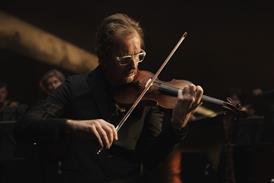











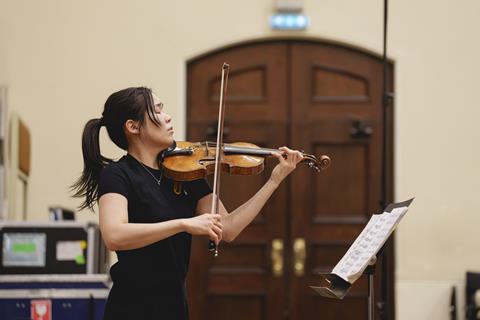
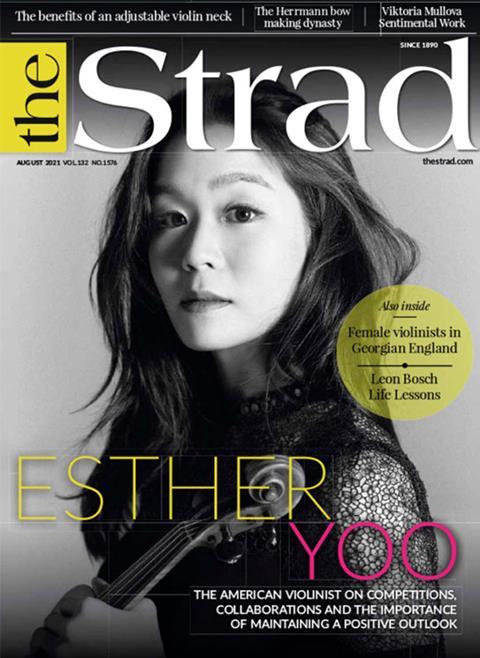
With her new album released just ahead of Valentine’s Day, violinist Esther Yoo explores love in its widest sense – from Plato’s ancient philosophies to the bonds of family, friendship, nature and self
Read more Featured Stories like this in The Strad Playing Hub
What is love? Violinist Esther Yoo sets out to explore its many forms in her new album Love Symposium. Timed for release on 12 February, just ahead of Valentine’s Day, the album presents a series of works that each capture a different facet of love.
Yoo’s selections range from the philosophical ideas expressed in Plato’s Symposium, which inspired Leonard Bernstein’s enduring Serenade (after Plato’s ’Symposium’) and appears on the album, to reflections on love of nature, family, friends, romantic partners and the essential act of learning to love oneself.
As well as Bernstein’s monumental work, the new album also includes a new chamber arrangement of the Adagietto from Mahler’s Symphony no.5, plus Vaughan Williams’s ever-popular The Lark Ascending, Elgar’s Salut d’Amour, and ‘Never Enough’ from The Greatest Showman.
Yoo shares her insights on her new album with The Strad.
Love Symposium explores many different forms of love beyond the romantic. What drew you to the idea of presenting love in such a broad way?
As I was studying Bernstein’s Serenade, I was quite fascinated by the piece and its source of inspiration: Plato’s Symposium, a philosophical dialogue about love. Through performing the Serenade and learning more about Plato’s Symposium, I was inspired to explore love through both a philosophical lens and a deeply personal one. We often think of love in music as something purely romantic and idealised, but I wanted to create a sound world on this album where we experience real, honest, complicated, messy, relatable love.
Leonard Bernstein’s Serenade (after Plato’s ‘Symposium’) sits at the heart of the album. How has your relationship with this work evolved since first learning it, particularly after performing it for your New York Philharmonic debut?
Bernstein’s Serenade is a piece that I love – both for the music and for the meaning behind the music. I really enjoy how Plato’s Symposium is a philosophical analysis on love, while Bernstein’s Serenade, although reflecting on the Symposium, is such an emotional piece and you can hear his own feelings about the Symposium through the music as well.
I made my New York Philharmonic debut with this piece which was an incredibly significant moment for me. Getting to play Bernstein with the NY Phil – an orchestra with a deep connection to Bernstein whose musicians understand his music so well – was particularly meaningful. I was also very touched and honoured to meet Jamie Bernstein who attended one of the concerts and was so kind and lovely.
I am really looking forward to performing it with Marin Alsop and the Philharmonia Orchestra for a UK tour together in November 2026.
You’ve commissioned a new chamber arrangement of Mahler’s Adagietto. What personal connections influenced this decision, and how does the intimacy of this new version change the way you experience and perform the piece?
The new arrangement of Mahler’s Adagietto was inspired by a personal experience which consequently made me feel the piece in a completely different light. Because I developed quite an intimate relationship with this movement of the Symphony, it inspired me to think about creating an intimate version, which led me to explore a chamber music version.
Iain Farrington, who so beautifully arranged the piece, and I had many discussions about how we were going to do this, and we wanted to make sure that we stay respectful and faithful to Mahler, the score and his intentions.
I was so happy to be able to share this arrangement with the wonderful musicians of the Royal Philharmonic Orchestra and recording it together was a very special experience. This piece on the album is the closest to my heart in many ways: my own love letter through Mahler’s.
From Vaughan Williams and Elgar to a song from The Greatest Showman, the album spans eras and styles. How do you see these diverse works speaking to one another, and what do you hope listeners ultimately take away from Love Symposium as a journey through love?
Through Love Symposium, I am inviting listeners to open their hearts and minds to the love that has shaped them. Each piece on this album represents a different kind of love that I have experienced in my life so far and my hope is that listeners find a piece of their own story within these works, remembering that music is the universal language that binds us all across time.
Love Symposium with Esther Yoo, the Royal Philharmonic Orchestra and Long Yu is out on Deutsche Grammophon on 12 February 2026.












No comments yet