
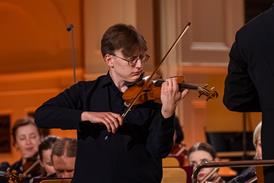





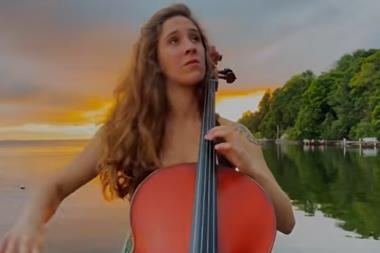
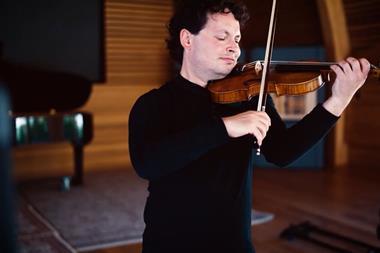
The first performance of Aus Licht gewoben / Woven from Light which David Philip Hefti wrote for Hellen Weiss and myself was many things: exciting, challenging, fulfilling, daunting. But more than anything else it inspired the gratitude of having lived a very special moment in our musical lives.
Just as the connection with David Philip himself clicked immediately even before the first note was written, the encounter with his new work was love at first sight. The writing spoke to us so clearly and immediately and the more we rehearsed and dove into the music, discovering its hidden corners and getting acquainted with its secrets, the more we started being utterly convinced by it and caring deeply for the piece.
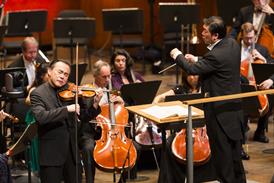
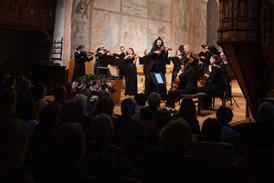
So we were thrilled to have the fantastic venue of the Elbphilharmonie Hamburg for its premiere, which perfectly fit the light-inspired title and the classy, intricate sound world of this music.
But even more importantly, we were overjoyed that the music seemed to speak as clearly to the audience as it had to us, as we could feel the enthusiastic reception of this new work during and after its performance!
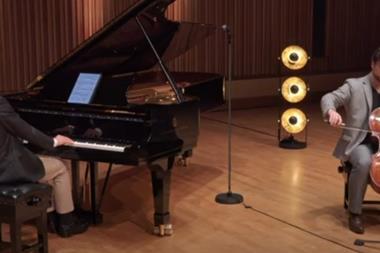
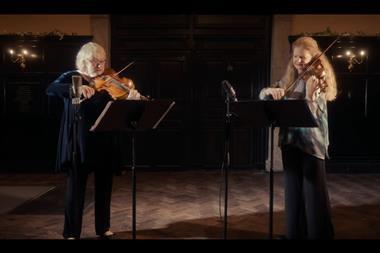
This listening guide accompanies the video recording of the world premiere on 2 March 2026.
00:00 Part I
The score marks scintillante - The work opens with shimmering, sparkling sounds played in arpeggiated harmonics on both instruments. Reflections of sunlight on wavy water, stars glistening on a dark night’s sky… No two bars are ever the same as the subtle modulations of the sound colour of these arpeggios through changing of the position of the bow and the finger pressure in the left hand keep things constantly shifting and transforming.
Soon you’ll hear motives breaking out from this pattern (00:23, 00:37). The juxtaposition of the ’sound carpet’ (as the composer calls it) with the contrasting figures standing out in front of it is an important part of the dramaturgy of this piece, as are the disparity or complete harmony of gestures in the two instruments, sometimes unexpectedly stopping and re-starting the music (00:27, 01:12).
The first part keeps exploring these ideas, shifting harmonic colors through new combinations of chords and harmonics like a kaleidoscope and expanding on both voices’ moments of independence from the floating arpeggios.
03:37 ’Furioso’
Having exhausted the material from the first part, a furious transition erupts out of nowhere with both instruments hurling sharp accents at each other and finding themselves – just as abruptly as this transition had begun – in a completely different world.
03:51 Part II
An striking stillness takes hold after the momentum-driven first part. The low G-string in the violin and high A-string in the cello are at the centre – a symbolic moment as here the registers cross and the violin becomes the lower voice of the two.
The glissados surrounding these notes (04:05) sound almost eerie before we pick up the theme of harmonics again, however in a completely new light.
In between the long drones being handed over from one voice to the other, ethereal harmonics start to bloom, first shyly, tenderly (04:24, 04:46) before taking complete hold of the music (05:50). This passage is followed by a variation on it (06:17) in which the subtle pulsating of the left hand makes for a very different experience – the sound of pulsars emitting light in outer space?
07:00 Each instrument shares a few longing thoughts in a more sensuous, lyrical sonority before they join together in a brief moment of harmonic density and richness (07:46). The sound starts to tremble (08:00) and leads into the final section of the piece.
08:04 Part III
The last part is dominated by strong and unrelenting rhythmic energy. The music has several metric layers that provide complexity: while the motive itself moves in groups of three, the metre is in four and the patterns of both instruments are permanently shifted against each other, adding to the overall excitement.
The material for the pattern is taken from a 12-tone row which is cleverly concealed by circling back within the row and regularly abandoning it altogether. However, the underlying row provides a sense of stability to the listener’s ear.
This pattern is constantly interrupted by irregular, fast moving outbursts (08:22, 08:33) which break the symmetry and sense of predictability. Again, the music is enriched by material which seems to stand out against the established background.
These moments come in many shapes and forms, such as harmonics in tremolo (08:48), glissandos or a motif of syncopated double stops which seems to truly swing with the pulse (08:58).
The four-note motif that has been carrying the music so far goes through two stages of transformation: First, it is turned into a five-note figure by repetition of the first note (08:58), adding tightness to the texture. Then, in the next stage, that second note is changed from a note belonging to the 12-tone row to one foreign to it, increasing the complexity and density of the music (09:30).
The music keeps pushing forward, both instruments seemingly chasing one another without ever quite catching up. In a final stretta (10:41), marked by the sound drifting in and out of the sul ponticello colour, this chase becomes ever more unhinged, before coming to an abrupt stop on a high, dissonant chord (10:58). Finally, the piece ends with a sweeping, brilliant gesture (11:05).
This incredible work explores the possibilities of the violin and cello duo in a new and original way and I am convinced that it will earn an important spot in the repertoire for this combination.








No comments yet