
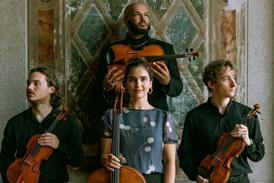

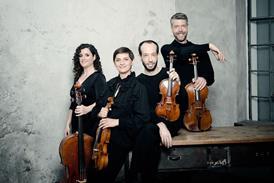
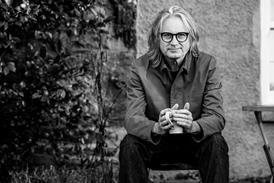




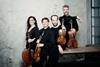
Ensemble Diderot’s upcoming Wigmore Hall debut explores the trio sonata’s cosmopolitan peak, uniting French, Italian and German influences through works from Bach to Vivaldi. Artistic director and violinist Johannes Pramsohler shares insights on the programme
Read more Featured Stories like this in The Strad Playing Hub
When I first envisioned the programme for Ensemble Diderot’s Wigmore Hall debut, I wanted it to do more than simply present some of the most beautiful works in our repertoire.
We wanted to focus on a snapshot of the trio sonata at its high point, exploring the form as it reached its most accomplished expression in Bach’s German world, a cultural melting pot where Italian, French, and local German influences converged. This repertoire lies at the heart of Ensemble Diderot’s work, and in this programme we highlight how these stylistic currents intersect and interact.
For me, this programme is more than an exhibition of repertoire; it is a living history of the trio sonata, revealing the subtle evolution of style, technique, and expressive approach from Couperin and Leclair through Bach, Goldberg, Handel, and Vivaldi. By performing both canonical masterpieces and lesser-known works, we hope to challenge assumptions about the Baroque repertoire.
Many of these pieces survived only in fragile manuscripts, and bringing them to life requires both scholarship and empathy for the composers’ intentions. Each work is a small world, with its own logic, colour, and expressive priorities.
In Ensemble Diderot, our research informs performance in tangible ways. When we uncover a variant in a manuscript or an unusual ornamentation, we experiment, testing how it sounds, how it balances with the other instruments, and how it interacts with phrasing. These discoveries shape bowing, articulation, tempo choices, and dynamic nuances.
For me, performing is inseparable from inquiry: every rehearsal is an opportunity to bridge the gap between historical knowledge and musical intuition, creating performances that feel both informed and alive.
Another aspect I cherish is the interplay of cultural influences visible in these works. French elegance, Italian virtuosity, and German counterpoint intersect across this programme. Bach absorbed Italian ideas; Leclair married French style with Italian technique; Handel traversed the continent, synthesising diverse idioms; Vivaldi’s innovations circulated far beyond Venice.
Exploring these cross-border connections reminds us that Baroque music was a networked, cosmopolitan art form, and performing these pieces today is a way of tracing those intricate lines of influence.
Ultimately, what drives me is the sense that performing these trios is not just about technical mastery, but about telling the story of musical evolution and human curiosity. From the soaring lines of Bach to the rhythmic vivacity of Vivaldi, each sonata invites both reflection and joy.
Our Wigmore programme is a snapshot of a larger narrative, one that encompasses pedagogy, stylistic innovation, and the search for musical expression across borders and generations.
Our programme opens with Bach’s Trio Sonata in C Major, BWV 529. Originally composed for organ, these trios represent some of Bach’s most intricate and challenging contrapuntal writing. They were used pedagogically, forming part of the exercises Bach employed in teaching his sons and pupils, including Johann Gottlieb Goldberg. Every line carries its own melodic integrity, demanding both independence and perfect integration with the others.
For performers, the organ setting presents particular technical challenges, and unfortunately, no trio sonatas by Bach survive for two violins and continuo. Adapting BWV 529 for our ensemble brings us as close as possible to the sound world and structural complexity of Bach’s trio writing, allowing us to explore the rigorous interplay and expressive depth that made this form central to his teaching and compositional mastery.
Juxtaposed with Bach is Jean-Marie Leclair’s Trio Sonata in D Minor, Op. 4, No. 3, which introduces a strikingly different palette. Leclair, the most important French violinist of the eighteenth century, absorbed Italian virtuosity while retaining an unmistakably French sense of proportion and refinement.
What is particularly remarkable is that the fugue from this very trio sonata appears in Johann Friedrich Marpurg’s theoretical writings as a model of fugal construction, an astonishing testament to the esteem in which German theorists held Leclair’s work. That a French violinist should be cited as an authority on fugue speaks volumes about the permeability of stylistic borders at the time.
For violinists, Leclair remains a central figure: his writing combines elegance with discipline, a kind of classy rigour in which dance, counterpoint, and virtuosity are held in perfect balance. This synthesis is exactly what makes the piece indispensable to us and so revealing within the context of Bach’s cosmopolitan musical world.
One of the central pillars of our repertoire is the C Major Trio Sonata by Johann Gottlieb Goldberg. The mythology surrounding Goldberg – the prodigy, the ’keyboard monster’, the melancholic genius – has long distracted from the quality of his music, yet this sonata stands remarkably close to the summit of the trio sonata tradition.
Its long-breathed melodic writing, rhythmic independence, and rigorous contrapuntal design place it in direct dialogue with Bach’s late works, so much so that it circulated early on under Bach’s name. The monumental fugal writing reveals a composer for whom counterpoint, harmony, and melody remain inseparable.
For an ensemble working in the standard scoring of two violins and continuo, Goldberg’s trio sonatas bring us closer to Bach than Bach himself allows us to come, as no trio sonatas for this instrumentation survive from him. That is why this sonata has become one of our warhorses: it does not merely reflect Bach’s world, it actively extends it.
The programme then turns to French Baroque with François Couperin’s La Convalescente, a work whose place here is anything but incidental. Far from standing apart stylistically, this early version of L’Impériale reveals how deeply Couperin had absorbed the Italian trio sonata idiom, standing remarkably close to the Corellian ideal.
Its connection to Bach’s world is concrete: the fourth movement (Air gracieusement) reappears in an organ trio attributed to Bach (BWV 587), almost certainly transmitted via the Dresden court. The manuscript was copied in Paris in 1714 by Johann Georg Pisendel, whose musical discoveries circulated widely among German musicians and may well have reached Bach himself.
For us, La Convalescente exemplifies the permeability of borders in Bach’s German milieu, French elegance, Italian structure, and contrapuntal thinking coexisting naturally.
This German connection continues with George Frideric Handel’s Trio Sonata in F Major, HWV 392, a work that, though Italianate in style, is deeply rooted in the German musical networks of the early eighteenth century. It was likely composed for Johann Georg Pisendel, the virtuoso concertmaster of the Dresden court, who probably used trio sonatas as rigorous training exercises for his musicians.
Though Dresden was primarily an orchestral rather than chamber-music city, this method of working on small-scale, contrapuntally demanding pieces is what helped the orchestra attain its remarkable technical precision and expressive flexibility, making it one of the finest ensembles in Europe at the time.
Vivaldi appears twice in the programme, first with his Trio Sonata for violin and cello in G Major, RV 820, and later with the celebrated La Folia from op.1, no.12 in D Minor. Beyond their rhythmic vitality and harmonic inventiveness, these works are deeply connected to the wider German musical world: Vivaldi’s music was known and admired at the Dresden court, and Bach studied, copied, and even modeled his own concertos on Vivaldi’s works.
Performing these trios convincingly requires more than energy; it demands an understanding of Vivaldi’s idiomatic writing for violin and cello and the improvisatory spirit expected of performers in his day.
In our programme, the G Major trio functions almost like a sorbet amid a meal of weightier works, a refreshing interlude of clarity, wit, and charm, while La Folia immerses us in Vivaldi’s fiery variation technique, balancing expressive freedom with structural precision.
By the time the final notes of La Folia fade, I hope the audience has felt more than the pleasure of listening. I hope they have glimpsed a timeline of creativity, of ideas transmitted and transformed, of manuscripts discovered and revived.
Performing these works with Ensemble Diderot is a privilege: it allows me to participate in an ongoing conversation between the past and the present, between scholarship and performance, and between composers whose voices continue to resonate centuries later.
For us, the trio sonata remains both a challenge and a delight, a form that constantly rewards curiosity, research, and the shared joy of making music. Wigmore Hall offers the perfect space for this journey, where every line, every interaction, and every carefully considered ornament can speak clearly to those who listen closely.
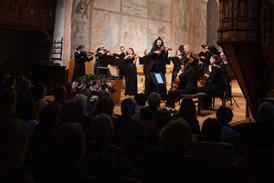
Ensemble Diderot performs ‘Bach beyond borders’ at Wigmore Hall on Monday 30 March, 7:30pm. More information and livestream can be found here.
Read: ‘I had to be tamed’ - Johannes Pramsohler’s life lessons
Watch: A jaunty performance from early music specialists Ensemble Diderot
Read more Featured Stories like this in The Strad Playing Hub







No comments yet