











Isaac Albéniz’s Asturias (Leyenda) occupies a curious position in the repertoire. Although now widely associated with the guitar, the work was originally composed for piano in G minor, with writing that evokes guitar techniques. It was first published simply as Prelude, the opening piece of Chants d’Espagne (1892).
Only after Albéniz’s death did the German publisher Hofmeister include it in the expanded 1911 edition of Suite española under the title Asturias (Leyenda). Ironically, the music evokes not the northern region suggested by the title, but rather the sound world of Andalusian flamenco.
The piece later entered the guitar repertoire through transcription – often associated with Francisco Tárrega, who placed it in the guitar-friendly key of E minor –and was later popularised by Andrés Segovia. The work has since invited adaptations for other instruments, including this solo violin arrangement by Xavier Turull in D minor.
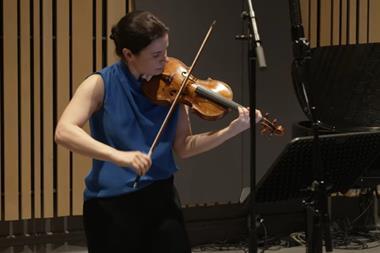
In the opening of this solo violin arrangement, the bow articulates the pedal point while the melody emerges on adjacent strings, producing a contrast similar to the separation between bass and treble strings that a guitarist achieves by alternating thumb and fingers. I recreate this texture with a light spiccato, using a small bounce of the right wrist and fingers while keeping the elbow at the level of the lower string.
Occasional sforzati on the first beats imitate the strong rasgueado (a guitar finger strumming technique) gesture of the guitar, and I place them slightly after the beat for clarity and effect. Later passages imitate the guitar texture using a 3+1 ricochet bow stroke on the violin: three down-bow bounces followed by a quick up-bow. This stroke relies largely on the natural elasticity of the bow, with the player simply guiding the rebound close to the string. At the end of these passages, I change to all up-bows in a gentle, floating up-bow staccato, allowing the line to broaden into a rallentando.
A contrasting section introduces a different colour through double pizzicato, something I had not previously encountered in the violin repertoire. Here, the violin closely imitates the plucked sound of the guitar. I use two fingers – thumb and index – to produce simultaneous pizzicato on the G and E strings. At other moments, I alternate left-hand pizzicato with right-hand pizzicato, using the index, middle finger, or thumb at different moments for the chords. Slightly arpeggiating the chords helps sustain the sound and shape expressive rubato. Feeling the tension of the string before release helps control the timing, and vibrato can help sustain the fast-decaying pizzicato sound slightly longer.
At the end of the piece, I experiment with another small adaptation: introducing vibrato on the final open string by subtly oscillating the instrument. The effect is subtle but allows the sound to retain warmth and movement even without the left-hand finger. Such solutions illustrate how performing an adaptation from another instrument can inspire an imaginative translation, allowing the violinist to evoke the original character while remaining idiomatic to the instrument.
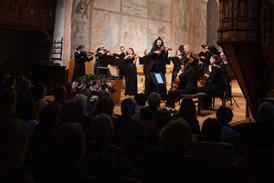
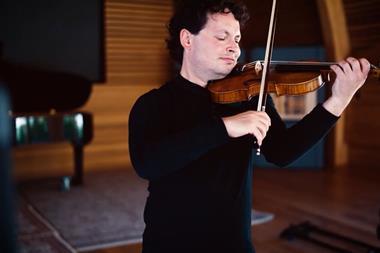
I recorded this work in Madrid during my Fulbright sabbatical in Spain. I have also performed it recently in an arrangement for string quartet by Werner Thomas-Mifune with Chamber Music Amici, joined by my Spanish colleague Juan Luis Gallego during his visit to Oregon.
Each time I play it, I am reminded of the tablao flamenco performances I experienced in southern Spain and my visits to the Alhambra in Granada and the Real Alcázar in Seville, whose intricate Moorish architecture and filigree-like ceilings echo the ornamental character of the music.
For me, Asturias becomes not only a technical exploration but also a reminder of how musical ideas travel across instruments and cultures.














No comments yet