
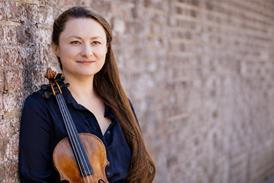




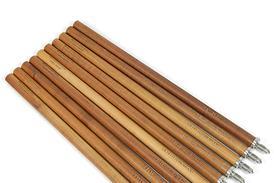

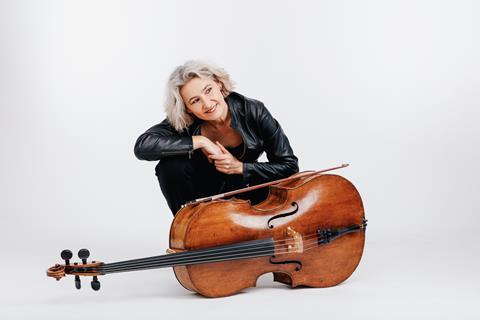
The cellist and composer speaks to The Strad about her new album of original works, Inner Voice, which stemmed from her exploration into jazz and improvisation
Discover more Featured Stories like this in The Strad Playing Hub
Asja Valčić is a cellist and composer who has released her ode to the cello, the album Inner Voice. It was recently nominated for the German Record Critics’ Award, and comprises Valčić’s original compositions, which she considers an exploration of the natural sound possibilities the cello has to offer.
One can hear this in the track ’Free Spirits’ which is composed solely of harmonics, to the expressive breadth represented in the flamenco-inspired ‘Love Story.’ Valčić explores themes such as home, freedom, love, and the peace of finding an ’inner voice.’ She showcases groove-driven passages, lyrical melodies and the use of aural space.
Valčić spoke to The Strad about her musical life, in which she departed from a career in classical music to one involving jazz and improvisation, and how her album took shape.
Can you tell us about your musical journey, and what led you from a classical career to improvisation and jazz, as well as composition?
After my studies in the USA, Moscow and Detmold, I eventually settled in Vienna. At that time, I found a very exciting musical environment, as different styles were beginning to merge. The city offered a wonderful atmosphere with an incredible number of musicians from all countries and genres, which was deeply inspiring for me. Already as a classical cello student in Zagreb, when I regularly attended the Zagreb Jazz Festival, I felt a strong attraction to improvisation – it had always held a magnetic pull for me.
At first, I was hesitant to explore music outside the classical world, simply because that world was unfamiliar to me. But my respect for improvisation grew stronger, and my first steps soon led me into the crossover field. Very quickly I met the colleagues with whom I founded the Radio String Quartet Vienna. Together we released five albums on ACT, one of Germany’s most renowned jazz labels. Almost in parallel, I began a duo collaboration with the wonderful accordionist Klaus Paier, which has now lasted for 16 years. We have recorded four duo albums, as well as one quartet and one trio release.
Other inspiring collaborations followed, for example with the celebrated Finnish pianist Iiro Rantala, with Joachim Kühn, and with his late brother Rolf Kühn.
Over time, my fascination for improvisation became so strong that I felt compelled to fully embrace this path. For me, improvisation is nothing other than composing in the moment – and composition is the natural continuation of that process. It opened up another voice for me: an inner voice that I sometimes hear, if I am lucky, when I compose.
For me, improvisation is nothing other than composing in the moment – and composition is the natural continuation of that process
How is the title of your album reflected in the techniques and methods you have used to celebrate the cello?
The title Inner Voice reflects both the intimacy of the solo cello and my personal journey. Playing alone gives me the freedom to explore the full range of the instrument – from lyrical, singing lines to percussive effects and extended techniques. These sounds often feel like an inner dialogue, as if different voices within me are speaking through the cello.
In composing and improvising for this album, I wanted to capture that inner voice – sometimes fragile and delicate, sometimes powerful and raw. The cello becomes not only my instrument but also my partner, allowing me to give form to emotions and thoughts that cannot be expressed in words.
How do your compositions take shape? Are they largely improvised and different each time you perform and record, or do you notate anything down?
For me, composition and improvisation are very closely connected. Often a piece begins with an improvised idea – a melody, a rhythm, or even just a certain atmosphere – which I then shape further. All of the pieces on this album are fully notated, and I also publish them as sheet music, available both digitally and physically through my website.
Within each piece, however, there are still sections left open for free improvisation. In the sheet music I sometimes also include my own improvised passages, written down afterwards, so that cellists who may not yet have much experience with improvisation can gain a first impression of how such moments might be shaped.
Inner Voice is out now on Quinton Records.
Watch: Cellist Santiago Cañón-Valencia performs his own composition, ‘Ouróboros’
Read: Top 5 reasons why more string players should compose: Jessica Meyer
Discover more Featured Stories like this in The Strad Playing Hub
The number one source for playing and teaching books, guides, CDs, calendars and back issues of the magazine.
In The Best of Technique you’ll discover the top playing tips of the world’s leading string players and teachers. It’s packed full of exercises for students, plus examples from the standard repertoire to show you how to integrate the technique into your playing.
In the second volume of The Strad’s Masterclass series, soloists including James Ehnes, Jennifer Koh, Philippe Graffin, Daniel Hope and Arabella Steinbacher give their thoughts on some of the greatest works in the string repertoire. Each has annotated the sheet music with their own bowings, fingerings and comments.
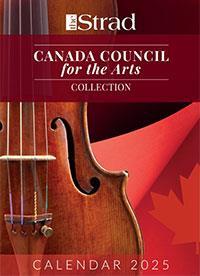
The Canada Council of the Arts’ Musical Instrument Bank is 40 years old in 2025. This year’s calendar celebrates some its treasures, including four instruments by Antonio Stradivari and priceless works by Montagnana, Gagliano, Pressenda and David Tecchler.












No comments yet