



![Ayanna Witter-Johnson [Jordan Woods] 7](https://dnan0fzjxntrj.cloudfront.net/Pictures/274x183/4/9/4/44494_ayannawitterjohnsonjordanwoods7_224583.jpg)


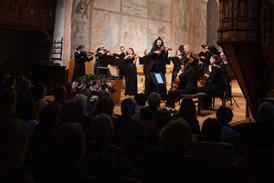



Richard Linnett attended the Danish Quartet’s concert on 16 November 2025 in Santa Fe, comprising a ‘mashup’ of Jonny Greenwood and Stravinsky, plus Beethoven and folk tunes

Discover more Featured Stories like this in The Strad Playing Hub
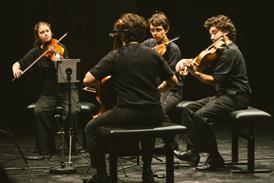
This past weekend, straight off the plane from Copenhagen, The Danish String Quartet was whisked over to the Simms Center for the Performing Arts where they played Schnittke, Shostakovich and Beethoven on a Chamber Music Albuquerque programme. That was Saturday 15 November, the next day on the 16 November, they shuttled north to appear at the Lensic Performing Arts Center for the first of Santa Fe Pro Musica’s String Quartet Series this season, a performance that can only be described as pure genius.
The Danes (including one Norwegian, Fredrik Schøyen Sjölin, on cello) opened with an inspired and apparently spontaneous mashup of Stravinsky’s Three Pieces for String Quartet and Jonny Greenwood’s Suite from the Wes Anderson movie There Will Be Blood.
’We decided to mix these pieces up and create a suite of our own, a seven-movement piece,’ said violinist Frederik Øland, introducing the work. He also invited the audience to meet with the quartet after the show to find out what movement was Stravinsky and what was Greenwood.
Greenwood is best known for being the lead guitarist of the rock band Radiohead. He’s also a prolific composer of modern music and film scores, a fan of Krzysztof Penderecki’s use of elaborate dissonant tone clusters and a champion of the ondes martenot, an obscure theremin-like instrument. Given his esoteric influences, Greenwood’s Blood score is not surprisingly severe, dark and elegiac, with frequent unmeasured tremolos swelling to the point of bursting.
Stravinsky did not compose his work in a ’string quartet’ idiom, it is a series of pieces rather than movements, and it lends itself to the Danes’ experiment in mixology. In the first piece, the first violin plays an almost danceable ditty while the second provides a raspy ricochet counterpoint. Equally austere as the Greenwood suite, the Stravinsky work is also fleetingly tuneful, a ballet of textures that are fragmented, with each instrument singing individually. The Danes blended the Stravinsky pieces deftly within Greenwood’s overall discord, creating a remarkable suite that sounded whole, and perfected.
After the programme, Øland and violinist Rune Tonsgaard Sørenson appeared in the Lensic foyer talking to fans and identifying the sequence in their new suite: Stravinsky, Greenwood, Stravinsky, Stravinsky and the rest, Greenwood, or something like that. It wasn’t easy to sort out by ear, the work flowed that seamlessly to this listener. According to Sørenson, they decided spontaneously to combine the works, ’one day and a half ago,’ and they practised it only once that morning. When they reached out to Greenwood to give him a headsup, the rocker blessed the project.
The second half of the programme featured a clearly stated and dynamic Beethoven Quartet in F major, op.135. The Danes played Beethoven alternating between reverence and levity, with a pluck of parody as tow-headed Sørenson appeared to grin, roll his eyes and exaggerate his bowing through the sombre third movement. Or perhaps this was just the artist unconsciously immersed, in full rapture.
The evening ended on a sweet medley of the quartet’s trademark Irish and Nordic folk tunes, with new compositions from the players incorporating elements of traditional folk music. It almost felt like being at a bluegrass festival. Audience members in the front row tapped their toes and barely restrained themselves from jumping onto the barren stage apron to boogie down.
The quartet’s new folk variations were especially winning, and a testament to the belief that serious modern music can be hopeful, uplifting and a swinging antidote to anxious modern life, rather than always a despairing reflection of it.

![Ayanna Witter-Johnson [Jordan Woods] 7](https://dnan0fzjxntrj.cloudfront.net/Pictures/100x67/4/9/4/44494_ayannawitterjohnsonjordanwoods7_224583.jpg)






No comments yet