









Lutherie – Page 56
-
 Premium ❘ Gallery
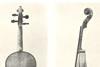
From the Archive: a Lorenzo Storioni violin, 1785
This illustration of a Lorenzo Storioni violin was published in The Strad, August 1912. The following text is extracted from the article accompanying the photographs: The Storioni illustrated is in a fine state of preservation, and well covered with varnish. Nearly all of this maker's instruments encountered today possess tonal ...
-
 Premium ❘ Gallery
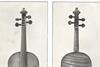
From the Archive: a violin by Giovanni Tononi, 1699
This illustration of a violin by Giovanni Tononi was published in The Strad, July 1923. The following text is extracted from the article accompanying the photographs: This fine violin is essentially a lady’s instrument in every way, being of the small Amatise type in build. It was made in the ...
-
 Premium ❘ Gallery
From the Archive: a violin by G.B. Rogeri, large pattern, 1697
This illustration of a violin by Giovanni Battista Rogeri was published in The Strad, February 1914. The following text is extracted from the article accompanying the photographs: The larger violins of this great maker are exceedingly scarce. This Rogeri’s ordinary fiddles are, relatively speaking, numerous enough, and are about the ...
-
 Premium ❘ Feature
Can you tell a fake instrument from the genuine article?
With more and more instrument forgeries finding their way on to the market, how do experts, dealers and buyers stay wise to deception? Femke Colborne finds out
-
 Video
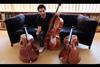
VideoComparing 3 Stradivari cellos
Pablo Ferrández visits the Nippon Music Foundation to compare the 1696 'Lord Aylesford' cello he has on loan with two others by Stradivari, the 1730 'De Munck, Feuermann' and the 1736 'Ladenburg' (part of the 'Paganini' quartet).
-
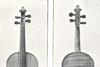 Premium ❘ Gallery
From the Archive: a violin by Giovanni Grancino, Milan 1714
This illustration of a violin by Giovanni Grancino was published in The Strad, April 1914. The following text is extracted from the article accompanying the photographs: Of the various Grancini, the instruments of Giovanni (1675-1737) are probably best known. Those of his father, sons, and various other relatives are seldomer ...
-

-
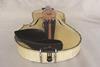 Premium ❘ Feature
Life out of balance
While many luthiers are happy making stringed instruments to the standard form, others are keen to explore the possibilities of alternative patterns. Peter Somerford discovers how asymmetric designs can affect tone quality, projection, acoustics and player comfort
-
 Premium ❘ Feature
An unexpected twist
The few remaining guitars by Antonio Stradivari have distinctive characteristics – which proved useful when another example came to light recently in a museum collection. Emiliano Marinucci and Lorenzo Frignani tell the story
-
 Premium ❘ Feature
The Jewel of Taiwan: The Strad Calendar 2020
The Chimei Museum in Taiwan houses the largest collection of stringed instruments in the world.The Strad Calendar 2020 marks 30 years since its founding, as Dai-Ting Chung and Andrew Guan highlight some of the remarkable treasures within its walls
-
 Premium ❘ Feature
Should violin makers embrace cutting edge computer analysis?
Violin maker Sam Zygmuntowicz explores how high-tech ways of analysing violins and their sound could help makers and even influence the future forms of instruments
-
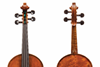 Premium ❘ Feature
In focus: a c.1930 violin by Ignacio Fleta
Jordi Pinto examines an instrument by the important Spanish maker
-
 Review
Book review: Füssen Lute and Violin Making; A European Legacy
John Dilworth reviews a history of lutherie in the southern German town
-
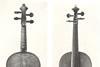 Premium ❘ Gallery
From the archive: a violin by Jacob Stainer, 1669
This illustration of a 1669 Jacob Stainer violin was published in The Strad, August 1934. The following text is extracted from an article accompanying the photographs: Jacobus Stainer’s instruments were always German in style, although the master was immeasurably in advance of his countrymen. That he was acquainted with the ...
-
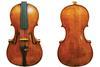 Feature
In focus: c.1767 violin by G.B. Gabrielli
Kai Dase takes a close look at a violin by one of the finest and most influential Florentine makers of the 18th century
-
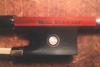 Premium ❘ Feature
Trade Secrets: Making a Tourte-style eye
How to use gold, tortoiseshell and abalone in copies of works by the ‘father of the modern bow’
-
-
 Premium ❘ Feature
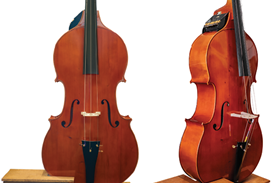
Northern double bass makers: Northern lights
The 19th century witnessed a thriving double bass making scene in the Manchester area of England. This northern school, which had its own distinct style points, flourished for a longer time than its southern counterpart, as Thomas Martin, Martin Lawrence and George Martin explain
-
 Premium ❘ Feature
Making Matters: Keep the wolf from the door
Joseph Curtin describes a quick and simple method for violinists to eliminate a wolf tone on their instrument, along with the science behind it
-
 Feature
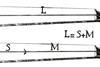
First principles of violin making: Music of the Spheres
In an age of little numeracy or literacy, how did luthiers settle on the proportions of stringed instruments, with hardly any variation in their basic design? François Denis shows how the principles of the classical Greeks – notably Pythagoras – informed their thinking