




In snowbound New York, Davina Shum gained an inside view of the collaborative ethos within the Chamber Music Society of Lincoln Center
Discover more Featured Stories like this in The Strad Playing Hub.
Read more premium content for subscribers here
’We’re sorry that your flight to New York has been cancelled. We’ve gone ahead and booked you on to the next available flight.’ And so began an unexpectedly arduous journey across the Atlantic to New York City at the end of January. My trip, to witness a week inside the workings of the Chamber Music Society (CMS) of Lincoln Center, coincided with the tail end of Storm Fern – the region’s worst snowstorm since 2021 – which buried New York and large parts of the US East Coast in an unprecedented heavy snowfall.
After nearly two days of delays, I finally made it to Manhattan. The storm’s effects were obvious on arrival: piles of snow taller than me were ploughed to the side of the road, with temperatures as low as -15C. Against clear blue skies and sun, it made a charming and beautiful backdrop for my week of immersion among New York’s most talented chamber musicians.
CMS is under the artistic direction of married power couple, the cello-and-piano duo David Finckel and Wu Han. As the name suggests, it is based at Lincoln Center for the Performing Arts, with regular performances at home venue Alice Tully Hall (on Broadway) and at the Daniel and Joanna S. Rose Studio (West 65th Street). It counts among its prestigious neighbours the New York Philharmonic, Metropolitan Opera, the Juilliard School and New York City Ballet.
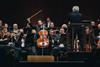
On my first day I attended a rehearsal of Copland’s Appalachian Spring Suite and Bernard Herrmann’s Psycho Suite at the Rose Studio. Located on the tenth floor at CMS headquarters, the studio sits among bright office spaces decorated with hanging plants and cupboards built from quarter-sawn maple, a wood familiar to string players.
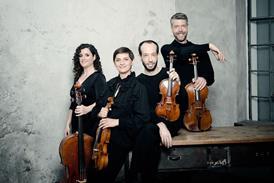
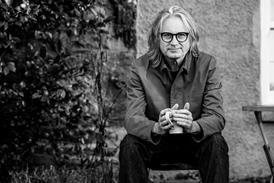
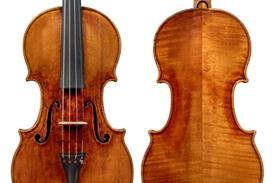
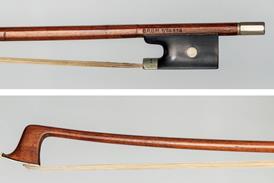
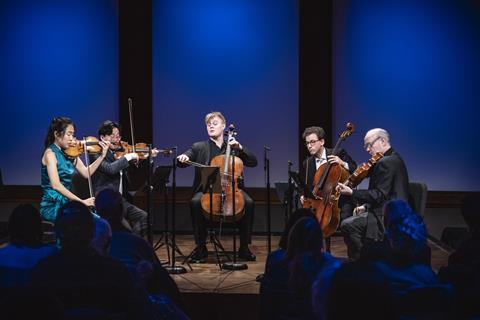
The Copland brought together an exceptional group of chamber musicians, reflecting CMS’s commitment to top-tier artists. The session was particularly notable because most of the string players were performing on instruments crafted by Brooklyn luthier Samuel Zygmuntowicz, who attended the rehearsal himself and was visibly moved to see all his creations in use.
Players performed on instruments crafted by Samuel Zygmuntowicz, who was visibly moved to see all his creations in use
The CMS’s roster fosters a strong sense of community. ‘It’s a big family,’ Wu Han told me: a merit-based group of musicians who support one another, value preparation and uphold the highest artistic standards. Making a living from chamber music is often seen as a luxury, with many musicians around the world juggling rehearsals alongside orchestral work, teaching, recording and other commitments.
The CMS schedule is deliberately rigorous, and therefore secures the best artists. ‘There’s no sightreading here,’ Wu Han said. ‘We demand that our artists come prepared. You have to make time for chamber music.’
Rehearsals were self-directed, with musicians offering feedback, experimenting with ideas and openly engaging in discussion. I particularly enjoyed hearing flautist Tara Helen O’Connor suggest bowings – something she incorporates into her own parts, influenced by her marriage to long-time CMS violinist and violist Daniel Phillips. I couldn’t help but laugh nervously when the entire ensemble played the iconic shower scene music from Psycho; the ferocity of the down bows brought the images from the film vividly to mind.
A sense of intergenerational camaraderie emerged as I joined the artists for a lunch of Greek gyros and souvlaki, ordered in so that they could avoid going out in the cold. Tables and chairs were set up in the Rose Studio so that everybody could ‘break bread’ together, giving me a chance to chat to the musicians.
The roster includes young players such as cellists Sterling Elliott and Jonathan Swensen, violinist Julian Rhee and pianist Sam Hong, all of whom are currently on the Bowers Program, for which emerging musicians are hand-picked and invited to spend three years performing alongside the CMS artists – Bowers alumni and established players, including violist and former Emerson Quartet member Lawrence Dutton, who told me how much he learns from the younger generation.
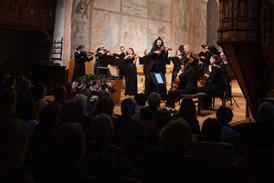
Artists are invited to projects designed to preserve and strengthen the repertoire. Works are rehearsed and performed extensively so that CMS audiences and players alike develop genuine familiarity with them. I attended a 6.30pm concert at the Rose Studio on 29 January, featuring the rarely heard Suite for strings op.8 by Alfred D’Ambrosio (1871–1914), unearthed by CMS violist Paul Neubauer. The piece received another, more informal, performance that evening, and is scheduled for next season – suggesting that it may soon enter the core repertoire.
The early evening concert also featured ‘one of Luigi Boccherini’s hundred quintets’ introduced by cellist Nicholas Canellakis – well known for his satirical classical music sketch videos. Swensen certainly had his work cut out with a loftily virtuosic first cello part rivalling that of the first violin, played by Rhee. As he had already tackled string-crossings and bariolage galore, it was impressive that Swensen then had the capacity to play Jean Barrière’s Sonata in G major for two cellos with Canellakis – a much more democratic sharing of virtuosity.
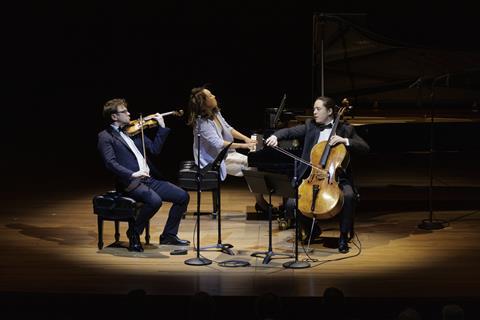
I also observed several rehearsals of Viktor Derevianko’s chamber arrangement of Shostakovich’s Symphony no.15, performed by violinist Paul Huang, Swensen, pianist Inon Barnatan and percussionists Victor Caccese, Ayano Kataoka and Ian Rosenbaum.
‘Can you make it sound more grotesque?’ said Barnatan, as Huang and Swensen coordinated their slow glissandos, laced with wide vibratos that bordered on trills, in the symphony’s second movement.
A dress rehearsal included audio-visual checks, reflecting CMS’s long-time investment in recording and archival processes. Although I regretted missing my first scheduled concert, Beethoven’s ‘Archduke’ Trio, I appreciated receiving a recording link to watch later.
My visit culminated on 2 February with an all-Shostakovich programme at Alice Tully Hall, featuring Symphony no.15 plus the Sitkovetsky Trio playing Piano Trio no.1 and Seven Romances on Verses by Alexander Blok with soprano Andriana Chuchman. Haunting, mournful lines alternated with spiky, staccato stabs: violinist Alexander Sitkovetsky and cellist Isang Enders showcased their versatility and sensitivity superbly.
The symphony prompted audible audience reactions – from gasps at the percussionists’ sudden interjections, to laughs at the ironic quotation from Rossini’s William Tell Overture, repeatedly hammed up by Swensen. CMS’s aim of repertoire longevity had clearly worked: themes from the symphony lingered with me on my overnight flight back to London.
All week, I was surrounded by upbeat musicians, despite the disruptive weather outside. When not rehearsing, artists relaxed together on the couches at CMS headquarters or shared stories over coffee. Being scheduled for a CMS programme seemed to offer both artistic fulfilment and a welcome social focus.
‘We’re always excited when we get called to do a CMS programme,’ O’Connor told me. ‘In a world that feels chaotic, it’s grounding to come into rehearsal, learn together and listen to one another. Imagine if the world worked this way.’ As she put it so aptly: ‘Good people make good chamber music. And good chamber musicians make good people.’
Read: ‘A second golden age’: cellist David Finckel on luthier Samuel Zygmuntowicz
Read: ‘The more Haydn you play, the better you’ll play everything’ - David Finckel’s life lessons
Discover more Featured Stories like this in The Strad Playing Hub.
Read more premium content for subscribers here








No comments yet