



Clare Varney reports from the String Quartet Biennale Amsterdam, where an array of star performers and repertoire old and new proved that the genre is alive and well
Discover more Featured Stories like this in The Strad Playing Hub.
Read more premium content for subscribers here
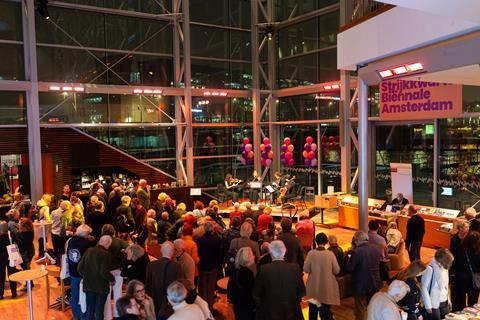
Now in its fifth edition, the String Quartet Biennale Amsterdam (SQBA) 2026, held at the city’s Muziekgebouw from 24–31 January, brought together 24 string quartets for 39 concerts across eight days. Alongside 16 Dutch and world premieres, the programme included talks hosted by British presenter Katy Hamilton, masterclasses, specialist advice from J&A Beare, and recitals by winners of the Banff, Trondheim and Wigmore Hall competitions.
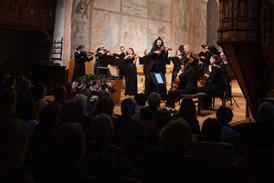
With such an abundance of ensembles – at different stages of their careers and from widely differing musical cultures – emotional connection was at the core of this year’s festival. The Belcea Quartet set the tone in the festival’s opening concert on 24 January. The ensemble’s performance of Mozart’s String Quartet in C major K465 ‘Dissonance’ unfolded with a sense of searching that gave real weight to the work’s harmonic ambiguities. Cellist Antoine Lederlin’s repeated opening pulses felt steady yet alive, while Corina Belcea’s voice-like phrasing and fluid bow arm, combined with the quartet’s wide dynamic range, made for playing that was both supple and intense. The group’s collaboration with Tabea Zimmermann in Mozart’s String Quintet in G minor K516 was equally compelling, particularly in the way they passed around the finale’s cheeky, rocking figure.
As the week progressed, emotional connection was joined by another equally strong realisation: that there is no substitute for intellectual rigour and sustained hard work. This was evident in the Pavel Haas Quartet’s concert on 27 January, featuring Martinů’s String Quartets nos.3, 5 and 7. Cellist Peter Jarůšek’s strummed pizzicatos in the opening immediately displayed the ensemble’s refined artistry. His extended lament passages were quietly gripping; Martinů’s intricate writing sounded like a natural extension of the cellist’s musical voice. Violinist Veronika Jarůšková’s bow technique was particularly striking – economical, controlled, yet capable of producing an extraordinary range of colour.
Jarůšková affirmed the quartet’s approach to assimilating repertoire after the concert. ‘It really takes time,’ she told me. ‘We need to know each voice completely so we can show the audience which one to listen to. We play for friends, and in our living room for my mum. It’s like theatre. You have four actors and you put the show together. I need to know what I’m going to say, and the others need to know how I’m going to say it.’
Emotional connection was at the core of this year’s festival
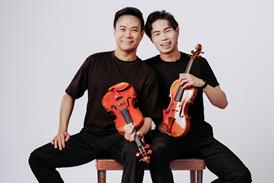
On 31 January, star conductor and cellist Klaus Mäkelä joined the Arod Quartet to play second cello in Schubert’s String Quintet in C major. French film-maker Bruno Monsaingeon introduced the session with a clip from his 2024 film about Mäkelä, Vers la flamme (‘Towards the Flame’), which showed the cellist–conductor and the Arod musicians rehearsing the quintet together. It mirrored the dynamic between the five players on stage: as they reprised the first-movement exposition, cheeky glances between them, and violinist Alexandre Vu’s occasional gleeful grins kept a sense of joie de vivre at the heart of their captivating storytelling.
Earlier in the week, the Arod players had led an outstanding masterclass in the Kleine Zaal entitled ‘On intonation’ where cellist Jérémy Garbarg spoke candidly about his early struggles to align his tuning with that of his colleagues when he joined the quartet five years ago. The foursome delivered a succinct history of modern-day tuning, detailing how equal temperament evolved over the years and the challenges that it poses to string players. They explained how they developed their own temperament system, which makes the most of natural harmonics and subtly reshapes the character of each chord.
What also made this session striking was the audience, made up of everyone from fellow professionals, agents and press to amateur musicians and enthusiasts from across the Netherlands and beyond. It summed up the ethos of the SQBA – a place where knowledge is shared openly and taken back into everyday music making.
Over the years, founder and artistic director Yasmin Hilberdink has created a festival that encourages this kind of exchange – not only between quartets and audiences, but between tradition and innovation. New music remains central to that vision. ‘Commissioned works are very important,’ she told me, ‘not just for keeping the string quartet genre alive and relevant, but for allowing ensembles to create their own legacy.’

Across the festival, several of these works stood out. On 26 January, Aftab Darvishi’s When the Sky Turns Red, written for the Animato Quartet and tanbour player Khorshid Dadbeh, drew the audience into a richly coloured sound world that felt immersive without being overwrought. Vinthaya Perinpanathan’s Her Resistance, performed by the Adam Quartet with visual engineer Boris Peters (28 January), paired soprano Elisabeth Hetherington’s finely ornamented vocal line – suggestive of Baroque coloratura refracted through an Indian raga lens – with electronics and fast-paced visuals.
Among Dutch contributions the music-theatre series entitled Een flat met duizend ramen (‘A flat with a thousand windows’) was particularly successful. Presented over three mornings, the project, conceived and directed by Primo Ish-Hurwitz, brought together six new works by six young Dutch composers, each responding to a Haydn op.20 quartet and a text by Joke van Leeuwen. Performed by the Chaos Quartet with actress Ariane Schluter, the collection interwove spoken narrative and musical material to portray a woman’s descent into memory loss. The narrative was enhanced by Haydn’s original music, extended techniques and Scottish jigs.
Some of the most striking performances took place in semi-darkness. The Attacca Quartet’s rendition of George Crumb’s Black Angels on 29 January – a world away from the Beethoven op.132 they had played the night before – was visceral and unsettling. Bowed wine glasses, artificial harmonics, whistling, shouts, and quotes from Death and the Maiden, played on an upside-down cello, combined to create a vivid experience.
A similar atmosphere characterised the Marmen Quartet’s collaboration with percussionist Dominiq in Samuel Adams’s Sundial, alongside his SQBA commission Devotions (30 January). Framed by Haydn and late Beethoven, the work drew listeners into a space that felt both intimate and expansive. Dominiq’s vibraphone, enclosed in a cage of cowbells, produced sounds that were both strange and comforting.
By its close, SQBA 2026 confirmed that the string quartet remains a vibrant and evolving form. I’m already looking forward to 2028.
Read: Postcard from Canada: Banff International String Quartet Competition
Read: Postcard from California: Music@Menlo Chamber Music Festival
Discover more Featured Stories like this in The Strad Playing Hub.
Read more premium content for subscribers here









No comments yet