
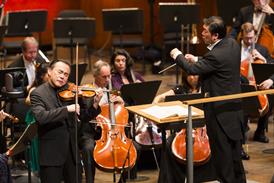


Bruxce Hodges hears the performance of Shostakovich and Tchaikovsky at Philadelphia’s Marian Anderson Hall on 13 February 2026
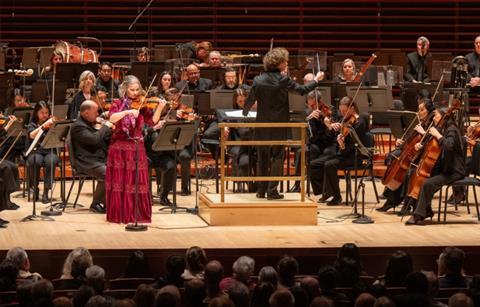
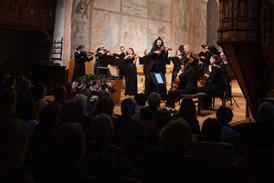
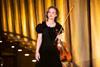
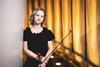
Given Hilary Hahn’s recent injuries, it is a delight to report that she has now recovered – at least, based on the power and precision of this outing. With Santtu-Matias Rouvali and the Philadelphia Orchestra as her partners, Prokofiev’s First Violin Concerto seemed less like a typical virtuosic showpiece, and more like a garden of exotic plants. For a few bars in the third movement, Hahn’s otherworldly timbre even evoked electronics, abetted by appealing growls elsewhere. In more introspective sequences, Rouvali and the ensemble matched her quietude note for note. As an encore, she offered Bach’s Bourrée from the First Partita, done with equal fastidiousness.
In the Shostakovich Sixth Symphony that closed the afternoon, the strings-heavy first movement is the longest of the three, and the second violins’ lengthy trills – a simple effect on paper – made an impressively mournful backdrop. In the fiendish galop of the finale, tempos were slightly too fast, with some articulation casualties, but offset by the pleasure of hearing one of Shostakovich’s less familiar symphonies performed by the same ensemble that gave its US premiere.
The concert opened with Tchaikovsky’s Capriccio italien, which in some circles causes eye-rolling and pitiful looks. For others, its over-the-top-ness is the point. Not everything has to be a spiritual catharsis. Perhaps sceptics might have eavesdropped on this performance, which began at a leisurely pace, but soon escalated into a supercharged circus. It’s no secret that Tchaikovsky loved strings, and here, the cellos and basses won the day.
Bruce Hodges
Read: Life Lessons: Violinist Hilary Hahn
Read: Violinist Hilary Hahn undergoes surgery for cervical spinal disc herniation






No comments yet