




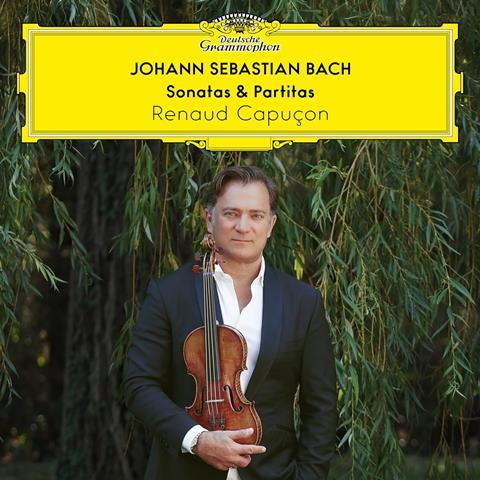
A great violinist marks his 50th birthday in style
THE STRAD RECOMMENDS
The Strad Issue: May 2026
Description: A great violinist marks his 50th birthday in style
Musicians: Renaud Capuçon (violin)
Works: Bach: Solo Violin Sonatas and Partitas
Catalogue number: DG 4868012 (2 discs)
Renaud Capuçon’s solo Bach at times sounds almost reverential, for all its variety and seeming simplicity. Those qualities are present in the opening Adagio of the G minor Sonata, along with a gentleness that carries through so much of his playing. The multiple-stops of the Fuga speak clearly, with strength but no undue muscularity, and the Siciliana is spacious, with deft handling of counterpoint.
In the B minor Partita a flowing legato underpins both the dotted rhythms and melodic leaps of the Allemanda and the equal quavers of the Double which follows. After the steadily paced Corrente, the Double provides the first turn of speed, presto as Bach requires. The Sarabande and its Double are sublimely unhurried, and the Tempo di Borea has an aristocratic bent to it.
There is care and space in the Grave which opens the A minor Sonata. Phrasing in the Fuga is impeccably understated, and the occasional accidentals spice up the stately progression of the Andante.
The Allemanda of the D minor Partita is agile and firmly phrased, and the following Corrente is melodious, its dotted figures as lyrical as the strings of triplets. The opening chords of the Sarabanda herald a warm, silky reading, and the Giga is fleet and dancing. The great Ciaccona has dignity and a tendency to quietude: the high demisemiquavers in the first part are barely whispered. The chordal variation at the end of the D minor section has a satisfying strength before the switch to D major brings back the softness. Back in D minor, the bariolage begins softly and develops in power. This is a beautifully crafted performance, without the self-conscious mightiness of some.
After the almost metronomic Adagio which opens the C major Sonata, Capuçon takes the Fuga at a brisk pace: some of the episodes are almost light-hearted. The phrasing in the Largo is exemplary, and the Allegro assai sweeps along joyfully.
In the Preludio of the Third Partita Capuçon’s tone is bright and full, and the Loure is smooth and elegant. The Gavotte en Rondeau and the following two Menuettes are unquestionably music for dance. The final Gigue is bustling, with slightly separated semiquavers.
This is a very fine set, which at times feels like a private meditation, but is cumulatively both musically gripping and emotionally moving.
TIM HOMFRAY
Read: Sentimental Work: Renaud Capuçon
Read: Renaud Capuçon: Life Lessons
Watch: Renaud Capuçon rehearses Beethoven’s Violin Concerto 2017









No comments yet