





![Ayanna Witter-Johnson [Jordan Woods] 7](https://dnan0fzjxntrj.cloudfront.net/Pictures/274x183/4/9/4/44494_ayannawitterjohnsonjordanwoods7_224583.jpg)






Bruce Hodges hears the performance of all six of Haydn’s op.33 Quartets at Philadelphia’s American Philosophical Society on 4 May 2025
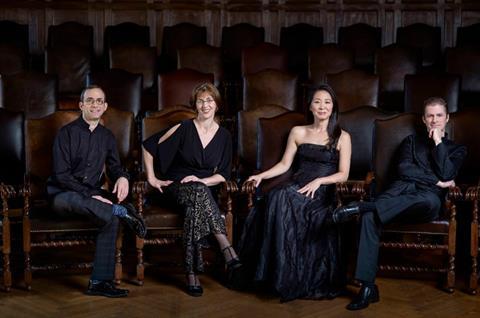
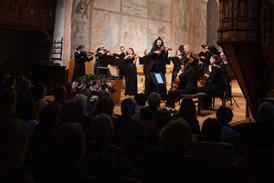
For this memorable afternoon from the Brentano Quartet – one of the highlights of the Philadelphia Chamber Music Society’s impossibly dense season – the veteran foursome offered all six of Haydn’s op.33 Quartets in two groups of three. In between the back-to-back concerts was a substantial interval, with local food and wine purveyors offering light snacks and drinks.
For this four-hour marathon, the ensemble performed the quartets in the order nos.6, 1, 4, 3, 5, and 2. Violinist Mark Steinberg explained the decision-making behind the scenes:
‘Immediately when we decided to present the whole opus I felt we had to end the programme with ‘The Joke’ [no.2], because, well, just because. I wanted the D major Quartet [no.6] before the B minor [no.1] in the hope that it would enhance the wild way that piece actually starts in D major. Then we just thought the ending of the B flat major [no.4] was so disarmingly fun and charming that it would be great before the break. And the rest just fell into place.’
In the opening Sixth Quartet, the group seemed to be riding a burst of energy – afternoon sunlight heralding the exhilaration to come. In the B minor Quartet that followed, the finale was taken at lightning speed, only increasing its humour. ‘Disarmingly fun and charming’ could easily apply to any of the six, but was entirely apt for the B flat major Quartet that closed the first half – not only for its pizzicato ending but for the droll phrases elsewhere, particularly from cellist Nina Lee.
After the interval, no.3 in C major (‘The Bird’) was true to its name, with the group evoking the composer’s delightful chirping and fluttering. In no.5, rhythmic inventiveness was infused with the same irresistible sense of play heard all afternoon. And to end it all, ‘The Joke’ (no.2) was despatched with appealing, understated comic timing. Rusticity in the Scherzo was complemented by admirably swooning glissandos, and of course, the sly finale made the ideal ‘thank you, goodbye, I’ll tiptoe out’.
The opportunity to hear these gems in a single sitting cannot be overstated. As violist Misha Amory wrote in his programme notes, ‘Witty and innovative as [Haydn] always was, in the op.33 he sharpened his attention in this department, finding new comedic timings, sudden stops, reversals of the expected order of events, funny ways of chopping up and jumbling his melodies.’
Violinist Serena Canin recalled that Haydn’s music appeared on the group’s inaugural concert in 1992, and added, ‘We never met a Haydn quartet that we didn’t like.’
Hearing all six in op.33, these truisms were brought into high relief. Some might argue about favourite moments or others that were slighted, and occasionally the four hours took a slight toll in execution. But likely most of the attendees at this sold-out concert will long remember this engaging colloquy as a masterclass in how a composer uses similar tools within a tight framework, to magnificent effect.
BRUCE HODGES








No comments yet