












Benjamin Hebbert reads the notes taken by Clare Hutter (née Nicolls) when she was a student at the Newark School of Violin Making in the 1980s
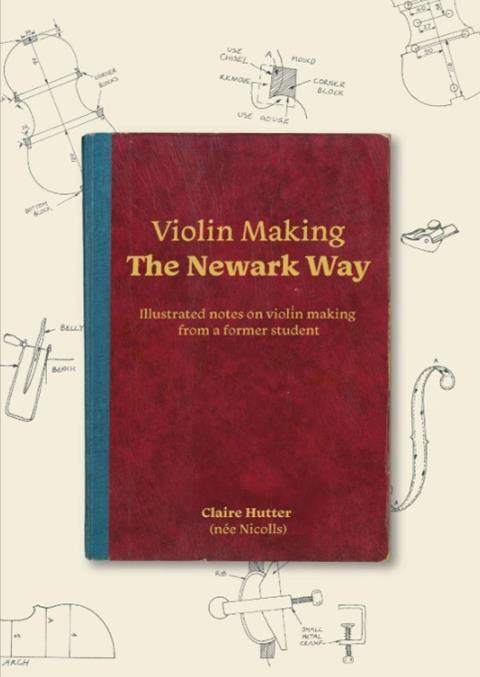
Violin Making the Newark Way: Illustrated notes on violin making from a former student
Claire Hutter (née Nicolls)
66PP ISBN 9798891708037
Gerard KilBride Violins £38
The general trends of the craft of violin making evolve from one generation to the next. Edward Heron-Allen’s Violin Making As It Was and Is now ranks as a relic of the 19th century, although for many in living memory it may have been the only book that aspiring violin makers might have accessed through their public library before they entered violin making school.
Since the late 1980s, times have changed in unexpected ways. The rite of passage of making your own closing clamps with threaded steel, wingnuts and bobbins has vanished with the advent of moulded plastic; and the days when that trusty blue Record 09½ block plane was the only option seems a long way from the multitude that can now be found on the student’s bench. The start of The Strad’s series of instrument posters in 1985, along with the catalogue of the Stradivari Exhibition in Cremona that same year, gave makers high-quality photographic resources that led to better understanding of varnish and how instruments age.
Yet within the constant innovation of violin makers, occasionally something that explains an outdated technique gives us the means to think about what we do now, and occasionally things may come full circle – and an idea forgotten 30 years ago seems like a remarkably good one today.
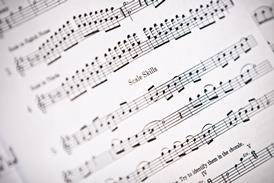
Claire Hutter’s notes begin in 1988, her first year of study at the Newark School of Violin Making. These aren’t the official college notes of the type that were refined into Courtnell & Johnson’s 1999 The Art of Violin Making, but they are written to capture the words of advice and more incidental tips and tricks that she received from her teachers. The handwritten presentation and drawings feel more readable and engaging, while the voice of the teachers is communicated in a gentle way, which is sure to provide nostalgia to those who studied with the same tutors.
When Gerard KilBride first told me that he had received Claire’s notes and spoken of his intention to publish them, the project seemed to me to be a beautiful ‘love letter to Newark’ at a time when support of the school was much needed (my words, which seem to have crept on to the back cover of the book), even if it were to achieve nothing more than a testament to violin making in Newark c.1990.
The book turns out to be as essential a part of the violin maker’s arsenal now as it ever was, even if violin making and the way that it is taught have changed with the times. I am sure that every violin maker will find something of tremendous worth within its pages. Meanwhile, for anyone aspiring to enter the craft, the attractive approachability of this book will be sure to serve as an enduring inspiration.
BENJAMIN HEBBERT







No comments yet