


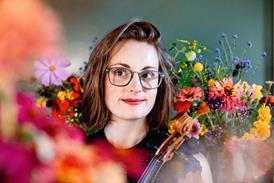


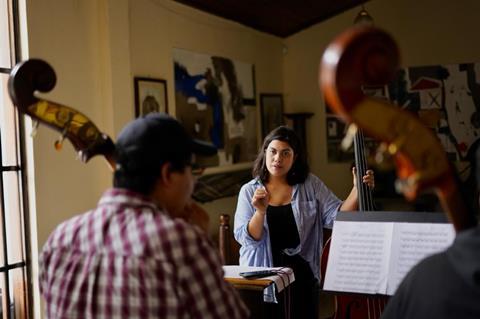
Honduran bassist Ethel Chavarría describes how she and her fellow musicians came together to create a create new opportunities for young double bass players in her home country
Discover more Featured Stories like this in The Strad Playing Hub
Somewhere on a train between Cologne and Essen, with my double bass and suitcase beside me, on my way to an audition, I began thinking about my 15-year-old self. Would she ever have imagined where music would take her? I found myself remembering what it was like to study double bass in Honduras, with all its challenges, and the people who had helped me along the way. Then a rather crazy idea crossed my mind: why not bring double bassists together in Honduras?
I messaged Jenson Ardón, now the double bass teacher at my former school, the Escuela Nacional de Música in Tegucigalpa. I had no budget, date or plan. Jenson liked the idea anyway. We decided to give it a try. Two editions later, I still can’t quite believe it happened.
If organising a double bass festival in Honduras requires one thing, it’s an army of friends.
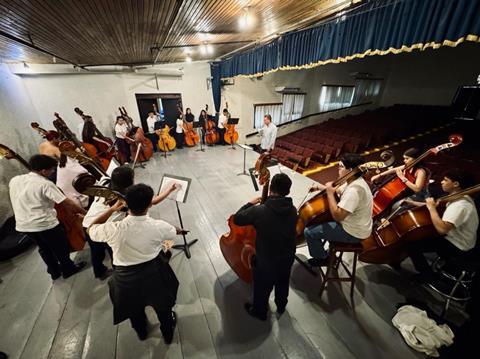
Jenson helped establish a partnership with the Escuela Nacional de Música, which offered its facilities and instruments free of charge. This mattered enormously: not every student owns a bass. In 2024, 4 of 19 registered participants didn’t have one; in 2026, 10 of 22 faced the same difficulty. The school’s instruments made their participation possible.
Oddly enough, when I studied there, we had the opposite problem. For a long time I was the only bassist, although the school had as many as seven instruments. There were more basses than players!
Music had always been part of my life. Growing up in Honduras, I started lessons alongside my siblings, first the recorder and later the violin, which I didn’t particularly enjoy. At 13, I decided to try the double bass. After all, it looked just like a giant violin, so surely it couldn’t be that different to play, right? I soon discovered otherwise!
What I really needed was a teacher nearby. There wasn’t one in Tegucigalpa, the capital, so every two weeks I travelled to San Pedro Sula, in the north of Honduras, for lessons with Ernesto Rodríguez. He was part teacher, part psychologist: studying an instrument almost alone, you need someone to hear your questions and frustrations as well as your scales. Finding repertoire was another adventure. Internet access was limited, and the school library had only a few beginner pieces and etudes.
San Pedro Sula already had a more established bass community. In 2007, the city hosted a gathering with Klaus Stoll of the Berlin Philharmonic, attended by my teacher Ernesto. The city has nurtured talented bassists, some now working abroad.
Fortunately, things are changing in Tegucigalpa, too. Jenson has helped strengthen bass education there. I’d love to see more students from San Pedro Sula join us – and perhaps one day bring the festival to their city.
Our festival has no substantial budget. Much depends on goodwill, personal connections and a shared belief in music education.
Many of those connections go back to my years studying and working abroad. After finishing high school in Honduras, I travelled to Germany to audition for music college. I was accepted into two and eventually chose to study in Hamburg with Jens Bomhardt, whom I’d love to welcome to our festival someday. Later, I pursued my master’s degree at Louisiana State University with Yung-chiao Wei. Shortly before graduating, I won an audition for the Firdaus Orchestra in Dubai, an all-female ensemble of musicians from many different nationalities. I had no idea at the time that some of the people I met along the way would one day become part of a double bass festival back home.
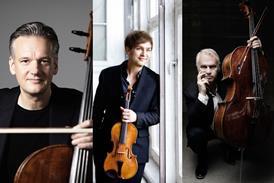
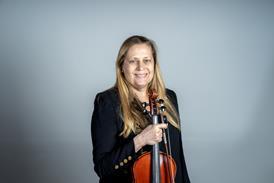
We’ve welcomed four guest artists across two editions, all important figures in my musical journey. In 2024, Dr Molly Redfield, my jazz double bass teacher during graduate school in the US, and Dr Carmen Rodríguez, whom I met in Panama in 2013, joined us. In 2026, we welcomed Prof Yung-chiao Wei, and Juan Carlos Peña, a Honduran bassist with an extensive career in the United States.
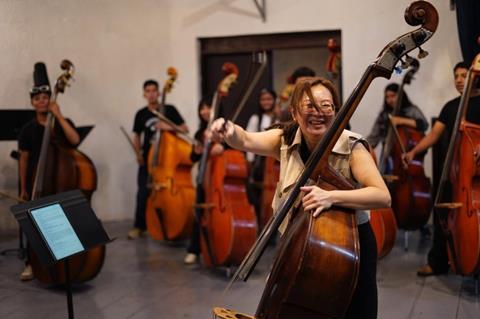
Juan Carlos has spent nearly two decades dedicating his summers to teaching students in Honduras. Collaborating with him as a colleague, after knowing him as an early mentor, was particularly meaningful.
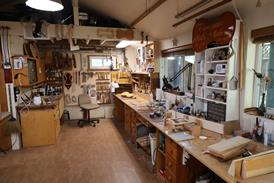
When I approached these musicians, they didn’t hesitate to support us. There are still so many bassist friends I’d love to bring to Honduras, people I’ve met along the way who are excited about the idea of contributing to our growing community. Their institutions helped cover flights, while other expenses often came from our pockets. Donations from our first closing concert helped fund guest meals and shipping rosin donated by 050 Rosin for the second edition. Even basic double bass supplies are difficult to find here, so the rosin was a real relief for students. I hope we can eventually replace the ageing strings on the school’s instruments and find a luthier to give them the care they need.
Of course, enthusiasm doesn’t necessarily prepare you for running a festival. During our first edition, I was organiser, host, translator, driver, teacher, soloist and workshop leader – sometimes all in one day! We were perhaps too ambitious. By the second, we had learned to delegate, trust others and accept that we couldn’t do everything ourselves.
One of my favourite moments in 2026 began with a planned workshop on the double bass in traditional Honduran music. We expected Beyrone Sauceda, the director of Folclore Nacional de Honduras, to arrive alone. Instead, he brought the whole ensemble! Suddenly our students weren’t just hearing about the music; they were playing alongside its musicians.
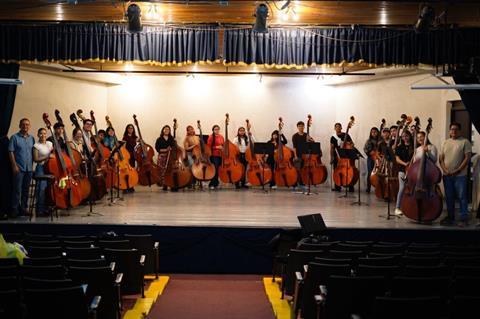
Another highlight was Cristhian Maldonado’s workshop on the bassist’s role in an ensemble. He brought instruments ranging from a bass ukulele to fretless and five-string electric basses. But the most meaningful detail was that Cristhian had attended our first festival as a participant. Two years later he returned as a workshop leader. To me, that’s what building a musical community is all about.
Our closing concerts have celebrated classical, jazz and Honduran repertoire, including Fénix by Edgardo Corea and El Bananero by Lydia Handal, arranged for our bass ensemble by my friend Po-yu Fang of the Singapore Symphony Orchestra. Hearing Honduran music performed by a room full of bassists is a feeling I won’t forget.
My greatest satisfaction is that this dream has come true twice. Bringing enthusiastic young musicians and Honduran talent into one room still feels extraordinary.
During both editions, the adrenaline kept me going until the very end, often during the drives to the airport with our guest artists. It was during those drives that everything finally began to sink in. I never imagined that Molly, Carmen and Yung-chiao, three mentors who had shaped my musical journey, would one day stay in my home, share the stage with me and help bring this festival to life. Going from learning from them to welcoming them to Honduras as friends and colleagues is something I still find hard to believe.
After several years of studying and working abroad, life eventually brought me back to Honduras, where I’m now based. Since returning, I’ve had the chance to perform with orchestras and chamber ensembles across Central America, including in Guatemala, El Salvador, Costa Rica and Panama. It’s been a wonderful way to stay connected with musicians throughout the region while continuing my own journey as a performer and teacher.
If I could speak to my 15-year-old self, I’d tell her the effort is worth it. Music has given me friendships around the world and taken me to places I never imagined. Now it’s given me another role: helping others find one another and build a community of their own.
And it started with a bass, a suitcase and a message sent from a train.
Read: The Strad Calendar 2026: 2019 Octobass
Read: Technique: Singing with the bow
Discover more Featured Stories like this in The Strad Playing Hub











No comments yet