



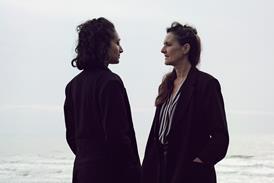




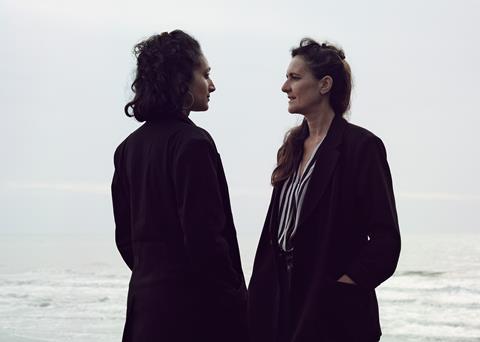
Violinist Preetha Narayanan and cellist Tara Franks of Balladeste build their music from improvisation, without writing a note down. Ahead of the release of their fourth album, Imprints, they talk about where that started and why classically trained string players should learn to lean into improvisation
Discover more Featured Stories like this in The Strad Playing Hub
Where it started - early connections to improvisation
Tara Franks: It was through voice for me - singing was an integral part of my house growing up, we all sang, my parents really valued being part of musical activities and although there was a grounding in choral music and history of choristers, it was our non-formal way of interacting musically. Whenever someone started singing, everyone would join in with their own harmony without even thinking about it!
I spent a lot of time at jazz gigs watching my saxophonist brother perform and improvise. Learning cello, I played in quartets, chamber groups and orchestras from a young age, yet I didn’t come across opportunities to explore that creative side of my playing through my instrument. My first cello teacher at school did encourage me to compose a short piece every week.
Preetha Narayanan: For me it was about home too. As an immigrant family in Memphis, TN, we listened to everything: Indian classical music, the Beatles, Michael Jackson, American Folk. My mother, though not a musician , believed in the power of music and started a small organisation bringing artists over from India to perform in our city. They’d stay at our house, see me play and teach me Indian tunes by ear.
Indian classical music is largely improvised, and I imbibed so much from witnessing the dialogue/communication on stage, even though I was far too young to truly understand what was happening. Meanwhile I was learning violin through the Suzuki method, which encouraged learning through listening, repetition, and group playing.
Finding each other – how our paths first crossed
PN: We met at the Guildhall School of Music and Drama, on a progressive MMus course about collaborative composition, improvisation and working across art forms and cultures. Before that, having received a research grant to travel to India to compare Indian and Western classical music, it became my artistic mission to become a bridge between the two styles/cultures.
Studying at the Guildhall allowed me to explore this while meeting like-minded individuals like Tara, who shared the desire to improvise, create and empower people from all backgrounds through music-making.
TF: I came upon this course from a different path. After my performance degree, I received a place on an EU funded chamber music course in Italy and stayed for two years joining an orchestra. I returned to the UK to do a PGCE and became a primary school teacher. I built up a music scheme in the school I worked, piloted whole-class string teaching for the borough and led group singing and drumming lessons.
Meanwhile my cello was gathering dust in the corner of the room and I wanted to reconnect with playing and performing in a space that felt less restricted and I could bring myself creatively. An amazing network of musicians came together on this Masters course, all sharing the same ethos to open up our practice into collaboration – Preetha and I also bonded through our background in Western classical strings too.
It’s about listening – why improvise?
TF: Fundamentally, improvisation is about listening deeply and actively. I was surprised growing up playing in orchestras how little people listened to what everyone else was playing. People were often so tuned into their own parts that their awareness, which should be wide, often narrowed. Improvisation makes you step out and listen differently.
PN: Historically, Western classical music was full of improvisation, without a divide between composer and performer, between hearing and seeing. Nowadays, many players are visually locked in, the page more important than the ear. I see it also with young students: they’re introduced to notation very early, before they’ve learnt to listen or get comfortable with their instrument, which in turn holds them back from the simple essence of music: aurality and deep listening.
TF: That resonates with me. Improvising with my voice always felt natural; yet on the cello it didn’t. I wasn’t exposed to environments where I could improvise due to the instrument I had chosen to play and group opportunities on offer.
Many players are introduced to notation very early, before they’ve learnt to listen, which in turn holds them back from the simple essence of music: aurality and deep listening
How improvisation is integral to our writing process
PN: Our approach is embodied. A piece most often starts with the two of us improvising in a room. Alternatively, one of us may bring in a motif, a chord sequence or a texture, and we develop it together, meticulously sculpting each melody, progression, and musical moment in real time.
TF: We’ve built a language between us: using improvisation as the tool to compose, it’s not jazz, not Indian classical music, not free improv, but something different, modal.
PN: We don’t write things down. Even our through-composed pieces live in recordings and in our heads; nobody else knows our parts unless they’ve listened.
Where can string players begin?
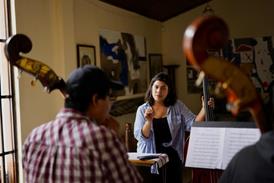
TF: Firstly, know that there isn’t just one kind of improvisation. It doesn’t have to start on your instrument either. In workshops we lead, we begin with embodied warm-ups, using rhythm, movement and voice, and slowly lead people onto their instruments until they’re playing freely over a mode in a way they’ve never done before. In a recent training session I led for teaching artists, it was wonderful to see an undergraduate violinist finding a way into improvising over the group, an experience she’d never had before.
PN: It’s helpful to start with small parameters. Find one note and hold it. Or as we may do when facilitating an improvised process with a group, choose one short note and one long note, and give them two chances in a one-minute improvisation to drop them in. Because I personally gravitate towards the Indian raga system, I often give string players a simple mode or even simply five notes to work with at random. Small cells like that played over a simple groove can be really satisfying.
TF: It’s a bit like meditating: you’re trying not to judge yourself or anyone else. I’ve certainly had improvised gigs where I’ve felt absolutely terrified, and others where I’ve felt invited to bring my voice into that moment. Improvisation teaches you presence: owning whatever comes out, rather than second-guessing it.
PN: Above all, it isn’t about the musical outcome. It’s about being in the moment and the dialogue that’s happening in front of you. Even as a long-term musical partnership, Balladeste still works at listening and staying present in our practice.
Balladeste’s fourth album, Imprints, is released on 5 November 2026. Stream and purchase here and on Bandcamp. Watch Balladeste’s single Dawn Raga in the video below:












No comments yet