







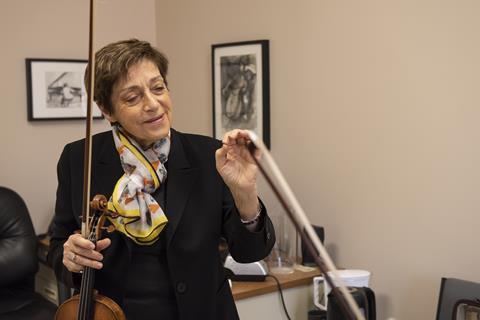
The US–Israeli violinist on her unique upbringing and career, and what it takes to master a piece
Discover more Featured Stories like this in The Strad Playing Hub.
Read more premium content for subscribers here
I had quite a non-traditional musical upbringing. I remember my first teacher, Alice Fenyves, giving me the music to all the Beethoven sonatas when I was only ten. She was very serious about providing me with a good technical foundation. At school, still only in my teens, I was also being given very specialised training in harmony, theory, musical structure, ethnomusicology and even the science of acoustics.
Growing up at this time in Israel meant that I saw and had lessons with incredible artists who came to visit – Stern, Milstein, Francescatti and more. It gave me such a special sense of possibility about what this profession could be. I think we all need these magical experiences – they create meaning amid the drudgery of practice and etudes. These moments need to be the goal of a performance. Often students will analyse their performance by counting how many mistakes they made, but I instead want to know what happened when they weren’t making the mistakes.
My next teacher, Lorand Fenyves, was my previous teacher’s brother, but they were very different. He taught me how to think about music and violin playing and was very analytical in his way of explaining things. When I moved to the US to study with Josef Gingold, I experienced his absolute love for the violin as an instrument. It was a concept I hadn’t considered until then, as I’d just seen the violin as a tool you used to play music. His total immersion in the music and instrument was infectious.
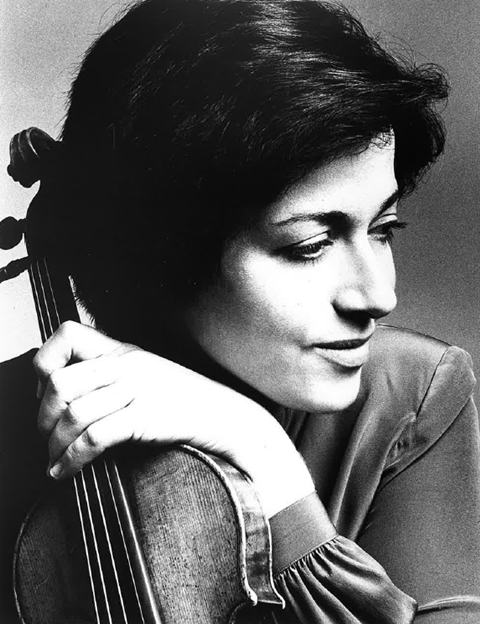
During my time with Ivan Galamian, I remember working on Lalo’s Symphonie espagnole. Every lesson he would tell me: ‘That’s better, but now go home and practise.’ This went on for months, and I started to get sick of the piece. But what I learnt from that is that it can be easy to get about 93 per cent of the way to mastering a piece. To get to 100 per cent takes far longer. And by ‘100 per cent’ I mean the point at which your technical ability frees you up to do what you want. There is a distinction between making a mistake, which is completely human, and not knowing something and therefore missing it. It’s important to learn which is which.
Winning the Queen Elisabeth Competition in 1971 was a huge turning point. The finals were on a Saturday, and by Sunday afternoon I had a manager. I was handed this career and now it was up to me whether to sink or swim. It was certainly difficult, especially as a woman. I remember people asking ridiculous questions like whether my husband had allowed me to travel. How could anyone think to ask that kind of question? I was extremely lucky that my father was the first feminist I ever met. He told my sister and me that if we worked hard, we could do anything. And he had absolutely no doubts about it.
Sometimes I hear ‘this person is an intellectual player,’ or ‘this person is an emotional player.’ I don’t think either is a compliment, because you need to be both. At the end of the day, you have to touch someone’s heart. And it is through your intellectual understanding of the music that you can find the magical points within it and communicate them in a way that will speak to the audience.
INTERVIEW BY RITA FERNANDES
Read: ‘Curiosity is at the core of human nature’ - Roberto Díaz’s life lessons
Read: Review: Miriam Fried masterclass
Discover more Featured Stories like this in The Strad Playing Hub.
Read more premium content for subscribers here










No comments yet