








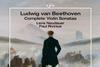
Robin Stowell reads pianist Daniel Tong’s detailed analysis of Beethoven’s ten sonatas for piano and violin
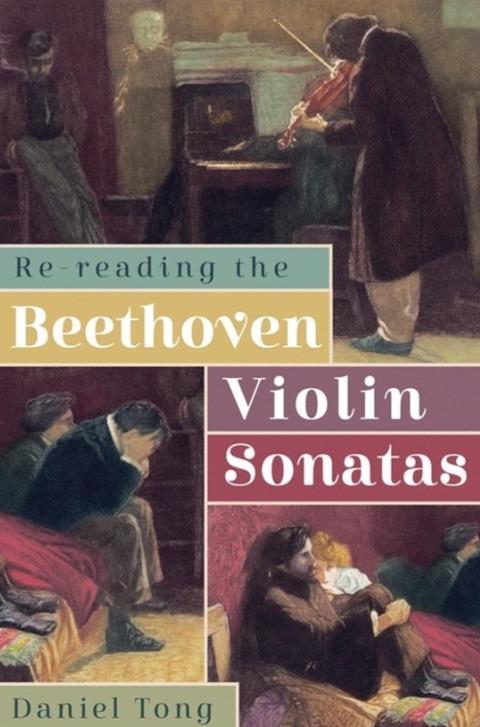
Re-Reading the Beethoven Violin Sonatas
Daniel Tong
244PP ISBN 9781837650378
Boydell Press £95
Daniel Tong’s introduction establishes his position as an erudite analyst and regular pianist–performer of Beethoven’s ten sonatas for piano and violin.
Engaging with a wide range of literature on Beethoven’s life and oeuvre, analytical theory and performance practice, he forges his own investigative pathway, incorporating enlightening cross-references to relevant works by Beethoven, his contemporaries and predecessors. For him, analysis and performance ‘interact and inform one another’ in ‘a constant ebb and flow between the cerebral and the tactile’.
Tong largely eschews the traditional structural approach to analysis in favour of more recent methodologies, embracing intertextuality, narratology, gender study, humour in music, musical meaning and temporality in the hope that he ‘will contribute to a more nuanced view of some of the sonatas that have often evaded notice’. Issues of historical performance are deliberately bypassed.
A cynic might suggest that Tong’s book is an attempt to fit selected sonata movements jigsaw-style with trendy analytical methods as if a purely academic exercise.
Readers may demand a more convincing reason than that proposed for the comparative critical neglect of, and Tong’s discomfort with, op.23: ‘an all-too-easy acceptance of sonata form’s phallogocentricity, to which the opening Presto movement does not readily conform’.
His gender reading of this movement contends that its unstable ‘masculine’ material fails to influence and is often transformed by the ‘feminine’, resulting in an unconvincing recapitulation or conclusion, and feelings of anxiety or instability.
Much of Tong’s case study of the humour in op.12 no.2 seems similarly far-fetched, as does his ‘unease’ with the hybrid op.47, especially the superficial affiliations between its two outer movements and the ‘hypermasculinity’ of its Presto (op.30 no.1’s original finale).
Nevertheless, his focus on various original and unique features in these sonatas, when placed in appropriate contexts, does yield new insights. Inspired by Sieghard Brandenburg, among others, he offers a revealing performer’s ‘hermeneutical reconstruction’ of the second half of the exposition in op.12 no.1’s opening Allegro.
The elements of Romanticism identified in op.96 are utterly credible, especially the ‘allusions and intertexts that suggest a personal content that would have been immediately apparent to those to whom the content was familiar’ (notably the composer’s ‘immortal beloved’), the parallels drawn with the encoded music of Schumann’s circle and the references made to Friedrich Schlegel’s notions regarding the arabesque.
Some may find less convincing the view that op.96 served as a model for Brahms’s Violin Sonata op.78, but the argument that aspects of the work ‘knock on the door’ of Beethoven’s late style is undeniable.
Late style is also identified in op.30 no.1, especially in its first movement, and Tong makes much of the so-called ‘disability narrative’ therein (that troublesome E sharp!) and in its two very disparate companions, written when Beethoven was struggling with deafness and matters of compositional style.
Tong’s consideration of the flamboyant op.12 no.3 as ‘a piano concerto in the making’ is also plausible and his endorsement of Josef Szigeti’s view of the artistic merits of coupling opp.23 and 24 in concert as a well-balanced pair encompassing an ongoing narrative seems very sound, even if his reasoning that ‘both works show an original handling of structure and material in a gendered sense’ seems questionable.
Tong’s book has all the requisite scholarly trappings – musical examples, tables, bibliography, index and even a Venn diagram! – and its chapters, fluently if somewhat extravagantly written, are tidily ordered in clearly defined subdivisions.
Although many readers may disagree with some of his claims and analytical stances, his volume offers very different readings of the sonatas from Lewis Lockwood and Mark Kroll’s edited essay collection and the violin-centric performance manuals by Szigeti and Max Rostal.
ROBIN STOWELL








No comments yet