




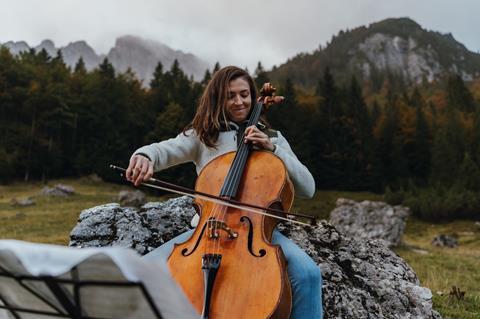
On a Fulbright Scholarship, cellist Sarah Ghandour delved into unfamiliar territory by immersing herself in Slovenian folk music traditions. She shares her year-long experience of making music both with locals and within the country’s landscape
Read more Featured Stories like this in The Strad Playing Hub
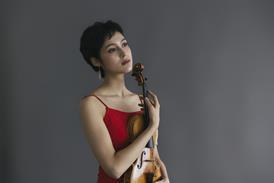
Sarah Ghandour studies baroque cello with Phoebe Carrai at The Juilliard School and is one of two Stone Fellows with Boston’s Handel and Haydn Society, a two-year experience that includes training and mentorship, performances with the H+H Orchestra and Chorus, career counseling, and additional coaching and performance opportunities with partners including the New England Conservatory (NEC).
She completed her undergraduate studies at Bard Conservatory, and earned a Master’s and Doctor of Musical Arts at Stony Brook University. Ghandour was awarded a Fulbright Scholarship to Slovenia, where she researched and performed Slovenian folk and classical music from September 2022 - October 2023. Here, she shares her experiences of her scholarship.
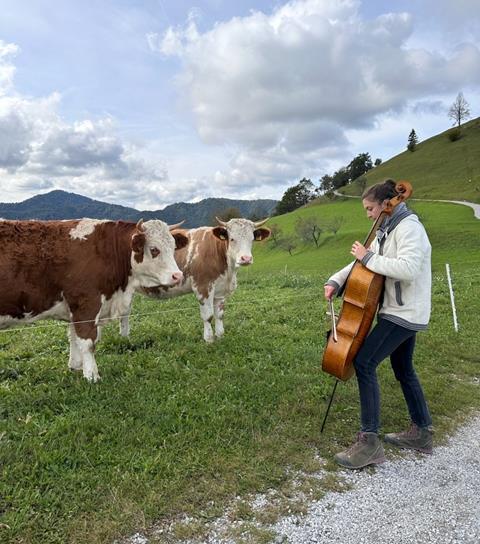
Before applying for a Fulbright Scholarship, I, like many, struggled to locate Slovenia on a map. Slovenia entered my life almost by accident, although in retrospect, it feels more like a quiet inevitability. During the early stages of my Doctor of Musical Arts degree, I gave a lecture-recital on a solo cello work by an Egyptian composer who wove traditional Arab melodic gestures in with Western polyphony. The project had special resonance with a desire to understand the meeting points between musical worlds, especially those shaped by oral tradition and complex histories.
Not long after, my professor, Dr. Erika Honisch, was helping to brainstorm countries for my Fulbright application and made a suggestion that would change the course of my life. ’Have you thought about the Balkans?’ she asked. ’I think you might find something there.’
I then looked up ’The Balkans,’ feeling both sheepish and curious. A list of countries appeared, names I had encountered in history books, but never imagined in connection with my cello studies. Slovenia caught my eye for reasons both logical and instinctive. Its position between Central Europe and the Adriatic suggested a natural meeting place of cultures.
As an avid rock climber, I was drawn to its dramatic mountains and its national climbing hero, Olympic gold medalist Janja Garnbret. But there was something else: I could find remarkably little written about Slovenian music in English. That absence intrigued me.
I had no idea then that if successful, a single year would be nowhere near enough.
During my first week in Ljubljana, I met someone who would alter the course of my Fulbright project and, quietly, the direction of my life with the kind of everyday magic I came to associate with Slovenians. Clarinetist Tomaž Zevnik and I met in the garden of a jazz bar, where the summer air was thick with late-night music. What I thought would be a brief conversation unfolded into hours of talking about Slovenian folk idioms and the musical landscapes of the country.
By the end of the meeting, we were already fast friends. I shared my dream of commissioning a new solo cello work from a Slovenian composer, hiking into the Alps with my cello, and performing it in the mountain huts that form such an essential part of Slovenian culture.
It is difficult to convey what the mountains mean to Slovenians. They are not mere scenery; they are companions, ancestors, guardians. To make music in them felt like the most respectful way to enter the culture.
Tomaž listened, nodded, and at nearly 11 p.m. took out his phone and called two friends, both accomplished videographers and mountaineers. ’She wants to play on the mountain,’ he said. ’Will you help?’ They agreed immediately. Their spontaneity, generosity, and absolute seriousness in the face of a slightly, what I felt was a mad artistic idea revealed something essential to Slovenians: imagination is met not with hesitation, but with enthusiasm.
Mountains are not mere scenery to Slovenians; they are companions, ancestors, guardians. To make music in them felt like the most respectful way to enter the culture
A week later, my phone buzzed. It was Tomaž. ’What are you doing right now? We have a small concert in a nearby village. Come along.’ He drove us to Škofja Loka, the oldest town in Slovenia, its medieval streets folded neatly into the hills. Gugutke, his ethno-folk ensemble, was performing at a local restaurant where each folk tune was paired with a dish from the region it came from. It was an intimate, sensory tapestry.
There are musical moments that fix themselves permanently in one’s memory, and this was one. The astounding musicianship and unpretentious joy with which the musicians played opened my senses to what folk music could be. Slovenian folk idioms were neither quaint nor simplistic. They were deep, regional, rhythmically alive, and emotionally charged. That concert was the moment my love for Slovenian folk music began in earnest.
In the months that followed, I spent long afternoons at the Institute of Ethnomusicology in Ljubljana listening to field recordings from every corner of the country. The archivists humoured my requests for everything from a particular village, decade, or dialect. I would sit for hours transcribing melodies that often-resisted notation.
But my richest education came outside the archive: at birthday parties, during after dinner discussions, and at weddings where the singing would erupt spontaneously. I attended the wedding of a member of Katice, an extraordinary women’s folk chorus. The reception was a flood of harmonies, laughter, clinking glasses, and the kind of communal singing that seemed to rise from a collective well.
Slovenia’s folk traditions vary so dramatically by region that one can almost hear the contours of the landscape inside the music itself. In Prekmurje, the far-eastern plains, melodies unfurl in long, supple arcs. The singing has a plaintive softness, as if meant to drift over fields rather than cut through them.
Bela Krajina, near the Croatian border, preserves one of Slovenia’s most striking vocal traditions: two-voice drone singing in which a steady lower pitch supports an upper line shaped by subtle folk-modal inflections. The effect is earthy and ancient; a sound rooted in communal memory.
In Gorenjska, the mountainous region surrounding Triglav, the traditions become more rhythmic and buoyant; the dance tunes, often tied to circle dances, echo the convivial interlacing of village life. In Haloze, the tradition of na tretko singing, with its close, inner-third harmony, creates a rich, humming resonance that feels both intimate and communal.
And, finally, Rezija, a tiny Slovenian-speaking enclave in modern northeastern Italy, whose vocal practice is unlike anything else in Europe. Marked by continuous drones highlighted by a bright, ornamented melodic line that moves with great rhythmic freedom, Rezija’s singing seems to pass from voice to voice like a living legacy.
Across all these regions, one constant remains: Slovenian folk music is fundamentally a vocal tradition. To spend time with Slovenian folk music is to understand that vocality is not merely a medium; it is the tradition’s beating heart.
Of all my experiences, one of the most unforgettable happened not in a rehearsal studio or archive but on Mangart, one of the high peaks in the Slovenian Alps. With my cello strapped to my back and two friends guiding the route, I hiked up the mountain to film my performance of Slovenska rapsodija, the piece I commissioned from composer Andrej Makor. The work traces nine Slovenian regions through their folk melodies; performing it in the Alps felt like returning the music to its original, elemental home.
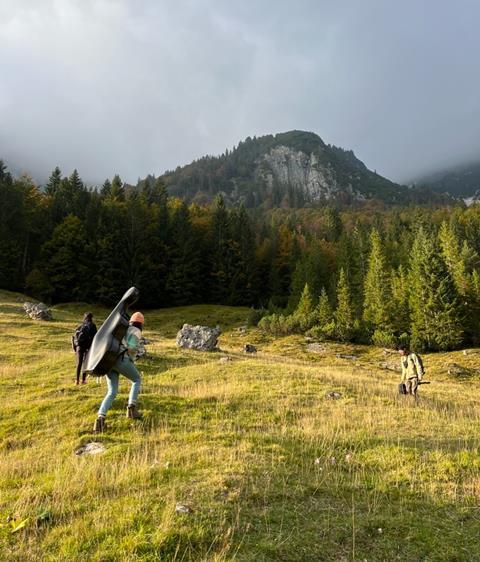
We chose a sheltered valley below the summit, a place where the slopes opened outward like a great natural amphitheatre. As I warmed up, I was astonished that I could hear my own sound returning to me from across the valley. Each phrase came back a fraction of a second later, softened by distance, brightened by altitude, as if the mountain itself were answering. The video, now in its final stages of editing, captures something I still struggle to put into words: music made with nature, not merely in front of it.
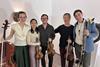
My Fulbright year culminated in a concert titled ’Melodies of Slovenia’, performed at a contemporary art space in Ljubljana. The programme was my love letter to the country that had welcomed me so fully. I performed works by Slovenian Renaissance, 20th century, and contemporary composers. I arranged for cello quartet one of the first folk tunes I ever encountered during my year, which is appropriately titled ’Šlabom na goro’ or ‘I will climb a mountain so high.’ And of course, I collaborated with Gugutke on two of the songs I heard at that first performance of theirs a year previously.
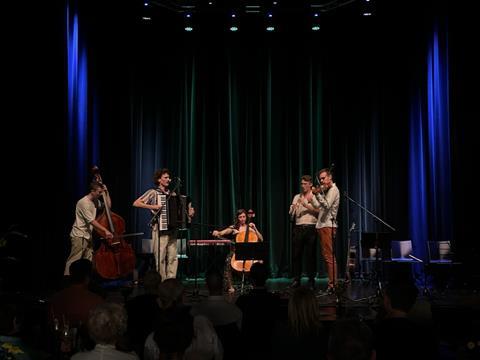
I wish I had words equal to the generosity of the Slovenian people and the depth of their musical heritage. Slovenia has shaped me not only as a musician but as a human being. It taught me to listen differently to landscapes, to communities, to the quiet truths held in regional traditions. Slovenia will remain with me wherever I go.
For those interested in exploring this musical world, Gugutke and Katice offer perfect entry points, richly authentic, inventive, and grounded in living tradition.
Photos courtesy of Sarah Ghandour.








No comments yet