


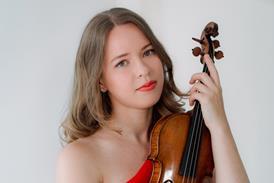



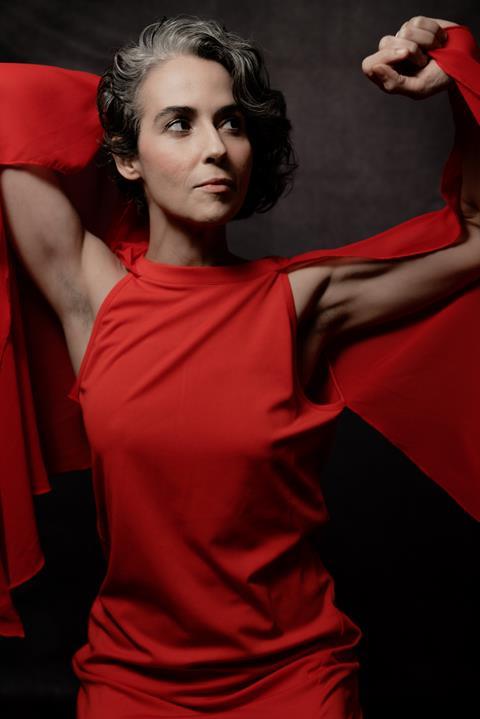
Violinist Harumi Rhodes on the Takács Quartet’s touring commission, NEXUS, which receives its New York premiere at Carnegie Hall on 4 March.
Read more Featured Stories like this in The Strad Playing Hub
On 4 March in Carnegie Hall’s Zankel Hall, the Grammy Award-winning Takács Quartet brings a programme that juxtaposes treasured repertoire with a striking contemporary voice. Between Haydn and Debussy, the quartet – violinists Edward Dusinberre and Harumi Rhodes, violist Richard O’Neill and cellist András Fejér – presents the New York premiere of NEXUS, written for the ensemble by Brazilian-American composer, pianist and vocalist Clarice Assad, whose earlier collaboration with the group yielded Clash (2021).
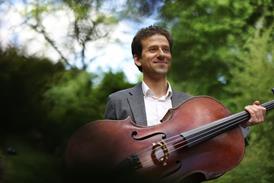
The performance also marks the quartet’s final New York appearance with Fejér, the last remaining founding member, who retires at the end of the season.
Rather than unveiling NEXUS in a single high-profile premiere, the Takács has carried the work throughout its 51st season, allowing it to evolve through repeated performance before arriving on one of the world’s most iconic stages.
Assad conceived NEXUS after observing what she describes as the quartet’s ’visceral, whole-body approach to musical expression’. The work, she writes, ‘amplifies the natural physicality of chamber music performance into choreographed symbolism’, with the players themselves incorporating structured movement into the musical argument.
In her programme note, Assad describes the work as unfolding across three movements. In the opening movement, ‘(Dis)connection’, four individual voices gradually coalesce, drawn together by a gravitational cello pulse. The middle movement, ‘Connection’, presents a more ordered unity, soon unsettled by rigidity and control. In the final movement, ‘Synchronization’, mirrored gestures and physical alignment become increasingly mechanical before giving way to moments of resistance and renewal.
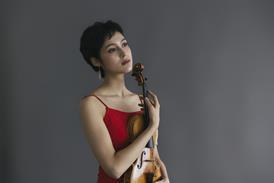
For an ensemble long praised for the way its players remain in constant dialogue with one another and the listener, NEXUS offers both a challenge and a natural extension of its identity, inviting listeners to consider connection, individuality and collective energy in equal measure. Takács violinist Harumi Rhodes shared her thoughts with US correspondent Thomas May about living with the piece on tour and embracing its physical and psychological demands.
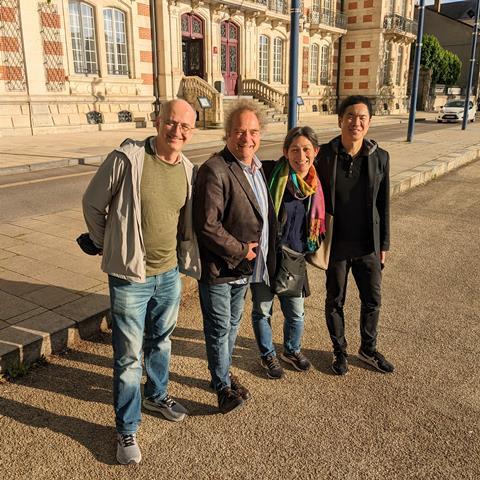
The Takács Quartet has travelled with Clarice Assad’s NEXUS throughout the season rather than introducing it as a one-off premiere. How has the piece changed through repeated performance? What only became clear once you started living with it on tour?
Harumi Rhodes: One of the many things I love about NEXUS is how it morphs and adapts to every physical space. We start the piece in four separate worlds, entering the stage at different times and completely ignoring each other. We form a duo, then a trio, then finally a quartet. Having the luxury of living with the piece on tour, we’ve memorised chunks of music and incorporated more choreographed movements to fit the physical space. In some ways, NEXUS has evolved greatly over time. In other ways, it feels like a new premiere every night.
Clarice Assad has spoken about being inspired by the quartet’s ‘visceral, whole-body approach’ to music-making. Did working on NEXUS heighten your awareness of physicality in performance? Did it articulate something you already recognised in your playing? How did that element challenge – or perhaps liberate – your usual sense of what string quartet performance entails?
Harumi Rhodes: Because Clarice asks us to move around on stage, we decided to film our rehearsals. It was a fun, awkward and painful process – we aren’t in the habit of watching ourselves in this way. We needed help, a trusted outside eye – we called our former student and friend, Michi Theurer. She gave us small tasks to focus on: take each footstep with intention, articulate each head nod, calculate your body placement in relation to each other and to the audience.
Much of this advice is what we strive for in our musical performance: clarity, conviction and character. But the process of using more physical space on stage opened our eyes to how much magnetism we can create between the four of us. Yes, it has been liberating, and also very humbling.
NEXUS traces shifting states of connection, from fragmentation to synchronisation. From inside the ensemble, does that progression feel narrative, psychological, or primarily musical?
Harumi Rhodes: The four characters in NEXUS struggle with the concept of freedom. Are we most liberated when we set out on our own? Do we feel utmost freedom when we achieve connection? Does synchronisation cause us to want to disperse? NEXUS articulates something about our need for connection and also disconnection – and perhaps casts an optimistic light on how this cyclical process is a beautiful part of being human.
You previously collaborated with Clarice Assad on Clash in 2021. What has deepened or changed in the quartet’s musical dialogue since then? What does she bring out in the Takács that other composers perhaps do not?
Harumi Rhodes: I love Clarice’s infatuation with spontaneity and the unknown. Her music demands precision but also asks us to be unhinged. Clarice brings out the more mischievous side of our quartet playing – more capricious, more provocative… more dangerous, in a good way.
At Carnegie Hall, NEXUS is framed by Haydn’s ‘Rider’ Quartet and Debussy’s String Quartet. Do you hear Assad’s work speaking to that tradition in any way? What does NEXUS reveal about where the quartet form can still go?
Harumi Rhodes: The psychology of NEXUS has infiltrated everything we do. That includes the Haydn and Debussy that bookend the programme, and much more. When we have spicy offbeats in Haydn that beg for more interplay, I now find myself saying to the others, ‘Let’s Clarice it up!’ When we have swirling passing material in the Debussy, one of us will seamlessly segue into a swirling passage in NEXUS and burst out laughing.
Our interactions in NEXUS range from disconnected to connected, synchronised to robotic, mischievous to mechanical, imprisoned to liberated, and more. We often talk about a string quartet being its own little village, its own ecosystem. Clarice asks the string quartet to design a whole new psychological universe, creating a strong gravitational pull linking together ideas of individual expression, collective wisdom, artificial intelligence and human connection.
Read: Clarice Assad: Soul of Brazil
Read: 50 years of the Takács Quartet
Read: Takács Quartet announces retirement of founding cellist
Discover more Featured Stories like this in The Strad Playing Hub









No comments yet