













Daniel Temkin outlines how the string quartet provides the perfect palette of sound colour for his Californian landscape-inspired work, ‘Ocean’s Call’

Read more Featured Stories like this in The Strad Playing Hub
Imagine standing on a mountain looking out towards the ocean. Patches of fog and mist gently hover and swirl as you walk among coastal cliffs. Peering into a deep blue ocean hundreds of feet below, waves crash against stark boulders, and light glints off the water. Swept up in this atmosphere, a subtle rush of energy and inspiration wells up within, as you ponder the beauty and sheer scale of your surroundings. Experiences like this lay at the center of my album Maksimal, and in particular, my string quartet Ocean’s Call which was inspired by Big Sur in central California.
It’s one thing to be physically immersed in nature, but quite another to create art in response. How can a piece of music portray vivid visual imagery? How can its abstract sound waves – which we can’t see, or smell, or touch – capture the visceral feeling of sand between our toes, or saltwater stinging our tongue? And, further still, how can music parallel or elicit deep emotions or thoughts we feel when in nature?
When I started composing Ocean’s Call a little over ten years ago, I had recently moved to California. I didn’t have a firm grasp of these exact questions, but I knew in my heart that California’s central coastline had something special and intangible calling out to me. When my friends at Chamber Music by the Bay (a San Jose music education series) asked to commission a new piece, it was a perfect match for this inspiration.
Using a string quartet gave me an incredibly rich colour palette to create sonic metaphors with, but it wasn’t the same as holding up a mirror to Mother Nature, or capturing a perfect photo
I’ve been lucky to hike around the world, from volcanoes in Chile and Hawaii, to seaside cliffs in California and Italy, to expansive canyons and mountain ranges throughout North America, Europe, Asia, and Oceania. Ocean’s Call, similarly, has found its way to distant global corners, from community performances in Bali and Tasmania, to professional events at France’s Philharmonie de Paris, the Bath Festival in the UK, and across the US with Kinetic Ensemble, Lansing Symphony Orchestra and others.
But, it didn’t start off this way. The first performances were in public schools and an assisted living home. The next in an art gallery basement. Those early performances, though intimate and sometimes electric, showed me that translating my oceanic inspirations into sound was no simple task. Using a string quartet gave me an incredibly rich color palette to create sonic metaphors with, but it wasn’t the same as holding up a mirror to Mother Nature, or capturing a perfect photo. Audiences needed an entry point into the expansive music and performers needed atmospheric direction.
Over the years, by coaching many groups and talking to audiences about the piece, I’ve found particular metaphors to describe key musical passages. Some of these were built into the piece – for example, airy harmonics representing fog in the first movement ’I. Hanging Cliffs, Rising Mist’ or literal waves of scales cascading through the ensemble at the stormy close of the second movement ’II. The Bitter Salt of the Sea.’
But other metaphors arrived afterwards – such as asking performers to picture a lighthouse and a sense of arriving home, before playing the closing measures of ’III. Lullaby Waves’ where a final modulation occurs. These analogies seem to help players anchor their interpretation, eliciting instantaneous changes in sound colour and phrasing.
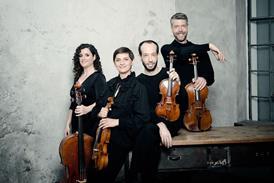
On the Maksimal album, I was fortunate to team up with the acclaimed Aizuri Quartet and engineer Ryan Streber of Oktaven studios. The musicians on this recording – violinists Emma Frucht and Miho Saegusa, violist Ayane Kozasa and cellist Karen Ouzounian – give a remarkable performance. Their subtle sense of articulation and bow colour, and their arresting pacing and clarity across a large-scale work, as well as Streber’s immaculate engineering, all enhance my musical ideas with a rare nuance worthy of the original landscapes that inspired the piece.
To help further tell the story of Ocean’s Call, I teamed up with videographer Evan Chapman of Four/Ten Media. We created a series of short films (that go ’Behind the Score’) to share some of the musical essence and spirit through interviews and landscape photography.
As with hikers traversing ocean bluffs, no two listeners to a piece of music will have the exact reaction in their hearts and minds, and these films don’t try to impose any single way of hearing this piece. But with a glimpse into my creative mind, musical language, and sources of inspiration, hopefully you will feel yourself pulled into this sonic world, as I was when I first laid eyes on the Pacific Ocean as a teenager several decades ago.
Ocean’s Call is released on the album MAKSIMAL (Orchid Classics) on 8 May 2026.
Read: Patrick Roberts and ’Del Gesù’: paying tribute to the legendary maker through timeless music
Read: Two violas, one story: Joanna Borrett’s new work, ‘Then’
Read more Featured Stories like this in The Strad Playing Hub













No comments yet