









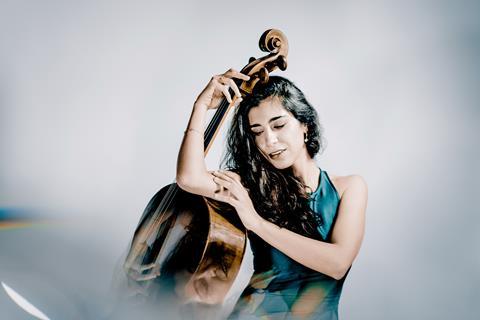
Ahead of her debut album release featuring works by Rachmaninoff, Amy Beach and Alma Mahler, cellist Ariana Kashefi shares how singing and breath informs her musical approach as a string player
Read more Featured Stories like this in The Strad Playing Hub
I’ve always felt that music begins with the human voice. Even with an instrument in our hands, we are still trying to breathe, to sing, and to communicate. That idea sits at the heart of my debut album, In Parallel, which features works by Rachmaninoff, including his Cello Sonata in G minor, op.19 alongside works by his contemporaries Amy Beach and Alma Mahler.
These three composers were writing in quite contrasting circumstances, coming to composition from very different backgrounds, yet their works share that era’s incredible sense of heightened Romanticism and unmistakable vocal quality. Even in the pieces that were not conceived as songs, there is a real sense of songs without words. The lines breathe, expand, and unfold in a way that feels inherently human and relatable.
At the centre of the album is the Rachmaninoff’s Cello Sonata in G minor, op.19. Rachmaninoff’s approach to melody is often linked to his admiration for Frédéric Chopin, a constant influence and inspiration throughout his life. In fact, just a few years after completing the cello sonata, he turned directly to Chopin in his Variations on a Theme of Chopin, Op. 22. Chopin’s melodic writing is often associated with his fascination with singers and with the bel canto tradition, particularly the operas of Vincenzo Bellini.
Bel canto – ’beautiful singing’ – prioritises breath, flexibility, and a seamless, long, sustained line. Chopin absorbed this completely, shaping his piano writing to imitate the voice, using rubato, ornamentation, and phrasing to mirror the natural inflection of a sung line. He famously encouraged his students to go to the opera and listen to the great sopranos of the day, such as Guiditta Pasta, rather than spending hours on purely technical exercises. Singing, to him, was the essence of music-making.
That idea of emulating how a lieder or operatic singer might approach this repertoire has felt central to my interpretation of these pieces. For me, it often comes down to simple questions: where would a singer breathe? Where is the line leading? Am I shaping this phrase musically, or am I being limited by my instrument?
In the Rachmaninoff sonata, the cello writing is built on long, sustained lines that only really come alive when approached through the idea of breath. There is a sense of longing and expansiveness that feels inseparable from vocalisation. At the same time, the sonata is not a solo line with accompaniment – Rachmaninoff insisted on equality between cello and piano. Musical ideas are constantly passed between the two, often feeling like a conversation or duet between two singers.
There is also the influence of Russian Orthodox chant, particularly in the use of close intervals and repetitive, meditative motifs. In the third movement, the almost obsessive repetition of single notes to me evokes prayer or plainchant. Again, this connects naturally to the voice — to chant, to breath, to the idea of sound as something deeply human.
Alongside the sonata, the album also includes an arrangement of Alma Mahler’s song, Die Stille Stadt and Rachmaninoff’s Zdes’ khorosho. Interestingly, I didn’t feel the need to approach these songs in a fundamentally different way. Singing is instinctive; it exists almost before language. Because of that, the most natural way to shape a phrase is to relate it back to something vocal. Even without words, I often imagine an underlying text or narrative – something that gives direction and prevents the line from becoming purely technical.
It is true that when there are words, as in the Alma Mahler song, there is an added layer of clarity for the performer. The text provides meaning, but also structure: punctuation, pacing, breath. In Die Stille Stadt, for example, the opening has a suspended, almost haunting quality. The text reads:
A town lies in the valley,
A pale day is fading;
It will not be long
Before neither moon nor stars
But night alone will deck the skies
The words offers an added insight into the emotional world of the piece, which we can then translate instrumentally — allowing space where a breath might fall, or shaping a phrase towards a particular moment of intensity. To capture the essence of this opening, I have tried, for example, to play sul tasto, with very little bow weight or pressure, to create this almost otherworldly atmosphere.
Ultimately, although we rely on technique to achieve these expressions, thinking vocally is about removing the barrier between technique and expression, so that what remains is simply the line in its most natural, human form.
Ariana Kashefi’s album In Parallel is out on 15 May (Champs Hill).










No comments yet