
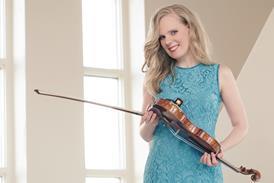








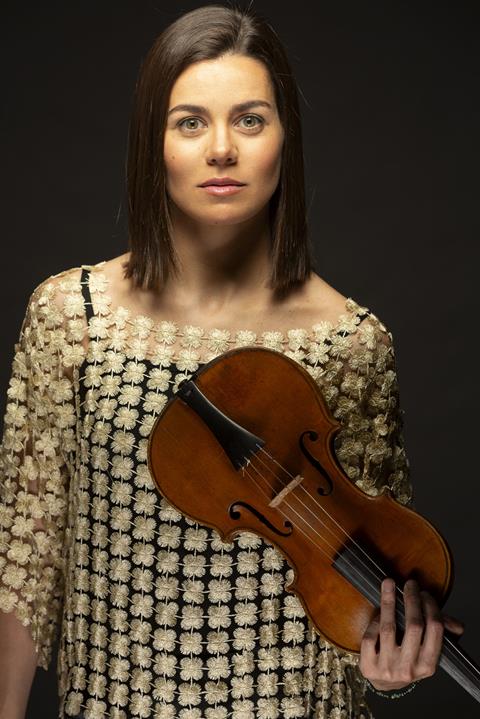
Cristina Prats Costa outlines the inspiration behind her solo recording debut Spiritillo Mediterraneo, a portrait of Baroque music shaped by Mediterranean cultures that reflects her own artistic journey and heritage
Read more Featured Stories like this in The Strad Playing Hub
Spiritillo Mediterraneo began with a simple question: how do we capture the sense of freedom at the heart of Baroque performance?
The title of this album comes from Il Spiritillo Brando by Andrea Falconieri, a piece full of energy, unpredictability, and character. The ‘spiritillo’ became, for me, a way of thinking about music, that moment in performance when the music feels alive, where structure and imagination meet, and the performer shapes the material in real time.
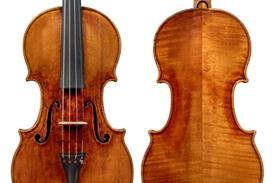
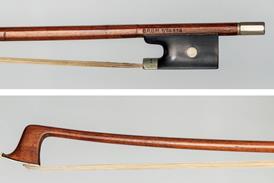
This is closely connected to the art of ornamentation, which I love deeply for its liveliness and spontaneity, its ability to renew the music with each performance, and which first connected me to Baroque music and made me fall in love with the Baroque violin.
The repertoire on this album reflects a historical moment when the Mediterranean functioned as a space of exchange rather than division. Cities such as Naples, Venice, Cádiz, and Barcelona were connected through travel, trade, and artistic collaboration.
Musicians moved between courts and regions, carrying styles with them and adapting to new contexts. What we often describe as distinct national styles were, in practice, closely intertwined.
This perspective shaped my choice of repertoire. Rather than focusing on a single region, I was drawn to the idea of a shared musical language, one formed through contact, adaptation and dialogue. I have a particular affinity for Nicola Matteis, whose music I deeply love for its imaginative freedom and expressive unpredictability, an Italian voice transformed through his life in England.
I feel a similar admiration for Heinrich Ignaz Franz Biber, whose virtuosic writing expands the expressive possibilities of the violin in striking and often surprising ways. Alongside composers such as Jean-Féry Rebel and Antonio Vivaldi, their music reflects how Italian idioms travelled across Europe, shaping a broader expressive language.
The most personal dimension of the project lies in the Spanish repertoire. Although it forms part of my cultural background, it was not central to my early training, which focused largely on Italian, French and German traditions. It was only more recently that I began to explore it in depth, particularly the guitar repertoire of Gaspar Sanz and Santiago de Murcia. What struck me was its immediacy, a strong connection to rhythm, dance, and popular traditions.
I was born in Ibiza and grew up surrounded by traditional music, the sound of castanets, the drum, and the flauta pagesa (traditional flute). These sounds were never something I studied; they were simply part of everyday life. Their rhythmic clarity and expressive character have remained with me, and I often recognise echoes of them across many musical styles.
Rather than focusing on a single region, I was drawn to the idea of a shared musical language, one formed through contact, adaptation and dialogue
This discovery led me to create my own arrangements of works such as Españoleta by Gaspar Sanz, Seguidillas by José de Nebra and Fandango by Santiago de Murcia. In the case of Españoleta, for example, I created an extended arrangement of around six minutes based on a simple eight-bar phrase from the original manuscript, allowing repetition, variation, and ornamentation to gradually unfold the music over time.
This process reflects a central aspect of Baroque practice, where a concise musical idea becomes a space for invention and expressive transformation. Rather than aiming for literal transcriptions, I approached these pieces as materials to be reimagined. The challenge was to translate the essence of guitar writing, its rhythmic vitality and harmonic framework, into a violinistic language, rethinking texture, articulation, and phrasing while allowing ornamentation to shape the musical line. In this process, the violin moves between lyricism and rhythm, responding to the expressive world of the guitar in a way that feels natural to the instrument.
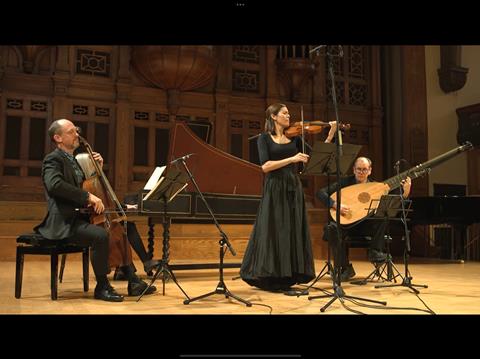
With José de Nebra’s Seguidillas, the approach shifts slightly. His music, closely connected to the theatre, invites a more vocal and rhetorical interpretation. Here, phrasing, timing and ornamentation shape the musical line, drawing the listener into a more expressive sound world.
Improvisation played an important role throughout the project, allowing the music to retain a sense of movement and responsiveness. This approach is closely connected to my research into ornamentation as a form of musical language, something internalised and adaptable rather than fixed.
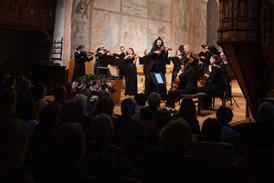
Collaboration was central to the realisation of this project. The musicians involved approached the repertoire with openness and sensitivity, engaging with it as something flexible and evolving. This shared approach was essential in capturing the character I associate with the ’spiritillo.’
Spiritillo Mediterraneo is ultimately an exploration of how this repertoire can be approached today. Rather than presenting it as something fixed, the aim is to engage with its flexibility, openness, and capacity for transformation.
At its core, this music invites participation. Its vitality lies in its ability to adapt, to respond, and to remain open, qualities that continue to resonate in performance today.
Spiritillo Mediterraneo by Cristina Prats Costa is out on 1 May 2026 on Pentatone.
Photos courtesy Pentatone.
Read: Hugo Ticciati: Programmes for embodied listening
Read: Earth Day with ecofeminism: exploring nature-inspired works by women composers
Read more Featured Stories like this in The Strad Playing Hub











No comments yet