








Lutherie – Page 24
-
 Premium ❘ Feature
Lutherie in the Vogtland: Stars of the East
The Vogtland in eastern Germany produced some of the country’s least known and most fascinating instrument makers.Rudolf Hopfner and Monika Lustig use CT scans to lift the lid on their unusual construction methods, and show why they should be more widely studied
-
 Premium ❘ Feature
Trade Secrets: Neck shaping
A quick and accurate method for this crucial part of the making process
-
-
 Premium ❘ Feature
Trade Secrets: Inlay techniques
Giving a decorative flourish to an instrument can add a personal touch – and be a true test of skill
-
 Premium ❘ Feature
Making Matters: A head for figures
Luthiers such as Jacob Stainer often surmounted their instruments with elaborately carved heads rather than scrolls. Lloyd McCaffery, a professional wood carver, explains how he developed a modern take on an ancient art form
-
 Premium ❘ Feature
Chinese Tonewoods: Interesting Times
For luthiers worldwide, European wood is still viewed as the best for making stringed instruments – even though China’s forests are filled with high-quality spruce and maple. Xue Peng presents the results of a study comparing the tonewoods of China and Europe, with some startling conclusions
-
 Premium ❘ Feature
Trade Secrets: Notes on cello endpin fitting
A guide to veneer bushing and creating an ‘abrasive reamer’ for making adjustments
-
-
 Premium ❘ Feature
Making Matters: The Sound of Science
Tom Croen reports on a 2019 experiment to discover how much variation in sound can be gained from fingerboard ‘tuning’ – and how alternative materials fare against traditional ebony
-
 Premium ❘ Focus
Trade secrets: bending the slope on a viola da gamba back
Care and accuracy are both essential for this delicate part of the making process. By Gabriela Guadalajara, luthier based in New York, NY, US
-
 Premium ❘ Feature
Universal Harmony: the ‘Four Circles’ system of violin making
Luthiers over the past three centuries have used a vast number of patterns for their instruments – but the basic geometric principles remain constant across them all. Kevin Kelly explains his ‘Four Circles’ system for instrument design, adaptable to violins, violas and cellos
-
 Premium ❘ Feature
Digital Amati: project luthier
A decade ago, François Denis’s Traité de Lutherie showed how the old Italians used Euclidean geometry to design their instruments. Now a computer program based on these principles allows luthiers to construct and adapt patterns quickly and easily. Its creator, Harry Mairson, explains the genesis of Digital Amati
-
 Premium ❘ Focus
Trade secrets: a method for cooking oil varnish by Nicolas Gilles
A technique that relies on the senses and helps you get the right varnish for your needs, by Nicolas Gilles, luthier in Villeneuvette, France
-
-
 Premium ❘ Feature
Sartory and the fake bows: Phoney war
One of France’s greatest bow makers,Eugène Sartory sued an unscrupulous American dealer who flooded the market with fake bows. Using the original court transcripts and contemporary news reports, Gennady Filimonov uncovers how the Frenchman sought justice
-
 Premium ❘ Feature
Jacques-Pierre Thibout: violins fit for a king
One of the key Parisian luthiers of the early 19th century, Jacques-Pierre Thibout had a distinctive – and often innovative – making style. Florent and Serge Boyer examine ten of his violins to track its evolution, and show why he became luthier to King Louis-Philippe
-
 Premium ❘ Focus
Trade secrets: An innovative method of neck setting
Gluing the neck to the ribs before the top and back plates allows for a more accurate and hassle-free process. By Hayato Nagaishi, luthier based in Cremona, Italy, and Tokyo, Japan
-
 Premium ❘ Feature
Pressenda: Combined impact
Despite his instruments showing very little difference in form, Giovanni Francesco Pressenda was one of the most idiosyncratic – and innovative – Italian luthiers of the 19th century. Drawing on 20 years of research, Tsutomu Miyasaka reveals how his style reflected both the French and Italian makers of his day
-
 Premium ❘ Focus
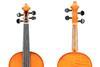
In focus: a 1972 violin by Alfredo del Lungo
Alfredo Del Lungo began studying the art of violin making at the workshop of his father, Giuseppe Del Lungo (1883–1926), while also taking cello lessons at the Conservatorio Cherubini in Florence. In 1933, aged 24, he was appointed official luthier to the Stabile Orchestrale Fiorentina, which soon became the Orchestra ...
-
 Premium ❘ Feature
Fingerboards: The lighter option
While the acoustics of the violin soundbox have undergone rigorous testing, the neck and fingerboard have been virtually ignored. Joseph Nagyvary reveals the results of experiments showing that a lighter material might be preferable to the standard ebony