












An impressive period-instrument set of these Mozartian treasures
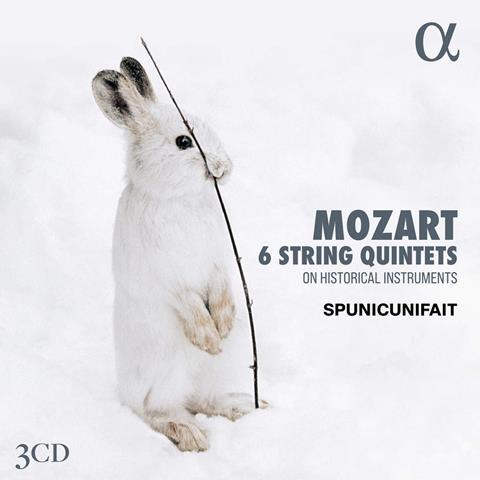
The Strad Issue: October 2025
Description: An impressive period-instrument set of these Mozartian treasures
Musicians: Spunicunifait
Works: Mozart: Six String Quintets: no.1 K174, no.2 K406, no.3 K515, no.4 K516, no.5 K593, no.6 K614
Catalogue number: ALPHA 1137 (3CDs)
Formed specifically for the study and historical performance of Mozart’s six string quintets, Spunicunifait takes its name from a mystifying three-word phrase coined by Mozart in his correspondence with a cousin.
Based on Henle’s Urtext edition, which significantly draws upon some previously unknown written-out parts incorporating additional annotations of dynamics, articulation and other details in the composer’s hand, these players’ perceptive interpretations are imbued throughout with a spirit of collegial discovery and enjoyment.
Tempos are carefully determined for optimum clarity of detail in the intricate counterpoint in, for example, K174’s finale and K406’s ingenious Menuetto in Canone; and not even Spunicunifait’s breakneck speed for K593’s Allegro finale can cloud the performers’ communication of Mozart’s contrapuntal artifice.
Particularly striking is the flexibility with which the musicians manipulate the pulse, as in the coda of K516’s opening Allegro; and any feeling of 3/4 is all but lost at the beginning of K516’s Menuetto, courtesy of the space given over to negotiating its dramatic dynamic contrasts and persistent off-beat interjections of two aggressive chords.
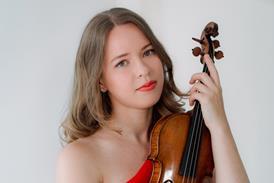
Subtle rubato usage and lingering tenutos, particularly those executed by lead violinist Lorenza Borrani, further emphasise this freedom, which also allows Spunicunifait time to highlight Mozart’s various harmonic audacities to maximum effect, notably in K515.
Despite such extensive tempo modification, the ensemble is impeccable throughout, evidenced, for example, by the powerful unison passages in K174’s second movement and K593’s contrapuntal final Allegro.
These players have tuned, unusually, to a’= 432Hz, and their intonation is mostly spot on. They exploit the full range of Mozart’s rhetoric and expressivity, faithfully reproducing the composer’s dynamic annotations in K174’s Adagio and K515’s Allegro and finale. The group’s tonal blend is also striking, particularly in the hushed opening of K515’s Andante and in K516’s muted Adagio.
Extempore ornamentation is only occasionally introduced, but it is tellingly employed in K174’s Menuetto, K614’s Andante variations and in the decorated fermata, varied on the repeat, in K593’s Menuetto. Slides are occasionally used for both convenience in shifting and expressive effect and vibrato is introduced modestly for additional colour.
Instrumental dialogue is well conveyed, with the engaging interplay between Borrani and first violist Max Mandel standing out particularly meaningfully in the slow movements of K174, K515, and K515’s opening Allegro, and between Borrani and first violist Simone von Rahden in the slow movement of K593.
Virtuoso passages in K406’s variation finale, K515’s energetic, high-spirited final rondo and K614’s opening movement extend the spotlight across the whole ensemble. Much is made of silence in realising phrasing, marking breathing points or highlighting structural pillars (K516’s slow movement and finale and the opening movements of K174 and K406 provide notable examples).
Captured in two periods of sessions in very different German venues, the close recordings admit some extra-musical noises, but are otherwise clear and warmly reverberant. One presentational blemish in my advance copies of the audio files may cause embarrassment to the booklet editors at Alpha: the identity of K515’s two middle movements is interchanged.
Robin Stowell










No comments yet