






![Ayanna Witter-Johnson [Jordan Woods] 7](https://dnan0fzjxntrj.cloudfront.net/Pictures/274x183/4/9/4/44494_ayannawitterjohnsonjordanwoods7_224583.jpg)






Two Auer pupils prove a mixed listening experience
The Strad Issue: May 2026
Album 1: Toscha Seidel: American Columbia Recordings
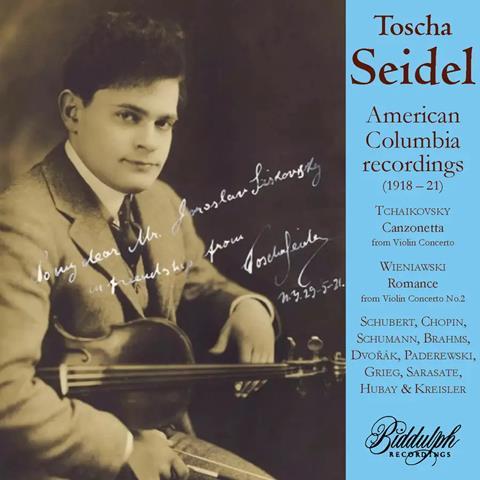
Musicians: Toscha Seidel (violin) Louis Gruenberg, Harry Kaufman (piano)
Works: Tchaikovsky: Violin Concerto (Canzonetta only). Wieniawski: Violin Concerto no.2 (Romance only); works by Brahms, Chopin, Dvořák, Hubay, Kreisler, Sarasate, Scharwenka and Schubert
Catalogue number: BIDDULPH 85067-2
Album 2
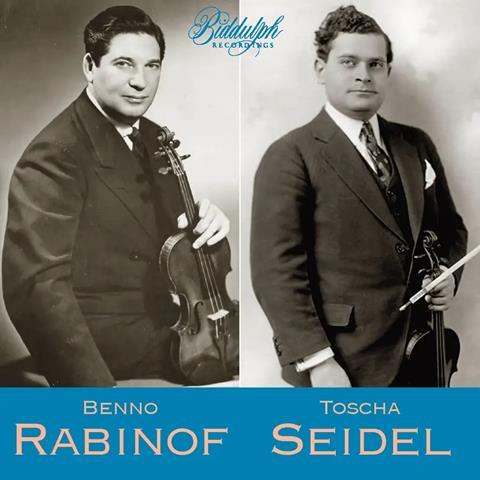
Description: Two Auer pupils prove a mixed listening experience
Musicians: Toscha Seidel, Benno Rabinof (violin) Harry Kaufman, Sylvia Smith Rabinof (piano)
Works: Franck: Violin Sonata. Grieg: Violin Sonata no.3; works by Albéniz, Brahms, Dvořák, Falla, Granados, Kreisler and Sarasate
Catalogue number: BIDDULPH 85066-2
These two discs enhance (if that is the right word) our knowledge of Toscha Seidel (1899–1962), who has a mythical reputation even though his career did not fulfil its early promise. I have encountered various pundits, even the generally reliable Boris Schwarz, scratching their heads over the reason for his relative eclipse.
I see it this way: Auer equipped Seidel with a lovely tone and a dazzling technique but no teaching could make up for his weakness in rhythm.
He first recorded in 1918, for Columbia. Even allowing for acclimatisation to the rigours of the acoustic process, he is utterly adrift in slow pieces. He is fine if the rhythm is obvious and he can throw off strings of little black notes; but, as we know, good rhythm over slow spans is even more vital. He doesn’t give the impression of singing Schubert’s ‘Ständchen’ mentally; and in two Kreisler pieces the subtle, teasing rubato which was a hallmark of the composer is beyond him.
In 1919, at Track 11, he acquires a better pianist – Harry Kaufman – a noted pupil of Sigismund Stojowski and Josef Hofmann. Hubay’s Hejre Kati may not be the most Hungarian version, but at least it goes with a zing. Almost everything from now on is pleasantly played – his double-stopping is beautiful – although in Tchaikovsky’s Canzonetta the phrasing is penny-plain.
The other CD resuscitates the only solo LPs made by Seidel and Benno Rabinof. The recorded sound on the Seidel is horrible and there is more than a hint of the violin-heavy ‘American balance’ which ruined most of Heifetz’s sonata records.
Fortunately, Kaufman has the personality to keep him in the picture. Grieg’s C minor Sonata gets a dramatic reading but I long for Seidel’s phrasing to be a little more ‘stretchy’, to use Albert Sammons’s word. If we refer to the benchmark recording by Tellefsen and Knardahl, we find their interpretation both more flexible and more folk-inflected. Seidel and Kaufman’s Franck is better but ultimately not memorable – I miss Thibaud’s magic.
Rabinof (1902–75) was one of Auer’s American disciples and his wife Sylvia Smith (1913–2001), a Serkin pupil, was a front-rank musician in her own right. Though a note near the start of the Brahms/Joachim Hungarian Dance no.20 sounds slightly flat, Rabinof gives a good account of himself here – I like his Zigeunerweisen as much as virtually any other. The Granados-Kreisler Spanish Dance is a little cut, but violin fanciers will be glad to have nine pieces by this unfairly neglected artist.
TULLY POTTER








No comments yet