








When music lessons are designed for inclusion, all students benefit. Katherine Findlay Hagstrom offers some practical strategies and methods for meeting the needs of students in large string ensemble settings, to ensure that music making is enjoyed by everyone
Read more Featured Stories like this in The Strad Playing Hub
Approximately 15 percent of students in the US receive special education services under the Individuals with Disabilities Education Act (IDEA), and that does not even include students who are English Language Learners or those experiencing poverty.
We are (finally) entering an era where many schools are embracing inclusive models, and our classrooms are beginning to reflect what we already know to be true: The arts are for all.
Now in my twelfth year of teaching, I’ve seen firsthand how much our classrooms have evolved. Early in my career, I quickly realised that I was not fully prepared to teach in inclusive settings. Over time, I created adapted music classes and collaborated with my school teams to learn how to better meet the needs of my students. The growth that I saw, both in my students and in my own teaching, sparked a desire to learn more. I returned to school to study music therapy, which gave me a new lens for creating accessible, inclusive classrooms.
When we design for inclusion, all students benefit.
With classes often ranging from 90 to 120 students (yes, at the same time), there are countless needs. Can I meet every individual’s needs perfectly? No. What I can do is be intentional in my inclusive methods.
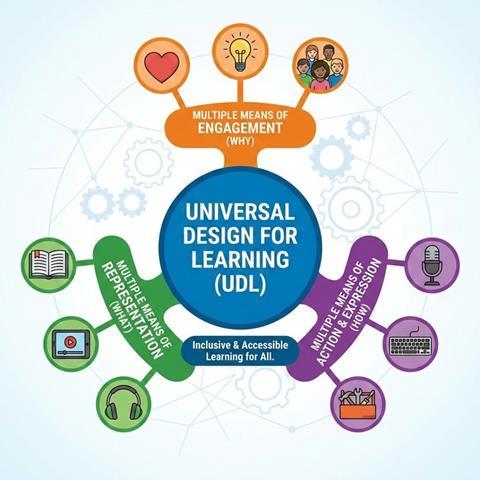
Frameworks like UDL (Universal Design for Learning) and DEIA (Diversity, Equity, Inclusion, and Accessibility) are essential starting points. Inclusion can feel overwhelming, but it doesn’t have to be all-or-nothing. Here are ten practical strategies you can start using tomorrow.
1. Start with the mindset: Music is for everyone
This is the foundation.
Music is part of our biology, culture, and identity. An inclusive mindset means:
- We are not ‘fixing’ students, we are removing barriers
- An individual’s goals may look different, and that’s OK
- We are not teaching to the test. We are enriching lives through music
There will be hard days, so I try to reframe challenges as growth opportunities for myself, my students, and the ensemble as a whole. Then, I reset: new day, fresh start, intentional adjustments and cautious optimism.
2. Build your support team (and actually use them)!
You are not meant to do this alone. When I refer to ’your team’ throughout this article, this is who I am referring to. Your team might include:
- Education Specialists
- School Psychologist
- Behaviour Specialists
- Occupational Therapists
- Adapted PE
- Administrators
- Nurse
- Speech therapists
- Counsellors
- Classroom/content teachers
- Paraprofessionals
Paraprofessionals are gold. They often know students best because they see them across the entire day. When I began collaborating closely, asking questions, inviting input and building relationships, the students clearly had more meaningful music experiences.
If they seem disengaged, invite them in. Build the relationship just as you would with a student.
3. Advocate for access and understanding
Access to formal accommodation documents
- Ask for IEPs (Individualised Education Program) and 504s (If you are a credentialed teacher, you have a legal right to them)
- IEP: An Individualised Education Program (IEP) is a written plan developed by a team of educators and parents to ensure a student with a disability receives specialised instruction and related services
- 504: In the US, students who do not require specialised instruction but still need support – such as extra time on tests for ADHD or elevator access for physical disabilities – often use a 504 Plan. Named after Section 504 of the Rehabilitation Act, it is a civil rights protection designed to remove barriers to learning and ensure ‘equal access’ to the classroom.
Request in-person meetings.
- Beginning-of-year meetings
- Go over the IEPs/504s (formal accommodation documents) with your team.
- Demonstrate that you are a part of the team: ’How can I best support this student?’
- If possible, attend the IEP meeting
IEPs (formal accommodation documents) are essential, but they don’t tell the whole story
Ask about what is not in the document. During in-person meetings, I often learn things like:
- A student is currently unhoused
- A student cannot tolerate certain sensory experiences
- A student is navigating complex family situations
- A student is struggling, but does not have official documentation
These details shape how students show up in your classroom. Understand the whole child, not just the documents
Understand the whole child, not just the documents
4. Cultivate an inclusive classroom culture
Creating a positive classroom climate is a big topic that can’t be covered in a few bullet points, but here’s a starting place:
Demonstrate with your own actions. Students are always watching us. If we model patience, encouragement, and celebration of effort, they will mirror us.
Try simple language shifts:
• ’Play to your strengths’
• ’How can you support your team?’
• ’Everyone’s contribution matters’
• Integrating goals such as: ’Can we match bows?’ ’Start and stop together’
Provide sentence frames for peer encouragement and use stand partners as built-in teams. Peer support builds empathy, leadership, and musicianship simultaneously.
5. Make your environment sensory-aware and seating intentional.
Students experience the classroom differently, especially in a strings setting where sound, movement and space can be overwhelming.
Small adjustments help:
- Noise-reducing headphones
- Dim lighting
- Intentional speaker and instrument placement
- Fidgets or sensory tools
Ask your team: ’What signs of overstimulation should I look for?’
Use preventative actions rather than being reactionary
Rethink seating for access, not just ensemble sound
Seating is one of your most powerful tools. In large ensembles:
- Start with grid seating for clarity (straight lines before arcs)
- Clear aisles improve access and safety
- Colour-coded systems simplify grouping
Important considerations:
- Proximity to exits (close or far depending on the student)
- Visual and physical needs
- Proximity to bathrooms
- Peer dynamics
- Access to space ‘wiggle room’
For some students, defining personal space with tape or clear boundaries is helpful.
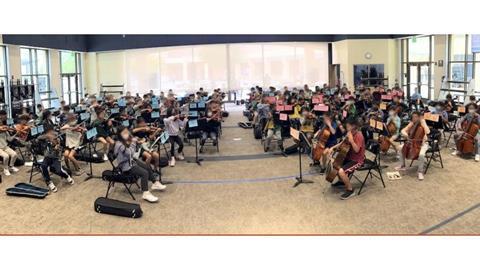
Physical inclusion through proximity is ideal. Sometimes inclusion doesn’t look like proximity. Due to safety concerns, I once had a student who needed space between himself and the ensemble, and for him to be seated near the door for safety. It wasn’t ideal, but I listened to my team’s advice, and it allowed him (and others) to participate safely.
Balance belonging with safety.
6. Use predictable routines and intentional transitions
Routine is one of the most powerful tools. When students know what to expect, they can focus on learning instead of managing uncertainty.
Big Picture:
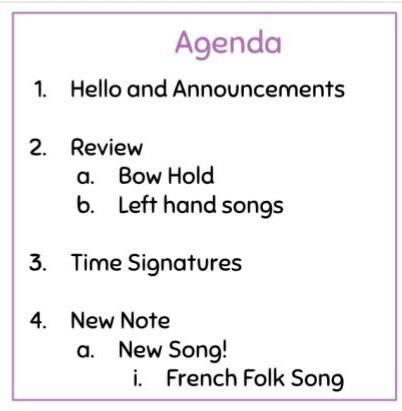
- Post a daily agenda
- Keep entry and exit procedures consistent
- Use thoughtful and consistent seating charts
- Use clear and familiar lesson structure
When possible, let students know before they enter if there is a change in routine.
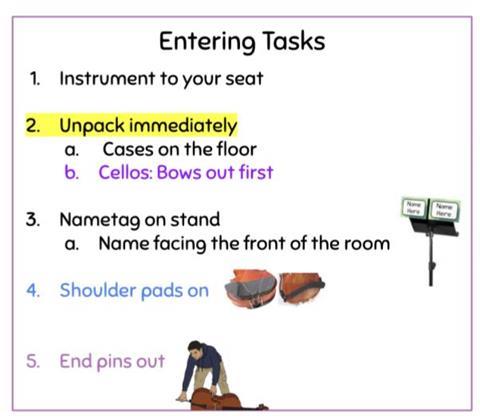
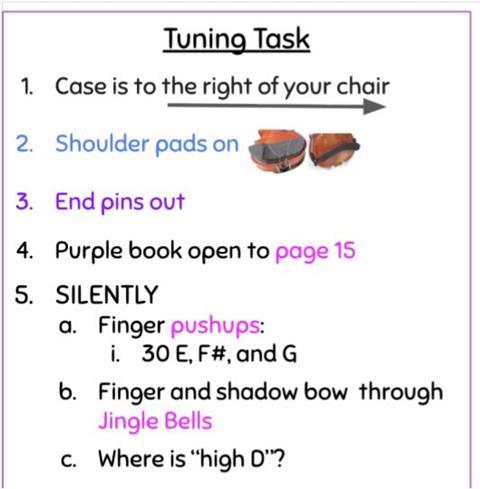
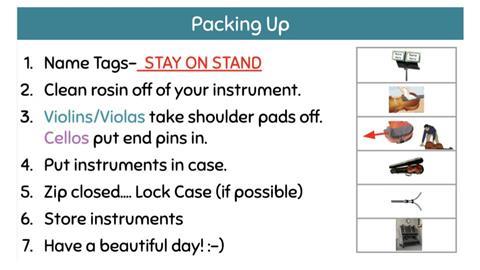
Zoom in: Break routines into small steps with visuals until the routine is established, such as:
- How to unpack and pack
- Instrument care
- Bow care and use
- Instrument storage
Design intentional transitions
Transitions are often where things get sticky icky.
When possible, use systems already established by your school team. Helpful tools include:
- ’First/then’ language
- Example: ’First music, then snack’ or ’First tuning, then playing’
- Visual countdown timers paired with statements
- Example: ’Five more minutes of playing, then break’
- Visual schedules and/or activity icons
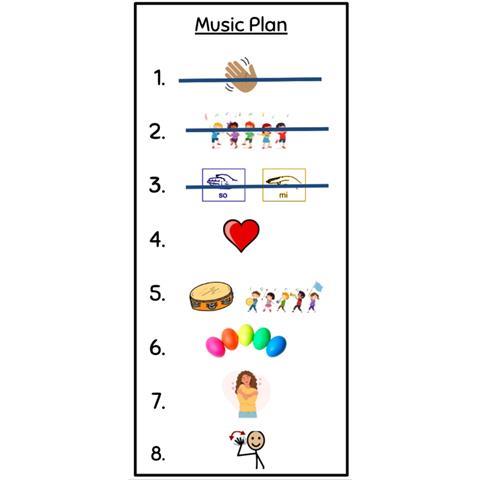
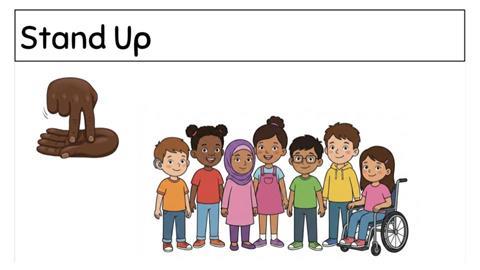
- Transition slides with ASL (American Sign Language) or visuals that your team uses
7. Layer your instruction.
Multi-modal instructions give more opportunities for ALL students to access the information.
Layer communication:
- Visuals (slides, posters, icons, color-coding, ASL)
- Verbal instructions
- Demonstration
- Tactile support when possible
PowerPoints
- Agendas are posted at the beginning and continue throughout the presentation. Visuals are a plus!
- Display expectations and reminders of routines such as entering tasks, exit tasks, test-taking, etc.
- Transition slides with visuals. ’All done ___, next is ____’
- Request sitting positions – verbally and with visual cues.
- Use close up visuals: Bow setup, bow hold, right and left hand finger placement, etc.
Other supports:
- Colour-coded fingerings or sheet music
- ’First/then’ boards
- Posters/objects in the room to help orient left/right
- Simple AAC (Augmentative and Alternative Communication) tools
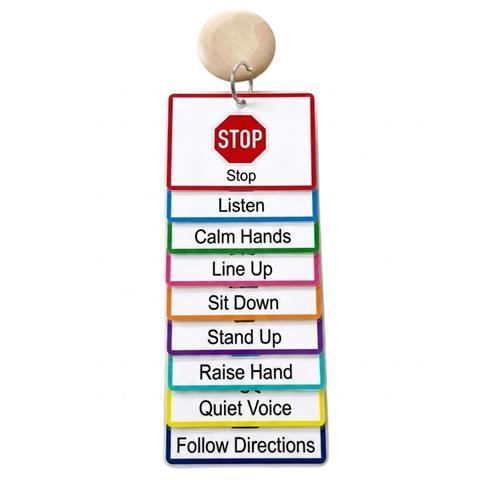
- Flip charts with icons of expected behaviour
- Programmes with icons: Symbol Stx and Widgitonline.com
One of my favourite tools is to use visual reminders on student name tags that hang over the music stands. They are always easily accessible.
8. Use thoughtful adaptations
Sheet Music
- Colour-code finger tapes with note heads
- Colour-code strings and use a system like ‘Green 1, green 2…’
- Colour-code patterns in the sheet music
- Enlarge music
- Braille music
- Simplified or open-string arrangements
- Tinted overlays or invert colours for potential help for students with dyslexia
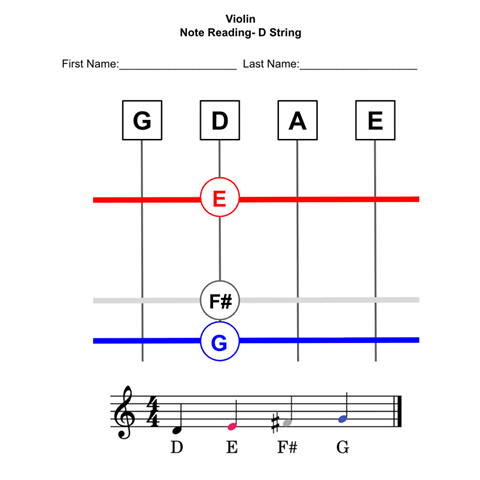
Adapted Instruments: Collaborate with your site’s Occupational Therapist.
- Remove or rearrange strings
- Use alternative playing positions such as:
- Viol da gamba style
- “Left-handed” (only for specific disabilities, not for student preference)
- Lower and/or label the bridge
- Explore adaptive or electronic instruments
- Work with specialists to create custom supports (including 3D-printed tools)
9. Proactive Behaviour Support
Addressing challenging behaviours is part of teaching. Work with your team and focus on proactive strategies:
- Build relationships
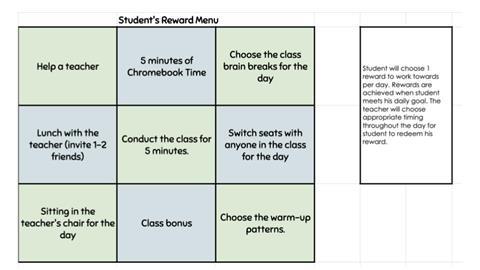
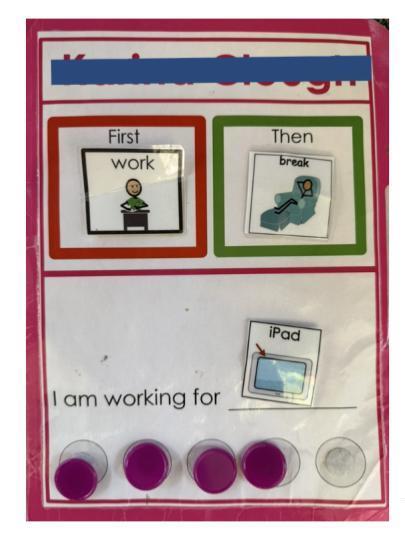
- Behaviour or reward systems
- Can be tailored to the needs and maturity of the student
- ’Working toward’ goals (like breaks)
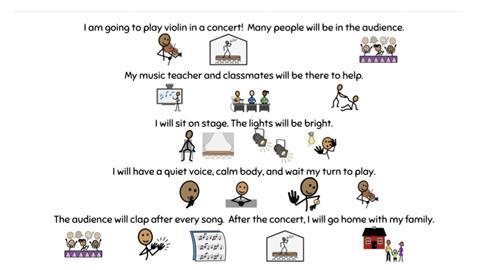
- Social Stories/Songs
- Pair visuals and simplified story/song to prepare students for things like new experiences, transitions, socialisation and big feelings.
- Planned ignoring when appropriate
- Redirect students to the wanted behaviour.
Depending on needs, tools may include:
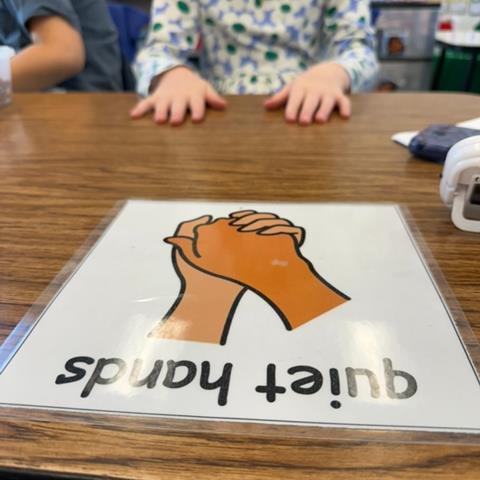
- Simplified language with visuals, such as ’Quiet hands’
- AAC to encourage communication of feelings and wants
10. End class with regulation, not chaos
In the past, I wanted students to leave class hyped, but that often led to dysregulation. Now, I use principles from music therapy, like the iso principle (Matching and gradually shifting energy levels).
- Slow the tempo
- Sometimes dim the lights
- Match breath to bow (whole notes or longer)
- Down bow = inhale
- Up bow = exhale
- Incorporate calm, intentional playing and even intentional thinking: ’What is something you are proud of from this class?’
Then we move into a structured exit routine.
I often do this as a warm-up as well. You can match energy with tempo, and gradually slow down, bringing very intentional focus to the playing.

Final thought
What’s one change you can make to help more students access music?
Start small. Stay curious. Lean on your team. Celebrate progress and intention, not just perfection.
Honour the daily thoughtful choices that remove barriers and invite every student into the musical experience. When we intentionally design spaces where all students can access music, the ensemble becomes stronger, the music becomes richer, and success extends beyond performance.
An inclusive music classroom reflects human values, who we are, and who we believe belongs in music: everyone.
Katherine Findlay Hagstrom is a credentialed music educator, music therapist and advocate for equitable access to arts education. She has received Irvine Unified’s Teaching in Excellence Award, SCSBOA Rising Star Award, Orange County Outstanding Arts Educator Award and Orange County Special Education Arts Educator Award. She has presented workshops for organisations including ASTA, CASMEC, MTAC, UCLA, Chapman University and Irvine USD.











1 Readers' comment