







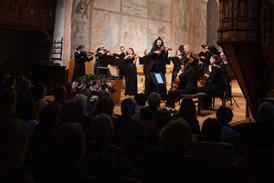



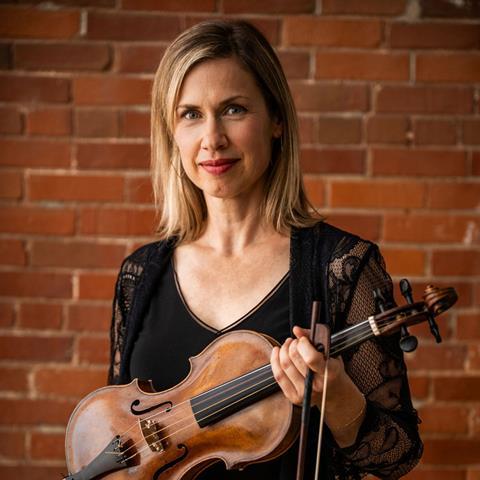
Violinist Cristina Zacharias, the artistic co-director of Tafelmusik Baroque Orchestra, reflects on the formative impact of pioneering female leadership at the ensemble and how that legacy continues through shared authority, equity and the rediscovery of women composers
Read more Featured Stories like this in The Strad Playing Hub
When I joined Tafelmusik in 2004, I was in my late twenties – grateful, a little awestruck, and not yet fully conscious of what I was stepping into. I knew I was lucky to join an internationally renowned baroque orchestra. What I did not immediately grasp was how rare it was for an organisation of this stature to be led by a female music director and a female managing director, as Tafelmusik had been since its beginning in the late 1970s.
Jeanne Lamon and Tricia Baldwin were formidable, inspiring leaders, and encountering them so early in my career was formative. It took a while for me to understand what a huge and unusual privilege it was to experience their leadership as something completely normal.
A woman at the helm of an established international orchestra was genuinely exceptional at the time, and here were two, leading both the artistic and administrative branches of Tafelmusik. Even today, women occupy just over 10 per cent of these roles worldwide; while the representation of women composers in performance repertoire remains even lower (source: Donne UK, 2024).
Jeanne’s leadership over those years shaped me musically and intellectually in many ways and, fundamentally, allowed me to imagine myself as a leader. She embodied qualities that I admired then and seek to emulate now – authenticity, collaboration and a strong sense of humour.
An organisation that questions who gets to lead will inevitably begin to question who gets to be heard. Over time, Tafelmusik has evolved into an organisation that centres shared leadership models, both onstage and off. In concert, we have long championed repertoire by underrepresented voices, from composers like Joseph Bologne (featured in our upcoming season finale programme, and in our ground-breaking 2003 recording of his music) to multimedia concert presentations that open our music to new audiences. We are driven by the conviction that history is not static, there is always room for new perspectives and more nuanced comprehension of the music we love.
Our most recent step in the re-discovery of women composers began in 2023 in partnership with the Art Gallery of Ontario’s landmark exhibition Making Her Mark, celebrating women artists from 1400 to 1800. The process of curating, performing, and recording our companion concert to this exhibition, Making Herself Heard, was extremely rewarding, and felt like the first leg of an important journey.
That sense of unfinished possibility became the seed of Hearing Her Voice, Tafelmusik’s next mainstage programme, featuring music by eleven female composers spanning the late Renaissance to the present day.
The curation of this programme was led by artistic co-director Dominic Teresi, in close dialogue with our guest artist, Grammy Award-winning soprano Amanda Forsythe. The research was long and intensive – necessarily so, given how thoroughly these composers have been neglected. Together, Dominic and Amanda centred the program around three arias she championed: works by Maria Teresa Agnesi, Marianna Martines, and Wilhelmina von Bayreuth; and built outwards from there, consulting manuscripts, scores, recordings, and an ever- growing body of scholarly research.
’I hope people will come away from this programme wanting to hear more,’ Teresi has said. So do I.
The programme also features a newly commissioned work by Métis Canadian composer Karen Sunabacka – a particularly meaningful addition for me personally. Karen and I shared formative years as undergraduate music students at the University of Manitoba. We spent long hours in practice rooms and longer hours in conversation, asking ourselves who we were becoming as musicians and what we had to offer as artists.
Her writing for strings is deeply informed by her own experience as a cellist; her incorporation of folk idioms and her distinctive harmonic language felt immediately right for Tafelmusik’s period instruments, and her new composition tells an important and deeply personal story about her own ancestors.
Hearing Her Voice is a programme of extraordinary music by composers who deserve to be heard – music that is beautiful, rigorous, surprising, and alive. The fact that it requires deliberate effort to bring this repertoire to light is a reflection of historical circumstance, not artistic merit. These works stand on their own, described in detail in these comprehensive programme notes. I’m thrilled that the performances will showcase all the women of Tafelmusik as they each take their turn as leaders and soloists.
The conversation does not end here. This September, Tafelmusik’s season opener places Louise Farrenc and Sophie Gail alongside Beethoven. The programme features the Tafelmusik premiere of Farrenc’s Symphony no. 3 in G Minor, a work of commanding ambition that has always belonged in this company, and of Gail’s Overture to La Sérénade. We are proud to keep carrying forward the voices of unjustly forgotten composers, and even prouder that this is only the beginning.
Hearing Her Voice runs from 30 April to 3 May at Jeanne Lamon Hall, at Trinity-St. Paul’s Centre, Toronto.
Read: Two violas, one story: Joanna Borrett’s new work, ‘Then’
Read: Earth Day with ecofeminism: exploring nature-inspired works by women composers
Read more Featured Stories like this in The Strad Playing Hub












No comments yet