

















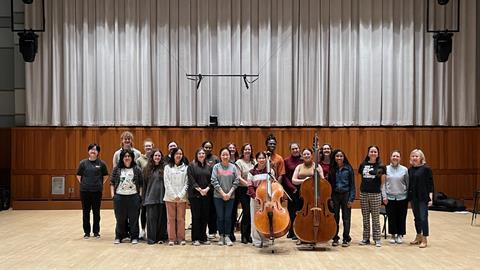
Nina DeCesare, Susan Cahill and Susan Hagen speak with The Strad about how the Artemis Bass Initiative is tackling gender disparities in the double bass world through mentorship, visibility, and professional development
Read more Featured Stories like this in The Strad Playing Hub
’It’s time for women and non-binary bassists to lead and succeed’.
So reads the leading statement on the website of the Artemis Bass Initiative – an organisation dedicated to women and non-binary bassists who have been historically underrepresented in the double bass community.
It was founded by Nina DeCesare, its board comprising board president Susan Cahill, with Susan Hagen serving as board vice chair. These bassists lead prolific careers as performers and educators.
Hagen is the first-ever female prinicpal double bassist in the Boston Pops Esplanade Orchestra, while DeCesare and Cahill hold positions in prestigious orchestra and institutions; DeCesare serving in the Baltimore Symphony and Peabody Conservatory, and Cahill in the Colorado Symphony and University of Colorado, Boulder.
What inspired the creation of the Artemis Bass Initiative? DeCesare and Cahill state that it was a response to the gender disparities within the double bass community, particularly at the professional orchestral level:
’Despite progress in other instrumental sections, bass sections have historically lagged behind in equity and access. Artemis was founded to address these gaps by creating pathways to mentorship, education, and professional opportunity.
’Our mission is rooted in the belief that talent exists everywhere, but access does not - and by intentionally supporting historically marginalised bassists, we aim to reshape the field into one that better reflects the diversity of the musical community as a whole.’
They share that many bassists from historically underrepresented genders share similar formative experiences, such as walking into rehearsal or audition and being one of few, or the only person of their gender in the room, often carrying the unspoken pressure of visibility and representation.
Hagen shares her experience of performing with the Boston Symphony Orchestra at Tanglewood one summer, which featured Mstislav Rostropovich as the cello soloist. Upon seeing Hagen backstage, he walked up to her and asked, ‘What is such a little girl doing playing such a big instrument?’
Hagen bent down to answer Rostropovich’s question, being taller than him, and said lightheartedly, ’Someone has to be the rock of the orchestra, so why not me?’
’The part that still makes me laugh is that he called me a little girl and yet I towered over him,’ she says. ’That’s par for the course but it’s the type of interaction that I pray will not happen much longer.’
Hagen illustrates the important of visibility of women and non-binary bassists for the upcoming generation of musicians. She shares the story of a ten-year-old girl who came up to the stage of a Boston Pops Orchestra concert.
The girl told Hagen she played the viola, but really wanted to play the double bass. However, her school orchestra director said that she was too small to play the bass.
’I explained to her that they make smaller basses for people to learn on, and that she was absolutely not too small to play the bass,’ said Hagen. ’When she heard that there is a bass the size of a cello, her face lit up and she said, “I don’t need anything THAT small! I’m going to talk to my orchestra director! I REALLY want to play the bass! If I hadn’t seen you, I never would have known that I can do this!”’
’These moments can be isolating, but they can also be affirming when paired with support and opportunity,’ say DeCesare and Cahill.
’Triumph often comes not just from winning a position or performing at a high level, but from realizing that one’s presence alone can challenge outdated norms and open doors for others. Artemis exists to ensure that these musicians don’t have to navigate those challenges alone, and that their successes are amplified rather than treated as exceptions.’
In addition to visibility, Artemis offers a mentorship programme, which pairs emerging bassists with established professionals based on a combination of artistic goals, career interests, and lived experience.
’We prioritise thoughtful, individualised matching to foster relationships that are both practical and supportive,’ say DeCesare and Cahill.
’Mentors provide guidance on everything from audition preparation and career navigation, to confidence-building and work-life balance. Our hope is that these relationships demystify the profession, expand professional networks, and offer mentees tangible models of success, while also creating a cycle of reciprocity that strengthens the bass community for future generations.’
The initiative offers professional development seminars, which are crucial for creating an inclusive and supportive bass community. They aim to address the realities of sustaining a career in music ‘beyond the practice room’.
Topics include audition strategy, contract negotiation, financial literacy, injury prevention, mental health, navigating bias in professional settings, and building sustainable freelance or orchestral careers.
’These seminars are crucial because technical excellence alone is not enough to ensure long-term success - particularly for musicians from marginalised communities who may lack access to informal networks of knowledge,’ say DeCesare and Cahill.
’By equipping participants with tools for self-advocacy and resilience, Artemis helps create a more informed, empowered, and inclusive bass community.’
Find out more at artemisbassinitiative.com
Read: Technique: Double bass spiccato
Read: Opinion: Creating a musical environment
Read more Featured Stories like this in The Strad Playing Hub






















No comments yet