

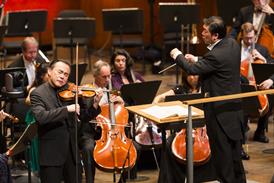







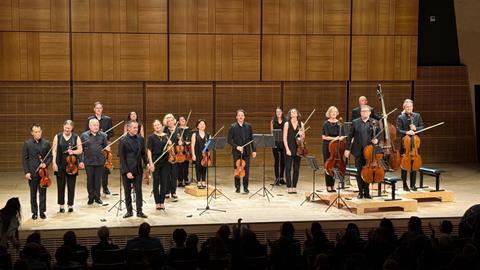
US correspondent Thomas May hears the Australian Chamber Orchestra on tour at Carnegie Hall, performing Schubert and the world premiere of Horizon by John Luther Adams on 22 April 2026
Read more Featured Stories like this in The Strad Playing Hub
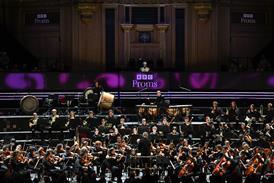
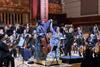
For its 50th-anniversary tour stop at Carnegie Hall, the Australian Chamber Orchestra (ACO) made a notably bold move. Rather than rely on safely familiar repertoire spiced with a token contemporary addition, the ensemble devoted half the programme to the world premiere of Horizon by John Luther Adams, a two-part composition that spans some 40 minutes, in which change registers in minute, often barely perceptible shifts.
The Pulitzer Prize-winning Adams, whose work engages with questions of landscape, time and climate change in ways that invite a radical rethinking of listening itself, relocated to Australia two years ago and began composing Horizon en route across the Pacific. Commissioned by the ACO, the work took shape across a wide sweep of Australian environments, from tropical savannah and desert to coastline and inland hills.
The ACO have just released their recording of Horizon (on Cold Blue Music) and have previously performed the two parts separately in concert. But presented in its entirety for the first time in the more intimate surroundings of Zankel Hall – Carnegie Hall’s chamber recital space – Horizon revealed its full scale and cumulative force.
Part I (‘Visible Horizon’) begins in benthic depths. A single double bass lays down a dark, steady ground and is joined by three cellos, establishing a kind of sonic bedrock from which the texture incrementally expands – inevitably recalling the opening of Wagner’s Das Rheingold, though without its sense of harmonic destination.
What at first feels like near-stasis proves anything but: minute variations accumulate as individual strands among the 17 strings flicker in and out of focus, emerging and receding across the texture. The music seems to move without ever quite leaving its place – like staring for a prolonged period into a Rothko colour-field painting.
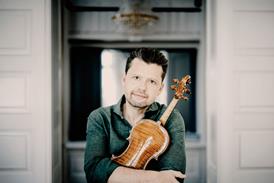
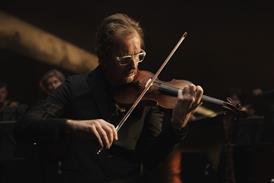
Under the direction of violinist Richard Tognetti – who has helmed the ACO for 35 years – the expansion and gradual contraction of Adams’s canvas was finely controlled, with the musical horizon, as it were, ever in view. Instead of a conventional interplay of parts, the musicians generated a continuous, shared sonority in which the distinction between foreground and background was constantly in flux.
For all the sense of an underlying process, as if governed by an impersonal logic, Adams’s music is charged with an intense sense of beauty, erupting in micro-flares of expressivity, shadowed by an acute awareness of loss – an Anthropocene refraction of the sublime.
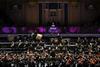
The visual design reinforced this aesthetic, with gradually shifting hues – at one point, a glowing gold, later a translucent silver – bathing the musicians in an otherwise darkened hall. As the music receded towards the depths again, individual spotlights were extinguished one by one, until only the double bass remained lit before it, too, fell into darkness – an echo, perhaps, of Haydn’s Farewell Symphony.
And then the process begins again. Starting once more in the lower depths, Part II (‘True Horizon’) is precisely as long as Part I, yet with a subtly altered perspective. If ‘Visible Horizon’ suggests a human vantage point, with its biases and limitations, ‘True Horizon’ is beyond the human and, in Adams’s words, ‘encompasses the totality, the wholeness of earth, sky and our presence within it’ – an idea that resonates with the insights of the late nature writer and essayist Barry Lopez, a longtime friend of the composer.
It was a brilliant touch to preface Horizon with Henry Purcell’s Fantasia upon One Note, whose sustained middle C introduces the idea of a drone, subtly inflected so that ‘normal’ harmonies take on an estranged quality. The tension created between stasis and motion perfectly set the stage for Adams’s music of micro-changes.
The concert’s second half, offering Tognetti’s string orchestra arrangement of Schubert’s Death and the Maiden, brought the evening to a more overtly dramatic close. The ACO’s razor-sharp precision across the ensemble was electrifying in the outer movements, their unanimity and attack enhancing the impact of Schubert’s score. Tognetti embedded the original quartet textures at the beginning and end of the variations movement, but even at full force the music conveyed a striking sense of intimacy and pathos.
Rhythmic articulation throughout was incisive, even across textures of quasi-orchestral sweep, while the expanded forces allowed for a striking range of colour and timbral variety, variously suggesting flutelike sweetness as well as a darker, almost brassy weight.
THOMAS MAY




















No comments yet